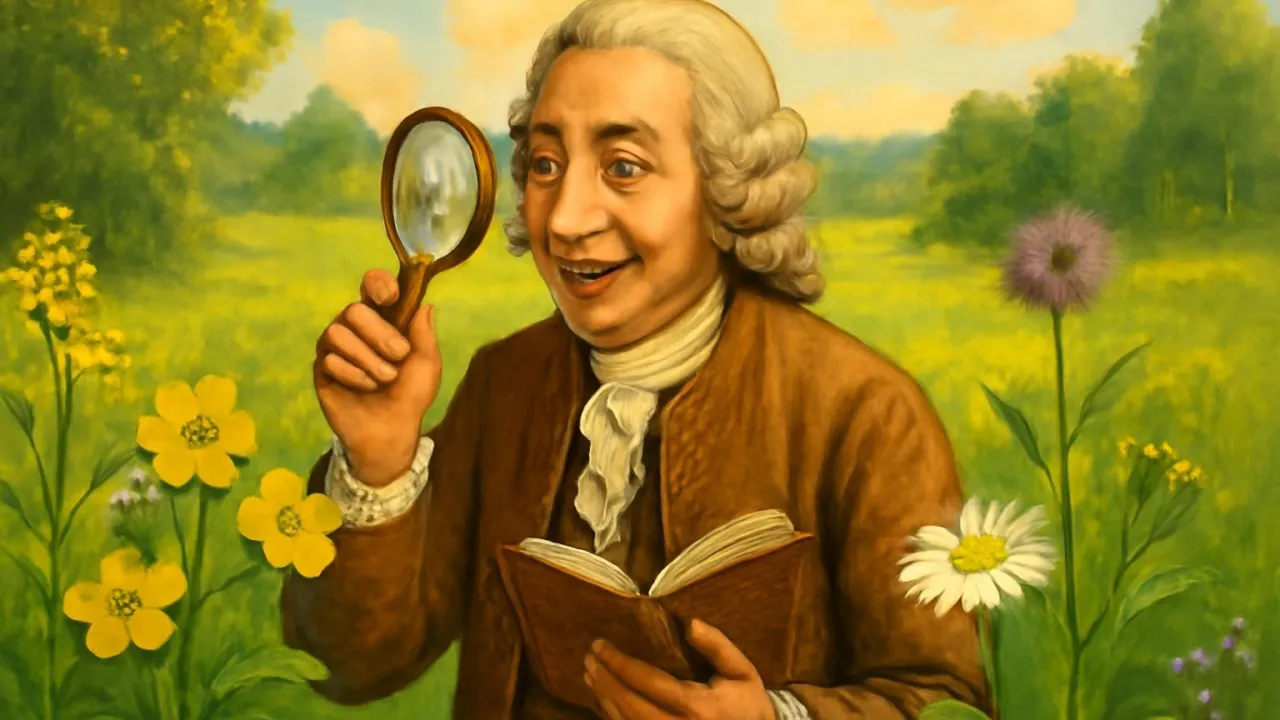
Carl Linnaeus named over 10,000 plants and animals in his lifetime!
✨ Word Sparks (Grade 2 Glossary)
Tap 🔊 to hear
taxonomy
A way to group living things
organize
To put things in order
notebook
A book for writing ideas
🪝
What if you could invent a way to name every plant and animal?
1
Curious Carl
Carl spent hours outside, looking at leaves and bugs. He asked questions about every living thing he saw. He wanted to know how plants and animals were alike. His curiosity made him want to nature.
2
Hard Work in the Garden
Carl wrote down details about each plant in his . He worked hard to group them by their shapes and parts. He made up a system using two names for each species. This helped people everywhere talk about nature in the same way.
3
A Big Achievement
Carl’s naming system is called . It is still used by scientists today. He helped people all over the world study living things. His work made it easier to learn about nature.
The two-part names Carl invented are called 'binomial nomenclature' and are still used today!
✨ Word Sparks (Grade 3 Glossary)
Tap 🔊 to hear
binomial
A name with two parts
perseverance
Not giving up, even when it’s hard
features
Special parts that make something unique
🪝
Imagine discovering a new animal—how would you decide what to call it?
1
A Boy with Big Questions
Carl Linnaeus loved to wander through forests, collecting leaves and insects. He wondered why so many living things had confusing names. As a child, he dreamed of making nature easier to understand. His curiosity made him look for patterns in plants and animals.
2
Building a System
Carl created a system called taxonomy, which grouped living things by their . He gave each species a two-part Latin name, like Homo sapiens for humans. This made it simple for scientists everywhere to talk about the same plants and animals. His notebooks became famous for their careful organization and detail.
3
Overcoming Obstacles
Carl faced challenges because some people did not like changing old ways. He kept working, collecting thousands of plants and animals for study. He traveled across Sweden and Europe to learn about nature. His helped him finish his big project.
4
Changing Science Forever
Carl’s naming system is still used by scientists around the world today. He made it possible for people to share discoveries and study living things together. His work helped unlock secrets about life on Earth. Carl Linnaeus is known as the 'Father of Taxonomy.'
1. What language did Carl use for his naming system?
2. Why is Carl called the 'Father of Taxonomy'?
🤯 Mind-Blowing Fact • Grade 4
Linnaeus’s 'Systema Naturae' was only eleven pages at first, but it grew to describe over 7,700 species!
✨ Word Sparks (Grade 4 Glossary)
Tap 🔊 to hear
specimen
A sample of a plant or animal
biodiversity
All the different living things on Earth
ecology
The study of how living things connect
🪝
What if every scientist used different names for the same animal—how would anyone share discoveries?
1
A Young Naturalist’s Curiosity
As a boy, Carl Linnaeus was fascinated by the wild meadows and forests of Sweden. He spent hours observing plants, insects, and animals, always asking questions about their differences and similarities. His father, a gardener, encouraged Carl to study nature closely and keep detailed notes. This early curiosity set Carl on a path to change the way the world understood living things.
2
Inventing Order in Chaos
In the 1700s, scientists used many confusing names for the same species, making it hard to share knowledge. Carl decided to create a simple, universal system to classify all plants and animals. He introduced binomial nomenclature, giving each species a unique two-part Latin name. This innovation allowed scientists everywhere to communicate clearly and organize discoveries.
3
Turning Points and Lasting Impact
Carl published his system in famous books like 'Systema Naturae,' which described thousands of species. He traveled and collected , working with students and explorers across Europe. Although some resisted his new system, Carl’s clear method won respect and changed scientific study forever. His taxonomy is the foundation for modern biology and .
4
A Legacy That Grows
Today, every scientist who names a new plant or animal uses Linnaeus’s system. His work made it possible to organize, compare, and protect Earth’s . Carl Linnaeus’s passion for naming and order still inspires naturalists and explorers. Thanks to him, the world of living things is easier to explore and understand.
1. What problem did Linnaeus’s system solve for scientists?
2. How did Linnaeus’s work help future scientists?
🤯 Mind-Blowing Fact • Grade 5
Linnaeus’s system is still used to name over 1.7 million species—and counting—across the globe!
✨ Word Sparks (Grade 5 Glossary)
Tap 🔊 to hear
classification
Sorting things into groups by their traits
universal
Used and understood by everyone
ecosystem
A place where living things interact
🪝
Have you ever wondered how scientists around the world agree on the names of millions of living species?
1
A Childhood of Curiosity and Observation
Long before he became a world-famous scientist, Carl Linnaeus spent his childhood exploring the meadows and forests of Småland, Sweden. He was endlessly curious about the natural world, collecting leaves, insects, and rocks to examine under the guidance of his father, who was a passionate gardener. Carl’s fascination with the diversity of life led him to keep meticulous notes and sketches in his journals. These early experiences fueled his desire to bring order and understanding to the chaos of nature. His childhood curiosity would later blossom into a groundbreaking scientific career.
2
The Birth of Binomial Nomenclature
In the 18th century, scientists struggled with a confusing jumble of local and lengthy Latin names for plants and animals, making communication difficult. Linnaeus recognized the need for a standardized, system, so he developed binomial nomenclature—a method that assigns every species a unique two-part Latin name. For example, humans became Homo sapiens, and the oak tree became Quercus robur. This innovation allowed scientists from different countries to share discoveries and research without confusion. Linnaeus’s system quickly gained popularity and transformed the study of biology.
3
Scientific Achievements and Global Influence
Linnaeus published several influential works, including 'Systema Naturae,' which began as an eleven-page pamphlet and expanded to describe over 7,700 plant and animal species. He traveled across Sweden and Europe, collecting specimens, teaching students, and corresponding with explorers who sent him new discoveries from around the globe. Despite facing criticism from some traditional scientists, Linnaeus’s perseverance and clarity won widespread respect. By the end of his life, he had named and classified more than 12,000 species, laying the foundation for modern taxonomy and ecology.
4
Lasting Legacy in Science and Conservation
Today, Linnaeus’s system remains the backbone of biological science, guiding researchers as they discover and name new species. His work made it possible to organize and protect Earth’s biodiversity, helping scientists understand how living things are related and how function. Linnaeus’s influence extends beyond taxonomy—his methods encourage careful observation, detailed record-keeping, and international collaboration. The principles he established continue to support conservation efforts and scientific discovery worldwide.
5
Inspiration for Future Explorers
Carl Linnaeus’s story is a testament to the power of curiosity, perseverance, and the desire to bring order to the natural world. His passion for naming and classifying life forms made science more accessible and united researchers across continents. By developing a language for biology, Linnaeus opened the door for countless discoveries and inspired generations of naturalists, botanists, and explorers. His legacy reminds us that asking questions and seeking patterns can change the way we understand our planet.