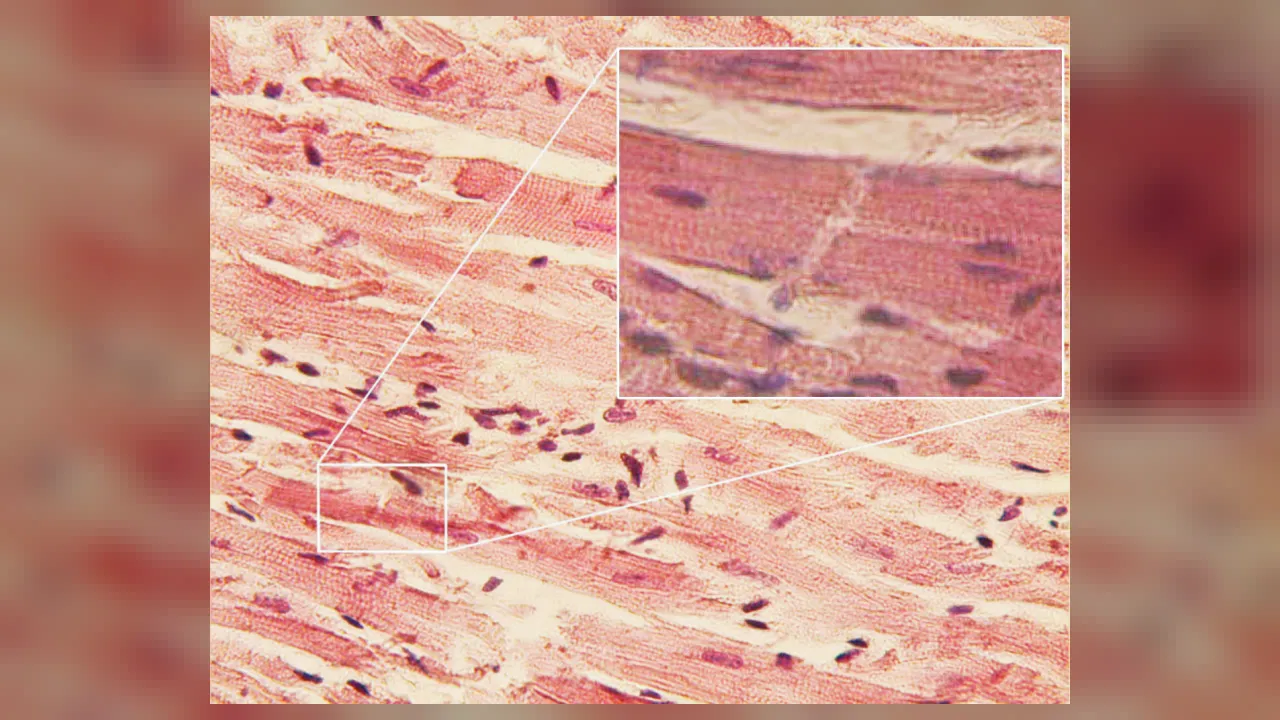
1. Where is the ONLY place in your entire body where cardiac muscle lives?
2. About how many times does your cardiac muscle beat in just one day?
🤯 Mind-Blowing Fact • Grade 2
Over an average lifetime, human cardiac muscle beats more than two and a half billion times!
✨ Word Sparks (Grade 2 Glossary)
Tap 🔊 to hear
Pulse
Rhythmic wave felt in arteries per heartbeat
Chamber
Room inside the heart holding pumping blood
Automatic
Happening by itself without conscious thought
🪝
How does your heart muscle blend the best powers of both skeletal muscle and smooth muscle?
1
Best of Both Worlds
Listen to your speed up after jumping jacks! Cardiac muscle combines two awesome superpowers: like skeletal muscle, it has strong microscopic stripes for powerful squeezes; like smooth muscle, it works automatically without you ever having to remind it.
2
Holding Hands Tight
Under a microscope, cardiac muscle cells branch out like tree twigs and lock ends together like linked fingers. When one cell gets the signal to squeeze, it passes the message instantly so the whole heart pumps as one team!
3
Packed With Power Plants
Cardiac cells hold way more tiny energy factories than any other muscle so your heart never runs out of fuel!
1. How is cardiac muscle similar to smooth muscle?
2. Why do branching cardiac muscle cells link tightly end-to-end?
🤯 Mind-Blowing Fact • Grade 3
More than one-third of the space inside every cardiac muscle cell is packed solid with mitochondria—the cell's tiny oxygen-burning power plants!
✨ Word Sparks (Grade 3 Glossary)
Tap 🔊 to hear
Myocardium
Thick cardiac muscle layer forming heart walls
Pacemaker
Special heart cells sparking a steady beat
Mitochondria
Tiny cellular power plants making clean energy
🪝
Where does the tiny spark that starts every single heartbeat come from?
1
The Myocardium Wall
Make a gentle fist—that is roughly the size of your heart! Its thick middle wall, called the , is built from swirling figure-eight spirals of striped cardiac muscle. Instead of just squeezing straight inward, those spiral bands wring blood upward and outward like twisting water from a washcloth.
2
Built-In Spark Plug
Skeletal muscles wait silently until a brain nerve tells them to fire, yet cardiac muscle generates its very own beat! A cluster of special cardiac cells at the top of your heart—called the natural —flashes a tiny electrical spark seventy to a hundred times each minute.
3
Intercalated Discs
Where branched cardiac cells meet, special zipper-like seams called intercalated discs rivet them together so they never pull apart, while tiny electrical doorways let the wave flash across the heart.
4
Resting Between Beats
How does cardiac muscle never cramp up? Between every brief squeeze, it relaxes for fractionally longer—resting nearly half of every second!
1. Why are cardiac muscle bands wrapped in spirals around the heart instead of straight lines?
2. What starts the electrical signal for each normal heartbeat?
🤯 Mind-Blowing Fact • Grade 4
In a single day, your fist-sized cardiac muscle pumps roughly 2,000 gallons (7,500 liters) of blood—enough to fill a whole neighborhood fire truck tank!
✨ Word Sparks (Grade 4 Glossary)
Tap 🔊 to hear
Cardiomyocyte
Individual branched muscle cell of the heart
Intercalated Disc
Zipper-like seam locking heart muscle cells together
Autorhythmicity
Ability of heart muscle to spark itself
🪝
Why is the left wall of cardiac muscle three times thicker than the right wall inside the exact same heart?
1
Engineered for Two Different Journeys
If you compared a cross-section of the heart's two lower pumping chambers (ventricles), you would spot a dramatic asymmetry. The right ventricle's cardiac muscle only needs to push blood a few inches next door into your spongy lungs. The left ventricle's myocardium, however, builds a wall three times thicker so its squeeze can propel oxygen-rich blood from the top of your brain all the way down to your toes and back!
2
Intercalated Discs: Rivets and Express Lanes
Individual are Y-shaped, striated cells usually holding one or two central nuclei. At their stepped junctions——two microscopic structures team up: ultra-strong desmosomes anchor cells together against relentless pumping pressure, while low-resistance gap junctions flash electrical ions instantaneously so millions of cells contract as a functional syncytium.
3
Autorhythmicity and Brain Modulation
Cardiac muscle possesses , meaning specialized sinoatrial (SA) node pacemaker cells depolarize spontaneously without needing external motor nerves. Your brain's autonomic nerves act like a gas pedal and brake—speeding your heart above 150 beats per minute during tag, then slowing it gently during sleep.
4
Personal Fuel Delivery: Coronary Arteries
Because up to forty percent of every 's volume consists of aerobic mitochondria, the heart cannot just sip oxygen from blood rushing inside its chambers; dedicated coronary arteries branch across its outer surface to feed the muscle nonstop.
1. Why is the cardiac muscle wall of the left ventricle three times thicker than the right ventricle?
2. What two jobs do intercalated discs perform between neighboring cardiomyocytes?
🤯 Mind-Blowing Fact • Grade 5
Thanks to a built-in 250-millisecond electrical cooldown timer on every beat, healthy cardiac muscle is biologically incapable of getting a sustained muscle cramp!
What built-in electrical safety timer makes it physiologically impossible for cardiac muscle to cramp up mid-beat?
1
Syncytial Bioengineering of the Myocardium
Pumping roughly five liters of blood per minute at rest and over twenty liters per minute during peak athletics, human myocardium performs staggering lifetime mechanical work without fatigue. Composed of branched, striated cardiomyocytes measuring roughly 100 micrometers long by 20 micrometers wide, heart walls wrap helical myofiber sheets that twist during systole to maximize ventricular ejection fraction.
2
Why the Heart Cannot Cramp: The Plateau Potential
If skeletal muscle receives rapid-fire nerve signals, its twitches fuse into a sustained lock called tetanus—useful for holding a suitcase, yet fatal if a pump forgets to refill! Cardiac muscle prevents cramping via a unique 250-millisecond electrical 'plateau phase' driven by slow L-type calcium channels. This prolonged guarantees the chamber must completely relax and refill with blood (diastole) before another contraction can ever be triggered.
3
Pacemaker Conduction and Calcium-Induced Calcium Release
Each heartbeat originates in specialized autorhythmic myocytes of the sinoatrial node, pauses 100 milliseconds at the atrioventricular node so atria finish topping off the ventricles, then races down the bundle of His and Purkinje fibers. Entering extracellular calcium triggers ryanodine receptors on the sarcoplasmic reticulum in a cascade called calcium-induced calcium release, engaging actin-myosin cross-bridges.
4
Unrivaled Oxidative Metabolism and Frank-Starling Law
Mitochondria occupy thirty-five to forty percent of cardiomyocyte volume, oxidizing fatty acids, glucose, and even lactate delivered via dense coronary capillary beds (one capillary per muscle fiber!). Intrinsically, stretching ventricular fibers with extra returning venous blood automatically increases their next contractile recoil—the famous Frank-Starling law of the heart.
5
Einthoven's Electrocardiogram Legacy
In 1901–1903, Dutch physiologist Willem Einthoven invented the string galvanometer to record the summed electrical currents of human cardiac muscle right from the skin—creating the (ECG) and winning the 1924 Nobel Prize.