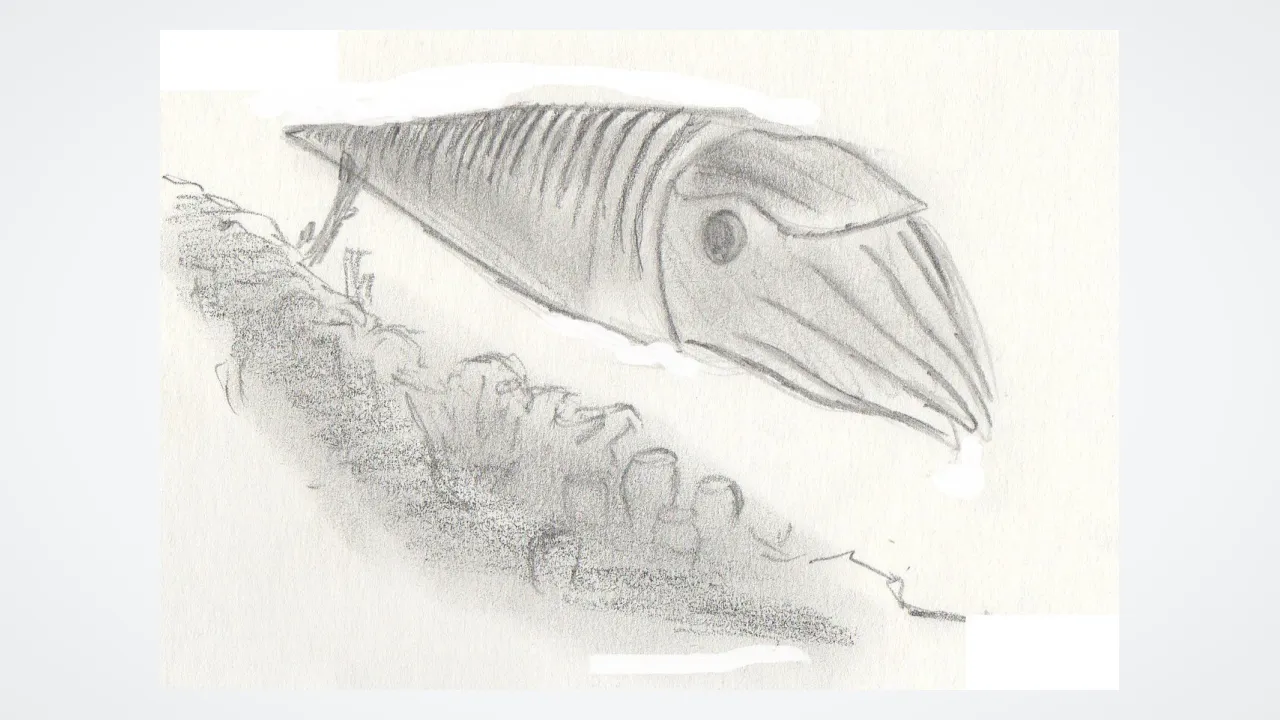
⚡ Survival SuperpowerJet-propelled cone shell balanced by gas-filled buoyancy chambers
🤯 Mind-Blowing Fact • Grade 1
Cameroceras was a distant cousin of today's octopuses and squids, even though its shell was straight as a flagpole!
✨ Word Sparks (Grade 1 Glossary)
Tap 🔊 to hear
Cone
A shape wide at one end and pointy
Tentacle
A flexible arm used for grabbing things
Beak
A hard, sharp mouth part for biting
🪝
What lived inside a shell as long as a van?
1
A Giant Cone in the Sea
Whoosh! A giant glides through warm sea water. Meet Cameroceras! It lived long before the first dinosaurs walked on land. Its hard shell was straight and pointy like an ice cream cone.
2
Arms and Jet Power
Soft arms peeked out from the wide end of the shell. It squirted water out of a tube to zoom backward! Big round eyes helped it spot food in dark water.
3
Crunch Goes Dinner
Cameroceras grabbed armored sea bugs with its strong arms. Its sharp cracked hard shells with ease. It was a top hunter of the early ocean.
2. How did Cameroceras push itself through the water?
🤯 Mind-Blowing Fact • Grade 2
The name Cameroceras means 'chambered horn' because the inside of its fossil shell is stacked with dozens of neat rooms!
✨ Word Sparks (Grade 2 Glossary)
Tap 🔊 to hear
Chamber
A closed room or space inside a shell
Trilobite
An ancient armored sea creature with three body parts
Funnel
A tube that shoots water for jet swimming
🪝
How could a twenty-foot stone-hard shell float without sinking to the bottom?
1
Ruler of a Fishless Ocean
Imagine diving into a warm ocean more than 450 million years ago, long before sharks existed. Drifting above the sea floor is Cameroceras, one of the biggest shell builders ever! Its straight cone shell grew nearly twenty feet long.
2
Hidden Float Chambers
A heavy shell sounds hard to carry, yet Cameroceras floated smoothly. Its shell was divided into many tiny rooms called . The animal lived in the front room and filled the back rooms with gas and water to stay level.
3
Tentacles on Patrol
Cameroceras glided above reefs using jet power from a muscular . When it spotted a or sea scorpion, its tentacles snatched the prize. Then a parrot-like beak crunched right through the tough armor.
1. How did Cameroceras keep its huge shell from sinking straight down?
2. What kind of animals did Cameroceras hunt on the ocean floor?
🤯 Mind-Blowing Fact • Grade 3
Heavy mineral weights grew inside the pointed rear tip of a Cameroceras shell so its head wouldn't tip downward like a seesaw!
✨ Word Sparks (Grade 3 Glossary)
Tap 🔊 to hear
Cephalopod
Ocean animal group including squids, octopuses, and nautiluses
Siphuncle
Living tube that controls gas and water in shells
Radula
Toothed tongue mollusks use to scrape up food
🪝
What made a shelled relative of the octopus the top ocean predator of the Ordovician Period?
1
Before Sharks Ruled the Sea
Picture Earth during the Ordovician Period, about 460 million years ago. Continents were mostly bare rock, while warm shallow seas teemed with sponge reefs, sea lilies, and armored arthropods. Gliding silently over the sea floor was Cameroceras, a giant related to modern squids and nautiluses.
2
Built Like a Submarine
Cameroceras grew up to twenty feet from tentacle tip to shell point. If its whole cone were solid stone, it could never swim. Instead, internal walls split the shell into sealed chambers connected by a living tube called a . By pumping water out and letting gas diffuse in, Cameroceras balanced its heavy shell horizontally.
3
Ambush in Dim Waters
Although jet propulsion moved Cameroceras efficiently, steering a stiff six-meter cone around tight corners was tricky. Paleontologists think it stalked prey near the seabed, using large eyes to detect movement in dim water.
4
A Beak Built to Crack Armor
Once within reach, muscular tentacles seized trilobites or giant sea scorpions. A hard beak and a rasping tongue covered in tiny teeth, called a , broke open exoskeletons and rasped up the meal inside.
1. What job did the siphuncle perform inside a Cameroceras shell?
2. Why did Cameroceras grow mineral counterweights near the pointed tip of its shell?
🤯 Mind-Blowing Fact • Grade 4
Because the outer shell wall often dissolved over millions of years, many Cameroceras fossils found in limestone quarries are actually just the thick, rod-like central siphuncle!
✨ Word Sparks (Grade 4 Glossary)
Tap 🔊 to hear
Orthoconic
Having a long straight cone shell without coils
Ballast
Heavy material used to keep a vessel balanced
Buoyancy
Upward force that helps objects float in water
🪝
How do paleontologists reconstruct an eighteen-foot squid cousin when almost only its inner shell core turns to stone?
1
An Ordovician Apex Predator
Slip beneath the waves of the warm epicontinental seas that covered North America and Europe 460 million years ago. Jawed fishes had not yet evolved, leaving giant cephalopods as the undisputed rulers of the marine food web. Among the largest was Cameroceras trentonense, an —or straight-shelled—nautiloid whose conical armor stretched roughly twenty feet.
2
Hydrostatic Engineering
Carrying a multi-meter calcium carbonate shell posed a serious physics puzzle. Gas trapped in rear chambers created lift, which would naturally flip the cone vertical with the animal's head pointing down at the mud. Cameroceras solved this with remarkable engineering. Its thick central siphuncle secreted dense mineral cones called endocones toward the pointed apex, counterbalancing the heavy head and muscular mantle at the wide aperture so the predator cruised level.
3
Sensory Gear and Feeding Mechanics
Soft tissues rarely fossilize, so scientists compare Cameroceras shell scars with its closest living relative, the chambered nautilus. Ten or more muscular tentacles likely ringed a powerful keratinous beak. Unlike modern squids, these arms probably lacked toothed suction cups, relying instead on sticky ridges and wrapping grip to pin armored trilobites, brachiopods, and eurypterids before the beak and toothed radula sheared through their plates.
4
Clues in Limestone Quarries
In the nineteenth century, incomplete shell fragments led early researchers to estimate lengths of thirty feet or more. Careful measurements of Trenton Limestone fossils later refined maximum size to around six meters—still making Cameroceras one of the largest Paleozoic invertebrates ever discovered.
1. Why did early nineteenth-century estimates of Cameroceras reach thirty feet before modern scientists revised them?
2. Which living ocean animal gives paleontologists the best model for understanding Cameroceras anatomy?
🤯 Mind-Blowing Fact • Grade 5
In some Cameroceras species, the central siphuncle tube grew so wide that it filled nearly half the diameter of the entire shell!
✨ Word Sparks (Grade 5 Glossary)
Tap 🔊 to hear
Phragmocone
The chambered portion of a cephalopod's outer shell
Endocones
Cone-shaped mineral weights inside a nautiloid's rear tube
Demersal
Living and feeding close to the ocean floor
🪝
How did a straight-shelled mollusk master submarine physics to dominate Earth's oceans millions of years before the first jawed sharks?
1
Giants of the Great Ordovician Biodiversification
Four hundred and sixty million years ago, during the Middle and Late Ordovician Period, life in Earth's shallow tropical seas underwent an explosive radiation of new body plans. While jawless fishes remained small bottom-dwellers, mollusks belonging to the order Endocerida rose to the top of the marine trophic pyramid. Foremost among them was Cameroceras, an orthoconic cephalopod whose slender, uncoiled shell reached approximately six meters (twenty feet) in total length.
2
Solving the Trim and Buoyancy Equation
Constructing a six-meter aragonitic shell created two competing biomechanical challenges: preventing the animal from sinking like lead and keeping buoyant gas chambers at the pointed apex from tipping the shell nose-down. Cameroceras partitioned its with curved walls called septa, evacuating chamber fluid via osmotic gradients across a wide tubular siphuncle. Simultaneously, it precipitated nested calcareous cones——inside the rear siphuncle, shifting its center of mass backward until it aligned vertically beneath the center of buoyancy for effortless horizontal trim.
3
Locomotion and Predatory Strategy
Water drawn into the mantle cavity and expelled through a flexible hyponome propelled Cameroceras backward or gently forward. Hydrodynamic modeling indicates that a rigid six-meter cone experienced high turning resistance, making high-speed pursuit in open water unlikely. Instead, Cameroceras functioned as a stealthy ambush hunter, hovering just above carbonate reefs and mudflats.
4
Trophic Interactions on the Paleozoic Seabed
Perforated trilobite carapaces and healed bite scars on smaller nautiloid shells preserve direct evidence of cephalopod predation. Grasping tentacles subdued megalograptid sea scorpions and large isotelid trilobites while a chitinous beak and multi-toothed radula pulverized calcified armor.
5
Fossil Legacy and Changing Seas
First described by paleontologist Timothy Abbott Conrad in 1842 from New York's Trenton Limestone, Cameroceras left fossils across Laurentia, Baltica, and Siberia. When glaciation cooled the planet and lowered sea levels during the Late Ordovician mass extinction around 444 million years ago, giant endocerids vanished, eventually ceding open-water dominance to coiled cephalopods and jawed vertebrates.