1. What shape were the big, strong teeth of Camarasaurus?
2. Who walked together in Camarasaurus herds?
🤯 Mind-Blowing Fact • Grade 2
Camarasaurus is the most common giant dinosaur fossil in North America, with hundreds of specimens found from Wyoming to New Mexico!
✨ Word Sparks (Grade 2 Glossary)
Tap 🔊 to hear
chamber
an enclosed hollow space or room inside
nostril
one of the external openings of a nose
abundant
found in very large numbers
🪝
Why did scientists name this sturdy Jurassic giant the 'chambered lizard'?
1
Hollow Chambers Inside Stone Bones
Crack, chomp! While other long-necked dinosaurs nibbled tender ferns, Camarasaurus bit right through tough tree branches. When scientists studied its backbones in 1877, they spotted huge hollow rooms inside them and named it Camarasaurus, meaning 'chambered lizard'!
2
Built Like a Bulldozer
Instead of a long, skinny snout, Camarasaurus had a deep, boxy head with giant openings for a keen sense of smell. Strong jaw muscles powered forty-eight thick, spoon-shaped teeth.
3
A Perfect Baby Skeleton
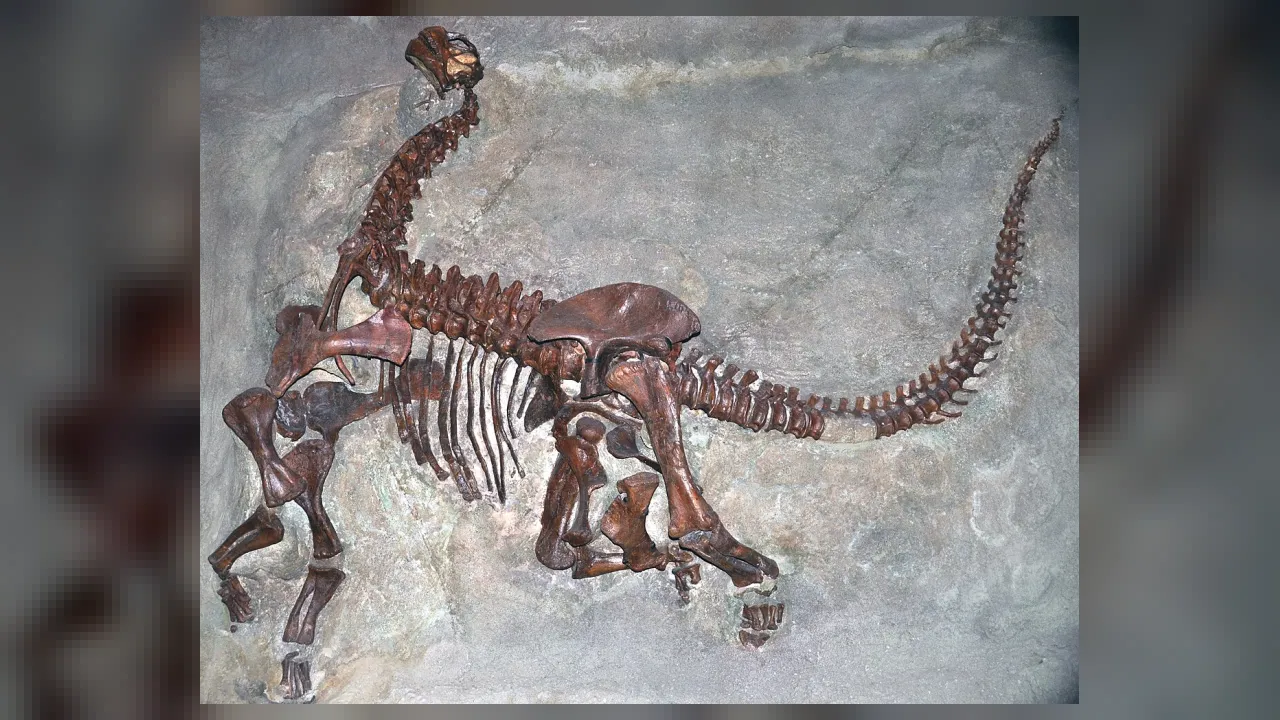
Fossil hunters in Utah once found an almost complete fifteen-foot youngster, showing youngsters looked like big-headed miniature copies of their parents!
2. How did Camarasaurus's diet help it get along with slender-toothed neighbors like Diplodocus?
🤯 Mind-Blowing Fact • Grade 3
Oxygen atoms locked inside 150-million-year-old Camarasaurus teeth proved that herds migrated roughly 180 miles into cooler uplands whenever lowland rivers dried up!
✨ Word Sparks (Grade 3 Glossary)
Tap 🔊 to hear
enamel
the super-hard outer coating protecting a tooth
migrate
to travel long distances with changing seasons
cycad
an ancient palm-like plant with tough leaves
🪝
Why did Camarasaurus thrive in places and dry seasons where pickier giants struggled?
1
The Tough-Plant Specialist
Heat shimmers across a dry Late Jurassic plain in Utah as drought wilts the soft riverside ferns. While pickier sauropods search upstream for tender greens, a herd of fifty-foot Camarasaurus calmly crunches coarse , seed cones, and woody conifer limbs!
2
Powerhouse Boxy Skull
One glance at a Camarasaurus skull explains its success. High, arched jawbones anchored thick chewing muscles, while broad, spoon-shaped teeth lined not just the tip of the snout, but the sides of the jaws too. Scratches on its tooth prove its jaws sliced slightly up and back before swallowing.
3
Air Sacs and Balanced Build
Named by Edward Drinker Cope in 1877 for the cavernous air pockets in its vertebrae, Camarasaurus had nearly equal-length front and back legs, giving it a level back and medium-height reach.
4
Migrating Across High Country
Chemical clues locked inside Camarasaurus tooth show herds drank snowmelt streams from distant highlands during harsh dry seasons, trekking hundreds of miles each year!
1. How were the teeth inside Camarasaurus's jaws arranged differently from Diplodocus?
2. What amazing secret did chemical clues inside Camarasaurus tooth enamel reveal?
🤯 Mind-Blowing Fact • Grade 4
Dinosaur National Monument in Utah preserves a famous fifteen-foot juvenile Camarasaurus fossilized almost completely intact with its head arched gently backward!
✨ Word Sparks (Grade 4 Glossary)
Tap 🔊 to hear
isotopes
slightly lighter or heavier atoms of one element
spatulate
broad and spoon-shaped for shearing tough plants
generalist
an animal able to eat many varied foods
🪝
How can paleontologists read a single dinosaur tooth like a weather diary to track an ancient migration?
1
Champion Survivor of the Morrison
Across ten million years of Late Jurassic rock layers stretching from Montana to New Mexico, one giant dinosaur outnumbers every other sauropod in museum collections: Camarasaurus. Measuring fifteen to eighteen meters long and weighing up to twenty tons, this sturdy macronarian succeeded by being the ultimate herbivore.
2
Built to Process Coarse Forage
Unlike pencil-toothed diplodocids that merely raked soft leaves, Camarasaurus wielded a short, vaulted skull reinforced against heavy biting forces. Nineteen-centimeter teeth interlocked along the jaws, leaving microscopic gouges and pits on the enamel that prove it sheared fibrous conifer branches, tough ginkgoes, and tough-skinned cycads.
3
Tooth Chemistry Tracks Upland Treks
In 2011, geochemist Henry Fricke sampled thin horizontal growth bands across Camarasaurus teeth, which took several months to form. Lowland evaporation makes summer river water heavier in oxygen-18 , whereas cool mountain rain carries lighter oxygen-16. Alternating bands inside single teeth proved Camarasaurus herds trekked roughly 300 kilometers (180 miles) westward into highland hills during seasonal droughts and returned when lowland rains resumed!
4
Snapshots From Hatchling to Giant
Remarkably intact juvenile skeletons—including a famous 4.5-meter youngster preserved in stone at Utah's Dinosaur National Monument—show every delicate bone in place, helping museums restore sauropods accurately.
1. How did geochemists discover that Camarasaurus herds migrated between lowlands and highlands?
2. Why are juvenile Camarasaurus skeletons so valuable to paleontologists?
🤯 Mind-Blowing Fact • Grade 5
Growth lines inside Camarasaurus teeth show that whenever a spoon-shaped tooth wore down from crunching woody branches, a fresh replacement tooth slid into place roughly every 62 days!
✨ Word Sparks (Grade 5 Glossary)
Tap 🔊 to hear
pleurocoels
deep air-sac hollows on the sides of vertebrae
macronarian
big-nosed sauropod group including Camarasaurus and Brachiosaurus
microwear
microscopic scratches on teeth revealing ancient diets
🪝
What made Camarasaurus the ecological backbone of Late Jurassic North America for nearly ten million years?
1
Cope's 'Chambered Lizard' and Macronarian Blueprint
Described in August 1877 by Edward Drinker Cope from towering vertebrae unearthed near Cañon City, Colorado—just weeks after rival Othniel Charles Marsh named Apatosaurus—Camarasaurus supremus took its name from the expansive pneumatic chambers () excavating its vertebral centra. Anchoring the clade Macronaria ('large noses'), which also gave rise to brachiosaurids and Cretaceous titanosaurs, Camarasaurus stood out for enormous external nares framing a deep, arched skull.
2
Cranial Mechanics and Oral Processing
Whereas diplodocids stripped soft foliage with anterior tooth combs and zero oral mastication, Camarasaurus possessed robust maxillae and dentaries bearing massive, chisel-edged spatulate teeth up to 190 millimeters long (root included). Finite-element stress modeling and dental reveal heavy coarse pitting from precise orthal-palinal jaw strokes capable of shearing woody araucarian twigs, Bennettitales, and conifer cones—replacing worn crowns roughly every 62 days.
3
Isotopic Proof of Seasonal Migration
How did twenty-ton megaherbivores survive harsh Morrison Formation dry seasons? In a landmark 2011 Nature study, Henry Fricke, Justin Tweet, and colleagues micro-sampled oxygen and strontium isotope ratios across sequential growth increments of Camarasaurus tooth enamel from Wyoming and Utah. Shifts between lowland evaporative waters and upland meteoric runoff demonstrated round-trip seasonal migrations of roughly 300 kilometers toward the Sevier Highlands.
4
Ontogeny From 'Toni' to Twenty-Ton Adults
Because Camarasaurus fossils span almost every growth stage—from embryonic remains and the articulated 4.5-meter juvenile CM 11338 at Dinosaur National Monument to 18-meter Camarasaurus supremus giants—researchers can trace how short-necked, large-eyed youngsters with flexible forefeet matured into broad-chested, twelve-cervical adults.
5
Keystone Browser of a Semi-Arid Savanna
By digesting fibrous plants unpalatable to slender-toothed neighbors and trekking between basins when droughts struck, Camarasaurus sustained immense multi-age herds that shaped Jurassic woodlands and supported apex predators like Allosaurus fragilis.