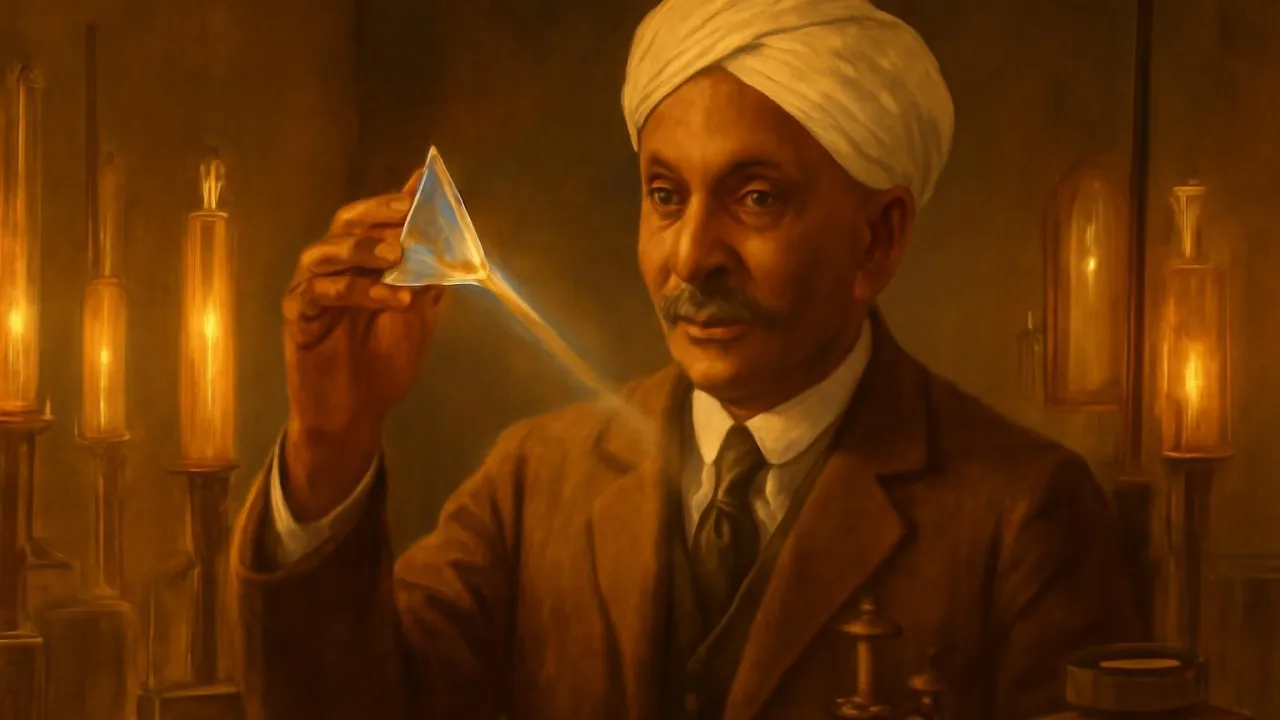
The Raman Effect helps scientists study stars and medicines today!
✨ Word Sparks (Grade 2 Glossary)
Tap 🔊 to hear
experiment
A test to learn something new
discovery
Finding something nobody knew before
scientist
A person who studies and learns
🪝
Have you ever seen a rainbow in sunlight?
1
Colors in Glass
Young Raman was amazed when sunlight passed through glass and made colors. He wondered why the colors appeared and wanted to find out. He began to study light whenever he could.
2
Testing and Learning
Raman spent many hours with prisms and bottles, shining light through them. He wrote down his ideas and tried different each day. His curiosity helped him learn new things about light.
3
A Bright Discovery
One day, Raman noticed light made new colors in glass. This special change was named the Raman Effect and helped understand light better. He became famous for his .
Raman’s discovery helps doctors use lasers to see inside the body!
✨ Word Sparks (Grade 3 Glossary)
Tap 🔊 to hear
scatter
To spread out in many directions
molecule
A tiny part of everything around us
perseverance
Not giving up, even if it’s hard
🪝
Why does sunlight look different through colored glass?
1
A Child with Questions
As a boy, Raman was fascinated by sunlight shining through bottles and glass. He noticed that light sometimes changed color when it passed through different things. This made him ask many questions and search for answers. He dreamed of discovering how light worked.
2
Experiments at Home
Raman used simple tools like bottles, prisms, and notebooks to test his ideas. He carefully shined light through objects and watched what happened. He wrote down every detail and tried new experiments each day. His helped him learn more about the mysteries of light.
3
The Raman Effect
One day, Raman noticed that when light passed through certain materials, it changed color in a special way. This new discovery was named the Raman Effect, which showed that light could and create new colors. Scientists everywhere were amazed by his finding. It helped people understand light and much better.
4
A Prize for Curiosity
Raman’s discovery was so important that he won the Nobel Prize in Physics. He was the first Asian scientist to win this prize for science. His work changed how people studied light all over the world. Raman proved that curiosity and hard work can lead to amazing discoveries.
Raman’s discovery lets scientists use lasers to study art, gems, and even planets!
✨ Word Sparks (Grade 4 Glossary)
Tap 🔊 to hear
physics
The science of matter and energy
legacy
What someone leaves behind for others
scatter
To spread out in many directions
🪝
Have you ever wondered why the sky is blue or why glass can make rainbows?
1
A Spark of Wonder
As a curious child in India, C. V. Raman was captivated by the way sunlight danced through colored glass bottles and windows. He often asked his teachers and parents why the colors changed and how light could look so magical. This early fascination with light inspired him to study science more deeply. Raman’s questions set him on a lifelong quest to understand the secrets of light.
2
Inventing Experiments
Raman did not have fancy equipment, but he used simple tools like glass prisms, bottles, and sunlight to create his own experiments. He spent hours observing how light scattered and changed color when it passed through different materials. Raman carefully recorded his observations and tried new tests to solve his puzzles. His perseverance and creativity helped him become a true scientist.
3
The Breakthrough: Raman Effect
One day, Raman discovered that when light traveled through certain liquids, it changed color in a special way. This effect, now called the Raman Effect, showed that light could and reveal information about the molecules it touched. His discovery was so important that it changed how scientists study light and matter. Raman’s work opened new doors for research in and chemistry around the world.
4
A Lasting Legacy
In 1930, Raman became the first Asian scientist to win the Nobel Prize in for his discovery. His research still helps doctors, chemists, and astronomers today, from using lasers in medicine to studying distant stars. Raman inspired generations of scientists with his curiosity and determination. His story reminds us that big discoveries can start with simple questions and a passion for learning.
Raman spectroscopy, based on his discovery, is used to study ancient paintings, rare gems, and even Mars rocks!
✨ Word Sparks (Grade 5 Glossary)
Tap 🔊 to hear
spectroscopy
Using light to study what things are made of
optics
The science of how light works
perseverance
Not giving up, even when things are hard
🪝
Imagine discovering a hidden message in a beam of light—what secrets would you find?
1
A Childhood Spark
Long before he became a world-famous scientist, C. V. Raman was a boy in India who marveled at the way sunlight streamed through colored glass and water. He constantly questioned why the world looked so different when light passed through various materials, and he filled notebooks with his ideas and sketches. Raman’s early curiosity led him to read advanced science books by age eleven, far beyond what most children studied. His family encouraged his passion, even though scientific resources were scarce in colonial India. This foundation of wonder and determination set the stage for his future breakthroughs.
2
Inventing Without Limits
As a university student, Raman improvised scientific experiments using everyday objects like bottles, prisms, and sunlight, because he lacked access to expensive laboratory equipment. He spent countless hours observing how light scattered and changed color when it passed through liquids and solids, meticulously recording every result. Raman’s and inventive spirit allowed him to develop new techniques for studying , the science of light. He published his first research paper at just eighteen years old, astonishing his professors and peers. His ability to turn simple questions into real experiments made him a pioneer in Indian science.
3
The Raman Effect Revolution
In 1928, after years of careful investigation, Raman and his team discovered that when a beam of light passed through certain transparent materials, a tiny portion of the light changed color. This phenomenon, now called the Raman Effect, proved that light could interact with the molecules in a substance and reveal their structure. Raman’s discovery provided a new, non-destructive way for scientists to study everything from chemicals to biological tissues. The Raman Effect quickly became a foundational tool in physics and chemistry, and its principles are still used in modern laboratories around the world.
4
Global Recognition and Legacy
For his groundbreaking work, Raman was awarded the Nobel Prize in Physics in 1930, making him the first Asian and first non-white scientist to receive this honor in science. He continued to teach and inspire young scientists, founding research institutes and promoting scientific education throughout India. Today, Raman —a technique based on his discovery—is used in fields as diverse as medicine, art restoration, and planetary science. His achievements demonstrated that world-changing discoveries could come from any corner of the globe, regardless of resources or background.
5
Inspiration for Future Explorers
C. V. Raman’s life is a testament to the power of curiosity, creativity, and in science. He showed that even the simplest questions—like why the sky is blue or how light makes colors—can lead to discoveries that change the world. By never giving up, even when faced with obstacles, Raman opened doors for generations of scientists in India and beyond. His story encourages all young learners to observe the world closely, ask bold questions, and believe that they, too, can uncover nature’s hidden secrets. The legacy of C. V. Raman continues to shine, lighting the way for future explorers.