🧬 HUMAN BODY
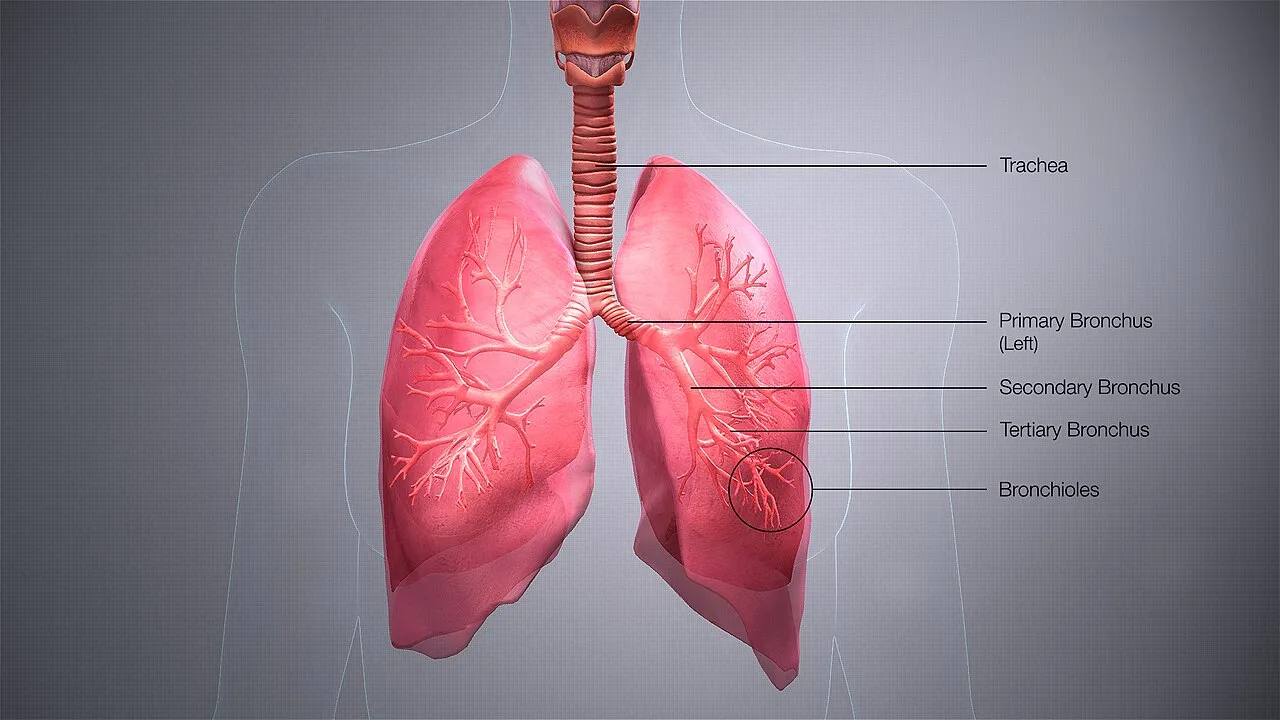
🧬 Bronchi & Bronchioles • Respiratory System
VA Science & Health SOL 1.1, 3.1, 4.2, 5.1 (Cells, Organs & Body Systems)
Bronchial Tubes
An Upside-Down Breathing Tree Branching Inside Your Chest
Grade 2 • Developing • 101 words
🩺 Body System & LocationRespiratory System • Branching network spreading through both left and right lungs
🔬 Size / Cell CountSplits ~23 times • Over 1,500 miles (2,400 km) of total airway passages
⚙️ Core JobDistributes inhaled air evenly to every corner of the lungs and adjusts airflow width
⚡ Body SuperpowerBranches from thumb-wide trunks down to hair-thin twigs in less than one second per breath
🤯 Mind-Blowing Fact • Grade 1
If you laid all the branching air tubes inside adult lungs end to end, they would stretch roughly 1,500 miles!
✨ Word Sparks (Grade 1 Glossary)
Tap 🔊 to hear
Branch
To split apart into two smaller paths
Airway
Any open passage that carries air inside you
Twig
A very thin little branch at the end
🪝
Did you know an upside-down tree grows right inside your chest?
1
Your Breathing Tree
Imagine flipping a big leafy tree upside down! Your windpipe is the trunk, and inside your chest it splits into two big called bronchial tubes. One goes left, and one goes right.
2
Smaller and Smaller Twigs
Inside each lung, those tubes split again and again! Soon there are thousands of tiny air reaching every cozy corner.
3
Sharing Every Breath
Thanks to all those , fresh air spreads quickly through both lungs every time you breathe in.
1. What nature shape do the bronchial tubes inside your lungs look like?
2. How many main bronchial tubes branch directly off the bottom of your windpipe?
🤯 Mind-Blowing Fact • Grade 2
The tiniest bronchial twigs at the ends of your breathing tree are thinner than an eyelash!
✨ Word Sparks (Grade 2 Glossary)
Tap 🔊 to hear
Bronchi
The two main air tubes entering your lungs
Bronchiole
A super-thin air twig deep inside your lung
Smooth muscle
Automatic muscle wrapping around tubes inside your body
🪝
How does one single breath reach millions of tiny spots in your lungs all at once?
1
Two Main Highways
Follow a breath of fresh morning air down your windpipe until you hit a fork in the road! Two wide tunnels called branch out, steering air into your left and right lungs. Sturdy cartilage plates keep these main highways propped open.
2
Down to Hair-Thin Twigs
Each main tube divides into medium branches, which split into even tinier twigs called . The smallest bronchioles are no thicker than a single strand of your hair!
3
Opening Wide for Recess
wrap around those tiny twigs like gentle belts. When you run and play at recess, those muscles relax to open the tubes wider so extra air zooms in easily!
1. What are the tiniest hair-thin air twigs at the ends of the bronchial tree called?
2. What happens to the smooth muscles around your bronchioles when you run hard at recess?
🤯 Mind-Blowing Fact • Grade 3
From your windpipe down to the deepest lung sacs, your bronchial tree splits apart roughly 23 separate times!
✨ Word Sparks (Grade 3 Glossary)
Tap 🔊 to hear
Lobe
One main rounded section of a spongy lung
Inhaler
A mist device delivering medicine into bronchial tubes
Bronchus
Singular word for one large bronchial air tube
🪝
Why are your left and right main bronchial tubes shaped slightly differently?
1
Making Room for Your Heart
Look closely at an X-ray diagram of your chest, and you will notice your bronchial tree isn't a mirror image! Because your heart tilts slightly toward the left side of your chest, your left lung is a bit narrower with two , while your right lung has three lobes. Matching that layout, your right main is wider, shorter, and more vertical, while your left main bronchus angles out longer to pass beneath your heart's main artery.
2
Twenty-Three Generations of Splits
Inside the lungs, each main divides into lobar bronchi—three on the right, two on the left—before branching roughly twenty-three times in total! Along the way, stiff cartilage rings gradually shrink into small cartilage islands and finally disappear completely in the flexible bronchioles.
3
Dialing Airflow Up or Down
Wrapped in spiral bands of smooth muscle, bronchioles work like adjustable valves, widening during exercise and narrowing slightly to block dusty fumes.
4
Helping Hands for Asthma
In kids with asthma, sensitive bronchioles sometimes squeeze too tightly and swell inside; quick-relief deliver gentle medicine straight down the bronchial tree to relax those muscles in minutes!
1. Why does your left lung have two lobes and a longer, angled main bronchus compared to the right?
2. How does a rescue inhaler help someone experiencing an asthma flare-up?
🤯 Mind-Blowing Fact • Grade 4
Even though individual bronchioles are tiny, there are so many of them in parallel that their combined tunnel area is hundreds of times wider than your windpipe!
✨ Word Sparks (Grade 4 Glossary)
Tap 🔊 to hear
Bronchodilation
Widening of bronchial airways when smooth muscles relax
Segmental
Supplying one distinct neighborhood inside a lung lobe
Parallel
Side-by-side pathways operating at the exact same time
🪝
Why does air actually slow down to a gentle breeze as it travels into narrower and narrower bronchial tubes?
1
A Surprising Physics Trick
Normally, squeezing water into a skinnier hose makes it shoot faster. Yet as inhaled air travels down your bronchial tree from one wide trachea into tens of thousands of tiny bronchioles, the air actually slows to a whisper! How? Although each individual bronchiole is less than one millimeter across, multiplying them into hundreds of thousands of tubes makes their combined cross-sectional area far wider than the trachea—turning a rushing gust into a calm, gentle drift ideal for gas exchange.
2
Changing Walls Along the Journey
Every zone of the bronchial tree is custom-built for its job. Primary, secondary (lobar), and tertiary () bronchi wear irregular plates of hyaline cartilage that prevent kinking inside shifting lung lobes. Once passages narrow below one millimeter to become bronchioles, cartilage vanishes completely; instead, surrounding elastic lung fibers tug outward in all directions like tent ropes, holding the delicate tubes open.
3
Autonomic Autopilot
Your nervous system adjusts bronchiole width automatically! Sympathetic 'action' signals and adrenaline trigger —relaxing smooth muscle so extra air floods in during sports—while parasympathetic 'rest' signals create mild bronchoconstriction to save energy and shield deep tissues from irritants.
4
Club Cells: Tiny Detox Guards
Deep in terminal bronchioles where sticky mucus cells stop so narrow tubes won't clog, specialized dome-shaped club cells secrete watery protective fluid and detoxifying enzymes!
1. Why does inhaled air slow down as it moves into hundreds of thousands of narrow bronchioles?
2. Why don't the tiniest terminal bronchioles produce thick sticky mucus like larger bronchi?
🤯 Mind-Blowing Fact • Grade 5
Because of fluid physics (Poiseuille's law), widening a narrow bronchiole's radius by just two times makes air flow through it sixteen times more easily!
✨ Word Sparks (Grade 5 Glossary)
Tap 🔊 to hear
Fractal
A branching pattern that repeats at smaller scales
Pulmonologist
A medical doctor specializing in lungs and breathing
Bronchoscope
A thin flexible camera for inspecting bronchial tubes
🪝
Why does the branching geometry of your bronchial tubes match mathematical fractals found in lightning bolts and river deltas?
1
Weibel's Fractal Airway Model
In 1963, Swiss anatomist Ewald Weibel mapped the human tracheobronchial tree across twenty-three dichotomous generations of branching—revealing a space-filling geometry! Each parent tube divides into two slightly narrower daughter tubes according to precise diameter ratios (Hess-Murray law), minimizing the mechanical energy required to pump air while reaching every cubic millimeter of three-dimensional chest volume.
2
Conducting Zone Versus Respiratory Zone
divide those twenty-three generations into two functional realms. Generations 0 through 16—from the trachea through primary, lobar, and segmental bronchi down to ~30,000 terminal bronchioles—form the 'conducting zone.' Because no gas exchange occurs across their walls, the roughly 150 milliliters of air lingering here each breath is termed anatomical dead space, though it vitally filters, warms, and saturates incoming air to 100 percent relative humidity. Generations 17 through 23 begin with respiratory bronchioles studded with scattered air pockets, transitioning seamlessly into alveolar ducts.
3
Beta-2 Receptors and Bronchomotor Tone
Bronchiolar smooth muscle cells express dense beta-2 adrenergic receptors on their membranes. Circulating epinephrine—or inhaled beta-2 agonist medications—activates cyclic AMP cascades that relax myosin cross-bridges, dramatically lowering airway resistance (which by Poiseuille's law scales inversely with the fourth power of tube radius!).
4
Bronchopulmonary Segments in Surgery
Each tertiary bronchus supplies one self-contained bronchopulmonary segment—ten in the right lung, eight to ten in the left—complete with its own arterial branch, allowing thoracic surgeons to repair a single segment without disturbing neighboring lung tissue.
5
Fiber-Optic Bronchoscopy
Invented by Japanese physician Shigeto Ikeda in 1966, flexible fiber-optic let doctors glide miniature cameras gently down bronchial generations to inspect airways cleanly and safely.