🏢 WorkplaceSchool districts, Talking Book and Braille libraries, publishing studios, and home offices
⚡ Everyday Impact SparkTranslates storybooks, math equations, maps, and even sheet music into crisp raised-dot patterns that blind and low-vision readers read with their fingertips
🤯 Mind-Blowing Fact • Grade 1
Louis Braille invented the six-dot reading system in France when he was just fifteen years old!
✨ Word Sparks (Grade 1 Glossary)
Tap 🔊 to hear
Braille
Raised-dot code read smoothly by touch
Tactile
Designed to be felt with fingers
Transcriber
Expert converting print into accurate braille
🪝
How can your fingertips read an exciting adventure book in the dark?
1
Reading With Tiny Bumps
Slide your fingers across an elevator button—feel those tiny raised bumps? Those bumps are ! People who are blind read braille with their fingertips.
2
Six Clever Dots
Every box has room for up to six tiny dots, like the six on a game die. Different dot patterns stand for letters and numbers!
3
Making Books for Everyone
A turns printed storybooks and school pages into raised-dot books so every child can read!
1. How many dot spots fit inside one standard braille cell?
2. How old was Louis Braille when he created his famous raised-dot reading system?
🤯 Mind-Blowing Fact • Grade 2
Braille is not a separate spoken language—it is a tactile code, so braille transcribers produce books in English, Spanish, Arabic, Chinese, math, and music!
✨ Word Sparks (Grade 2 Glossary)
Tap 🔊 to hear
Embosser
Printer punching raised braille dots into paper
Cell
Six-dot rectangle forming one braille symbol
Diagram
Labeled drawing showing how something works
🪝
Why does a classic braille typewriter have only six letter keys instead of twenty-six?
1
Typing Chords Like a Piano
Clack, clack, ding! On a classic Perkins Brailler desk machine, there are six main keys—one for each dot in a braille —plus a space bar in the middle. Instead of pressing one letter at a time, a braille transcriber presses several keys together like a piano chord!
2
Embossers and Thick Paper
Today, transcribers also use special computer keyboards and heavy-duty printers called braille . Instead of squirting ink, tiny metal pins punch firm raised dots onto thick paper so the bumps do not squish flat.
3
Touchable Maps and Diagrams
What about pictures in a science book? Transcribers craft raised lines and textures so students can feel volcano shapes, state borders, and butterfly wings!
1. Why do braille embossers print on thick, sturdy cardstock paper instead of thin notebook paper?
2. How does a braille transcriber make a science-book map of Virginia readable by touch?
🤯 Mind-Blowing Fact • Grade 3
A single printed Harry Potter novel can fill more than ten thick oversized volumes when embossed in paper braille—which is why contracted shortcuts and digital braille displays are so helpful!
✨ Word Sparks (Grade 3 Glossary)
Tap 🔊 to hear
Contracted braille
Braille using smart shortcuts for common words
Manuscript
Carefully prepared book text before final printing
Refreshable display
Electronic strip with pop-up braille pins
🪝
Why cannot a computer simply translate a textbook into braille automatically without a human specialist?
1
Why Human Brains Are Essential
Open your third-grade math or science book and look closely: sidebars, colorful arrows, fractions, bold vocabulary boxes, and cartoon captions jump all over the page! Plain software gets confused by tricky layouts, so certified braille transcribers reorganize pages logically and clearly for touch readers.
2
Uncontracted Versus Contracted Braille
Beginning readers start with 'uncontracted' braille, spelling out every single letter. Experienced readers prefer 'contracted' braille, which uses smart single-cell shortcuts for common words like 'and,' 'for,' 'the,' and '-ing'—making thick books slimmer and reading much faster!
3
Certified by the Library of Congress
In the United States, professional braille transcribers study rigorous rules for months and submit a full trial to earn official certification from the Library of Congress.
4
Pop-Up Pins on Refreshable Displays
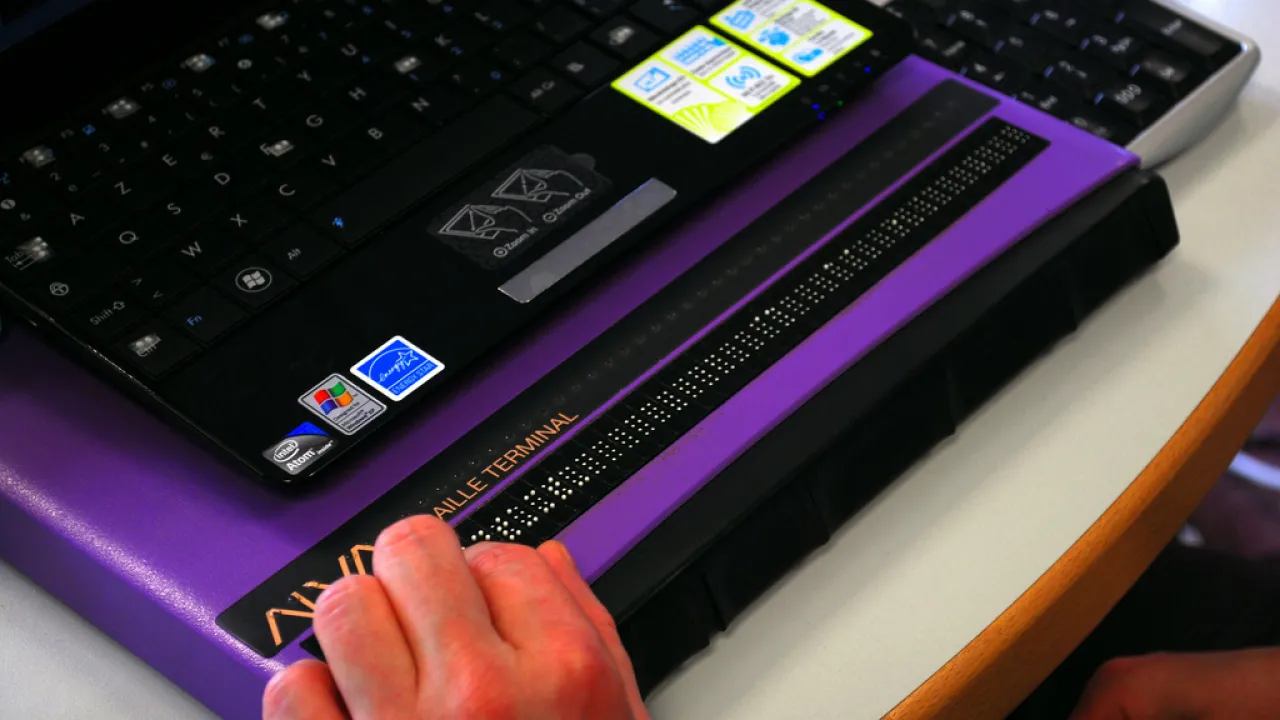
Transcriber files also power electronic 'refreshable braille displays' where tiny rounded pins pop up and down beneath a student's fingers line by line!
1. How does 'contracted' braille help blind readers enjoy long chapter books?
2. Which famous national institution certifies braille transcribers in the United States?
🤯 Mind-Blowing Fact • Grade 4
Mathematician Dr. Abraham Nemeth was once discouraged from studying math because people thought blind students could not write equations—so he invented the Nemeth Braille Code and became a university math and computer science professor!
✨ Word Sparks (Grade 4 Glossary)
Tap 🔊 to hear
Nemeth Code
Specialized braille system for math and science
Indicator cell
Prefix symbol signaling numbers or capital letters
Literacy
Ability to read and write independently
🪝
How can just six dot positions represent advanced geometry equations, chemistry formulas, and symphony music?
1
Sixty-Four Combinations and Clever Prefixes
Do quick math on a six-dot braille cell, where each dot position (numbered 1, 2, 3 down the left and 4, 5, 6 down the right) is either raised or flat: two to the sixth power equals exactly sixty-four possible combinations, including the blank space! How can sixty-three dot shapes cover capital letters, punctuation, fractions, and musical notes? Braille uses clever 'indicator' prefix cells placed right before a symbol to shift its meaning into capitals, numbers, or italics.
2
Unified English Braille and the Nemeth Code
Literary books follow Unified English Braille (UEB). When students tackle long division, geometry angles, or chemistry equations, specialized math transcribers switch to the Nemeth Braille Code—invented in 1946 by blind mathematician Dr. Abraham Nemeth so blind scientists could read and write advanced equations independently.
3
Braille Music Code for Musicians
Louis Braille himself was a talented organist! Because a pianist needs both hands on the keyboard while playing, braille music transcribers arrange notes, rhythms, and fingerings horizontally so musicians memorize one hand's passage by touch, then play.
4
Why Tactile Literacy Still Matters Alongside Audio
Audiobooks are wonderful for listening, yet reading braille directly teaches spelling, punctuation, paragraph structure, and math layout—building lifelong and career independence across Virginia schools and beyond.
1. Who invented the specialized braille code used for math, fractions, and science equations?
2. Why is learning to read raised braille still vital even though smartphones can read text out loud?
🤯 Mind-Blowing Fact • Grade 5
fMRI brain studies show that when fluent blind readers read braille with their fingertips, the brain's 'visual' cortex lights up intensely—proving that the reading brain cares about patterns and meaning, not whether words enter through eyes or fingers!
✨ Word Sparks (Grade 5 Glossary)
Tap 🔊 to hear
Mechanoreceptor
Fingertip nerve sensor detecting pressure and texture
Piezoelectric
Crystal flexing with electricity to lift pins
Syllable boundary
Dividing point between spoken word parts
🪝
Why does two-point fingertip nerve resolution dictate the exact millimeter spacing of every braille sign and textbook on Earth?
1
Somatosensory Neuroscience of the Reading Finger
Why did Louis Braille's 1824 six-dot grid triumph when earlier raised Roman-letter books failed? Human index-finger pads pack roughly 240 Merkel-cell per square centimeter, giving a two-point tactile discrimination threshold near two millimeters! Braille specifications align precisely with human neuroanatomy: adjacent dots within a cell sit 2.34 millimeters apart center-to-center, letting a sweeping fingertip capture an entire character in a single touch without tracing awkward loops.
2
Visual Cortex Plasticity in Tactile Readers
Functional MRI brain scans reveal a remarkable neuroscience twist: when fluent blind readers glide both hands across braille lines at up to two hundred words per minute, signals from their fingertips route straight into the occipital 'visual' cortex—repurposing high-speed pattern-recognition circuits for touch!
3
Rule-Driven Transcription Architecture
Library of Congress certified transcribers master complex linguistic rules inside software such as Duxbury Braille Translator and Braille2000. In Unified English Braille, a contraction like the 'ea' sign may be used inside 'bread' yet is strictly forbidden across certain syllable boundaries like 'react' where it would mislead pronunciation! Specialized certifications require years of training across Literary UEB, Nemeth STEM formatting, Foreign Language, and Music Braille.
4
Swell-Touch Graphics and Piezoelectric Displays
To render geometry graphs, circuit diagrams, or cellular mitosis, tactile graphics specialists simplify visual clutter—removing 3D perspective shadows that confuse touch—and print onto microcapsule 'swell paper' that puffs into crisp relief under infrared heat, or onto multi-line braille tablets.
5
Civil Rights and Universal Educational Access
Backed by the Individuals with Disabilities Education Act (IDEA), the Chafee Amendment copyright exemption, and the international Marrakesh Treaty, certified braille transcribers ensure blind students, scientists, and musicians receive crisp textbooks, exams, and scores right alongside their sighted peers.