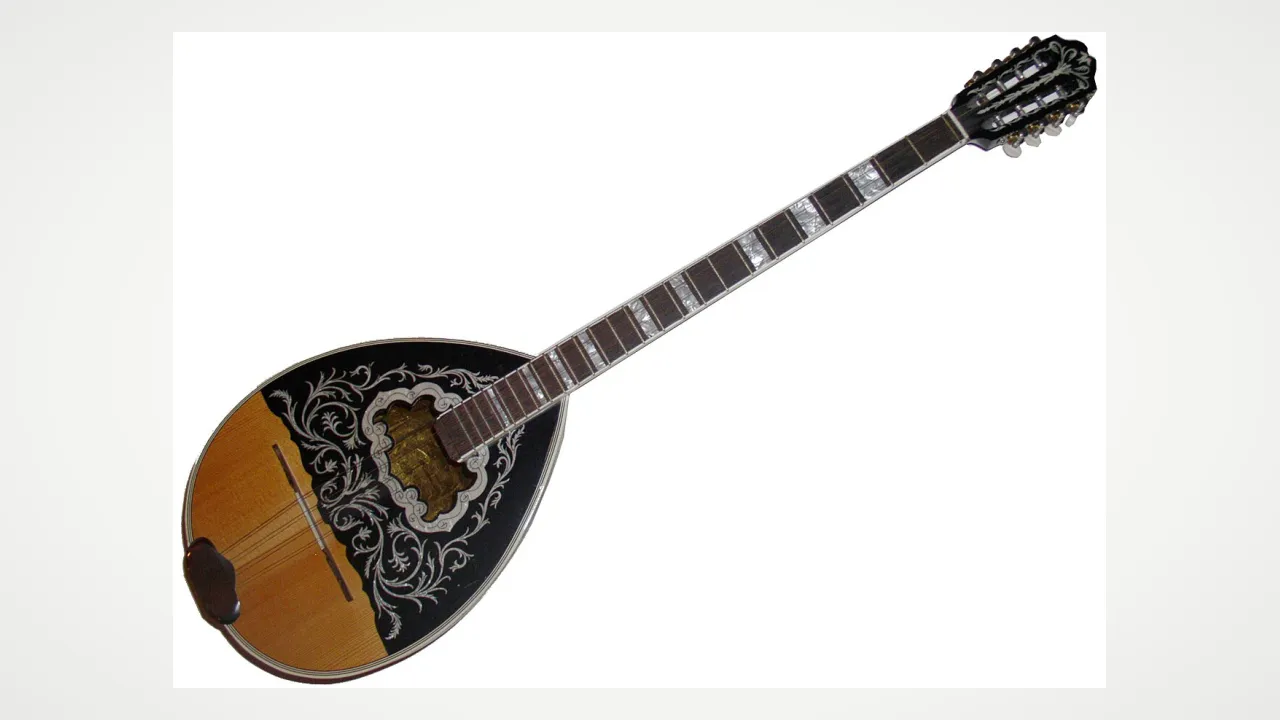
1. How are the steel strings arranged on a Greek bouzouki?
2. What shape is the wooden back of a traditional Greek bouzouki?
🤯 Mind-Blowing Fact • Grade 2
In the 1960s, Irish folk musicians fell in love with the Greek bouzouki and redesigned it with a flat wooden back for Celtic jigs and reels!
✨ Word Sparks (Grade 2 Glossary)
Tap 🔊 to hear
course
A pair or group of strings played together.
staved
Built from curved narrow wooden strips glued together.
shimmer
A bright, wavering sparkle of light or sound.
🪝
What happens when a bass string teams up with a high buddy string right beside it?
1
Dancing by the Aegean Sea
Ting-a-ling-ring! Step into a bustling harbor café in Athens and you will hear silvery notes dancing faster than your feet can tap! That unmistakable Mediterranean voice belongs to the Greek bouzouki.
2
Striped Wooden Bowl and Long Neck
Craftsmen glue thin, curved strips of dark walnut and pale maple together like melon slices to build its rounded bowl back. Up front, a long, skinny neck lined with metal frets stretches far out from a spruce top decorated with gleaming shell designs.
3
Six Strings or Eight Strings
Older bouzoukis carry three pairs of steel strings, while newer ones carry four pairs—eight strings in all! On the lowest pairs, one thick string and one thin string sound an octave apart for extra sparkle.
1. How are the two strings inside a lower bass pair tuned on a Greek bouzouki?
2. Which country's folk musicians adopted the bouzouki in the 1960s and gave it a flat wooden back?
🤯 Mind-Blowing Fact • Grade 3
Many lively Greek bouzouki dances called zeibekiko count nine beats per measure—grouped unevenly like 1-2, 1-2, 1-2, 1-2-3!
✨ Word Sparks (Grade 3 Glossary)
Tap 🔊 to hear
trichordo
Traditional Greek bouzouki with three pairs of strings.
tetrachordo
Modern Greek bouzouki with four pairs of strings.
rebetiko
Soulful Greek urban folk music featuring the bouzouki.
🪝
Why do Greek bouzouki builders still argue happily over six strings versus eight strings?
1
Echoes of Ancient Greece
Trill—glimmer—ring! A flexible teardrop pick blurs across twin steel wires, filling the night air with bittersweet melody and joyful dance! Greece's bouzouki descends from the ancient Greek pandoura and the Byzantine tambouras, carrying thousands of years of Eastern Mediterranean lute heritage.
2
Trichordo Versus Tetrachordo
Walk into a Greek workshop and you will meet two famous cousins. Classic bouzoukis carry three double courses—six strings tuned D–A–D—loved since early twentieth-century harbor songs. In the 1950s, virtuoso Manolis Chiotis popularized the —four double courses or eight strings—for faster chords and dazzling solos!
3
Octave Pairs and Unison Pairs
Both styles combine two string textures: high melody courses pair identical unison wires for silvery volume, while bass courses pair a wound string with a thin octave string for harpsichord-like ring.
4
Staved Bowl Resonance
Inside the rounded walnut-and-mulberry stave bowl, crisp sound waves reflect toward an oval soundhole framed by intricate mother-of-pearl vines.
1. How many total strings does a 'tetrachordo' bouzouki carry?
2. Who popularized the four-course tetrachordo bouzouki in the 1950s for fast chords and solos?
🤯 Mind-Blowing Fact • Grade 4
Master Greek bouzouki bowls can be assembled from as many as sixty paper-thin alternating dark and light wooden staves fitted seamlessly together!
✨ Word Sparks (Grade 4 Glossary)
Tap 🔊 to hear
pandoura
Ancient Greek three-stringed lute carved on marble.
marquetry
Decorative picture patterns inlaid from wood and shell.
asymmetric
Grouped in uneven, lively rhythmic beat patterns.
🪝
How did an ancient marble-carved lute evolve into both Greece's national voice and a star of Celtic folk bands?
1
Silver Sparks in Nine-Eight Time
What would happen if you combined the ringing paired steel strings of a mandolin, the long agile neck of an Eastern tanbur, and dance rhythms that skip in counts of seven and nine? Across Greece, the shimmering tremolos of the bouzouki anchor both soulful harbor ballads and celebratory circle dances—made world-famous in the 1960s by composer Mikis Theodorakis.
2
From Marble Reliefs to Rebetiko Ports
Fourth-century BCE Greek marble carvings at Mantineia already show muses plucking a long-necked three-stringed lute called the ! Passing through the Byzantine tambouras and Ottoman-era bozuk, the instrument found new life in the 1920s port cities of Piraeus and Thessaloniki, where refugees from Asia Minor wove Eastern modal scales (dromoi) into soulful urban folk songs called rebetiko.
3
Bowl-Back Luthiery and Course Tuning
Building a concert Greek bouzouki demands painstaking geometry: luthiers steam-bend twenty to sixty narrow staves of walnut, mulberry, or maple into a deep teardrop bowl topped with bookmatched spruce and protective celluloid or pearloid . Three-course trichordo instruments tune to D3–A3–D4—creating natural open drones along a single string—while four-course tetrachordo models tune to C3–F3–A3–D4 like the top four strings of a guitar dropped one whole step.
4
An Unexpected Celtic Cousin
In the late 1960s, Irish musician Johnny Moynihan brought a Greek bouzouki into Dublin folk sessions, inspiring English luthier Peter Abnett to build a flat-backed, wide-bodied 'Irish bouzouki' tuned in open fifths (G–D–A–D) for driving Celtic accompaniment!
1. Why do many traditional rebetiko musicians still love the older six-string trichordo tuning (D–A–D)?
2. How does an Irish bouzouki usually differ structurally from its Greek parent?
🤯 Mind-Blowing Fact • Grade 5
To stop sixty kilograms of taut steel-string tension from bending its pencil-slim neck, Greek luthiers sandwich up to five alternating lengthwise strips of hardwood inside every bouzouki neck!
✨ Word Sparks (Grade 5 Glossary)
Tap 🔊 to hear
laminate
To bond thin layers of wood for strength.
taximi
Rhythm-free solo improvisation introducing a Greek song's mode.
coopered
Assembled from bevelled wooden strips like curved barrels.
🪝
How do staved-bowl shell reflections, octave-paired steel courses, and long-scale tension forge the bouzouki's metallic Mediterranean brilliance?
1
Metallic Radiance Across Twenty-Seven Frets
Slice a flexible plectrum across the paired steel courses of a Greek bouzouki and the air ignites with an unmistakable silvery ring—part harpsichord chime, part vocal cry. Stretching roughly ninety-five to one hundred centimetres overall with a long vibrating scale length around sixty-seven centimetres and twenty-seven metal frets, the bouzouki commands more than three chromatic octaves from C3 (130.8 hertz) past F6.
2
Millennia of Continuity: Pandoura, Tambouras, and Rebetiko
Cataloged under Hornbostel-Sachs 321.322 as a long-necked fretted bowl lute, the bouzouki traces an unbroken Aegean lineage from the fourth-century BCE Hellenistic pandoura through the Byzantine tambouras and Anatolian bozuk saz. Following the 1922 population exchange between Greece and Asia Minor, port musicians such as Markos Vamvakaris fused Anatolian modal pathways (dromoi) with equal-tempered metal frets, cementing the bouzouki as the soul of rebetiko.
3
Multi-Stave Bowl Acoustics and Neck Engineering
Acoustic focus begins inside the deep hemispherical resonator, painstakingly from twenty to sixty heat-bent staves (douges) of walnut, mulberry, maple, or rosewood. Unlike flat guitar backs that absorb and flex low-mid energy, the rigid faceted bowl reflects high-frequency partials directly upward through an oval rosette cut into thin European spruce. To resist nearly sixty kilograms of cumulative steel-string pull without warping, luthiers the slender long neck from alternating strips of linden, maple, and ebony.
4
Inharmonicity and Octave-Paired Course Physics
Two distinct tunings coexist in Greek organology. The traditional six-string trichordo tunes three double courses to D3/D4–A3/A3–D4/D4, promoting linear single-course phrasing over open modal drones. In 1953, virtuoso Manolis Chiotis introduced the eight-string tetrachordo tuned C3/C4–F3/F4–A3/A3–D4/D4—matching a guitar's top four strings lowered a whole tone. Pairing wound bass strings with thin plain-steel octave companions injects crisp upper harmonics, while slight micro-detuning between unison treble wires produces shimmering acoustic beats.
5
Taximi Improvisation, Odd Meters, and Global Offshoots
Armed with a thin teardrop pena plectrum, performers open pieces with unmetered modal explorations called taximia before launching into 9/8 zeibekiko or 7/8 kalamatianos dances—inspiring both symphonic works by Mikis Theodorakis and the flat-backed GDAD Irish bouzouki across Northern Europe.