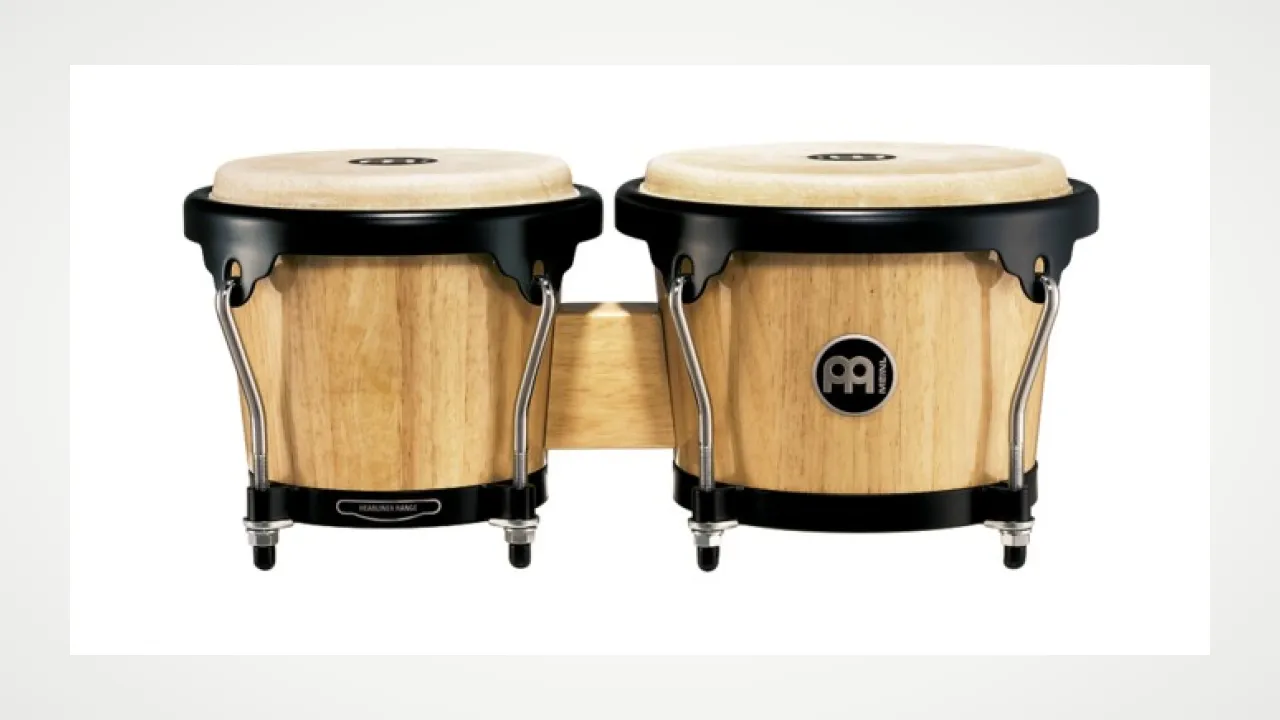
1. How are the two shells of bongo drums kept together?
2. Where does a seated player traditionally hold bongo drums while playing?
🤯 Mind-Blowing Fact • Grade 2
In salsa bands, the bongo drummer often sets the bongos down halfway through a song and grabs a heavy metal cowbell to boost the chorus!
✨ Word Sparks (Grade 2 Glossary)
Tap 🔊 to hear
macho
Smaller higher-pitched drum in a bongo pair
hembra
Larger lower-pitched drum in a bongo pair
martillo
Steady Cuban finger pattern meaning little hammer
🪝
What would happen if you shrank tall drums down until your fingertips could race across two at once?
1
Two Voices in One Lap
Paka-tiki-pak! Out on a warm porch in eastern Cuba, guitars strum a sunny tune while two tiny connected drums chatter like excited birds. Because their wooden shells stay short and open underneath, every tap bursts out clear and bright.
2
Meet Macho and Hembra
Cuban musicians gave each side its own special Spanish name. The smaller drum, usually placed on the left, is called the and sings high popping notes. Beside it sits the slightly wider , which answers back with a warmer, lower tone.
3
Tap Like a Little Hammer
Instead of swinging heavy sticks, players bounce their thumbs and fingertips in a steady pattern called the , which means 'little hammer.' Those quick, joyful beats keep dancers spinning all evening long!
1. Which drum in a bongo pair is smaller and produces the higher pitch?
2. What does the Spanish rhythm name 'martillo' translate to in English?
🤯 Mind-Blowing Fact • Grade 3
In 1931, French-born composer Edgard Varèse shocked concert audiences by giving Cuban bongos a starring role in Ionisation, one of the first classical works written solely for percussion!
✨ Word Sparks (Grade 3 Glossary)
Tap 🔊 to hear
conical
Shaped like a cone narrowing toward one end
portable
Light and compact enough to carry easily
mute
To soften or shorten a ringing vibration
🪝
How can two tiny drums project their sound over blaring trumpets and pianos without a microphone?
1
Born in Cuba's Mountain Towns
Around the year 1900 in Cuba's eastern Oriente region, acoustic guitar groups playing son cubano wanted a percussion instrument with dazzling speed. Drum makers joined two short, hardwood shells with a carved wooden bridge, creating a nimble pair gripped right between the knees.
2
High Tension, High Frequency
Why do bongos cut through a loud band instead of getting lost in the bass? Thin calfskin or rawhide membranes are cranked to very high tension across narrow rims—roughly six inches wide on the macho and eight inches on the hembra. High tension makes the skin vibrate at rapid frequencies, sending crisp sound waves slicing through thicker low instruments.
3
Sculpting Tone with Thumbs and Rim Shots
During the classic eight-beat martillo groove, one thumb presses down on the macho to overtones and bend pitch upward, while the other hand snaps sharp rim-edge strokes before leaping to the deeper hembra on beat four. Every tiny finger movement shifts the drum's color instantly.
4
From Folk Porches to Orchestras
That sparkling, dry timbre soon traveled far beyond Cuba, energizing Latin jazz combos, classic rock recordings, spy-movie soundtracks, and even twentieth-century symphony orchestras around the globe.
1. Why are bongo sounds able to slice clearly through loud pianos and brass horns?
2. During the martillo pattern, why does a player press a thumb onto the macho head?
🤯 Mind-Blowing Fact • Grade 4
After every concert, experienced bongo players loosen their tuning nuts a few turns because drying rawhide shrinks overnight with enough pulling force to warp rims or split the skin!
✨ Word Sparks (Grade 4 Glossary)
Tap 🔊 to hear
decay
How quickly a musical sound fades away
repique
Dazzling improvised rhythmic flourish on Cuban drums
articulate
Crisp and distinct so every note separates
🪝
Why does a short, open-bottomed wooden cone make bongo strokes decay in a split second instead of booming?
1
Chattering Sparks of Son Cubano
Listen to a classic Cuban sextet in full flight: beneath the soaring trumpet melody, a flurry of lightning-quick pops, snaps, and rolls dances between every beat like crackling campfire sparks. Emerging around 1900 in eastern Cuba's Guantánamo and Santiago regions, bongo drums grew out of Afro-Cuban changüí and son ensembles, where drummers called bongoceros invented breathtaking fingertip solos known as .
2
Short Shells and Fast Acoustic Decay
Compare a bongo shell to a tall conga barrel and you immediately spot an engineering secret. Each bongo shell measures only about seventeen centimeters deep, carved or coopered from dense cedar, mahogany, or oak with open bottoms angled slightly outward. Because there is no deep air chamber underneath to trap low-frequency resonance, sound waves escape almost instantly. Paired with thin, tightly stretched rawhide membranes—tuned roughly a musical fourth or fifth apart—this shallow geometry produces ultra-fast transient attacks and dry, .
3
Heat Tuning Versus Mechanical Lugs
Early Cuban bongos nailed their animal skins directly onto the wooden shells with decorative brass tacks. Because humid tropical evening air loosened rawhide and dropped its pitch, bongoceros warmed their drums over small pans of glowing charcoal between songs! By the late 1940s, steel rims and threaded tuning lugs let players adjust membrane tension swiftly with a simple wrench. Even today, musicians always detune skin heads slightly after concerts so overnight cooling and shrinking will not crack the delicate hide.
4
Two Instruments, One Musician
In traditional salsa and son arrangements, a bongocero masters dramatic dynamic shifts: weaving delicate fingertip martillo grooves behind quiet vocal verses before switching to a handheld iron campana bell to drive fiery chorus sections. That versatility carried bongos into Motown hits, rock anthems, and acoustic coffeehouse sessions worldwide.
1. How did early Cuban bongoceros raise their drums' pitch before metal tuning lugs were invented?
2. How does the shallow 17-centimeter depth of bongo shells shape their sound?
🤯 Mind-Blowing Fact • Grade 5
By sliding a slightly moistened or rosin-rubbed fingertip steadily across a tight bongo head, master Cuban drummers trigger stick-slip vibrations that make the tiny drum let out a sustained, singing roar called a bramido!
✨ Word Sparks (Grade 5 Glossary)
Tap 🔊 to hear
clave
Foundational five-stroke rhythmic timeline in Cuban music
ostinato
Short musical pattern repeated steadily throughout songs
density
Amount of mass packed into given space
🪝
How do high radial tension, thin membrane mass, and minimal cavity loading transform paired six-inch and eight-inch cones into high-speed rhythmic precision tools?
1
Improvisational Spark of Eastern Cuba
Listen closely to a classic Havana conjunto recording and notice who speaks with the freest rhythmic agility: darting around the timeline in rapid-fire thirty-second-note bursts, the bongo player converses directly with dancers and lead singers. Originating around the turn of the twentieth century in Cuba's eastern Oriente province within changüí and son cubano ensembles, bongo drums distill Afro-Cuban Bantu hand-drumming aesthetics into a compact, paired conical membranophone.
2
Asymmetric Pairing: Macho and Hembra
Constructed from seasoned tropical hardwoods such as cedar, mahogany, or oak—or spun fiberglass for stage durability—the instrument couples two open-bottomed, slightly conical shells across a bolted hardwood center block. Standard concert dimensions pair a 6-to-7-inch (15–18 cm) macho shell with an 8-to-8.5-inch (20–22 cm) hembra shell, each approximately 17 centimeters deep. Seated percussionists wedge the pair between their inner knees at an outward tilt so sound waves radiate freely from both bottom openings while positioning the higher-pitched macho on the non-dominant side.
3
Membrane Physics and High-Frequency Transients
Unlike tumbadoras, which employ thick mule hides for warm low-frequency sustain, bongos mount thin, supple calfskin, goatskin, or synthetic membranes tensioned tightly over steel counter-hoops. Low areal combined with intense radial tension elevates fundamental pitches into the 220-to-290-hertz band on the hembra and 350-to-480-hertz band on the macho—often tuned a perfect fourth, fifth, or octave apart. Because the shallow conical shells exhibit negligible low-frequency Helmholtz air-column loading, membrane vibrations damp rapidly, preserving razor-sharp transient definition even during blistering finger rolls.
4
Kinematics of the Martillo and Glissando
At the core of traditional technique sits the eight-pulse martillo ('hammer') . Across each cycle, the left thumb rocks onto the macho head—simultaneously muting stray overtones and raising tension for a subtle upward pitch inflection—while the index finger snaps high-overtone rim strokes and swings across to strike an open low accent on the hembra. Master players also drag a friction-warmed middle fingertip across the skin to unleash a singing friction roar known as a bramido.
5
Global Reach from Salsa to Symphonic Scores
Pioneered by Cuban virtuosos such as Agustín Gutiérrez, Armando Peraza, and Roberto Roena, bongos crossed swiftly into American jazz, Motown studio tracks, and orchestral percussion literature—including works by Edgard Varèse, Leonard Bernstein, and Pierre Boulez—proving how two palm-sized drums can command an entire concert hall. Whether anchored on a swivel stand inside a modern multi-percussion rig or gripped traditionally between a soloist's knees, their crystalline voice remains unmistakable.