1. Which muscle pulls to bend your elbow and lift a snack to your mouth?
2. What must your biceps do while your triceps pulls your arm straight out?
🤯 Mind-Blowing Fact • Grade 2
Ancient Roman scholars thought a flexed biceps looked like a little mouse hiding under a blanket—so the Latin word 'musculus' literally means 'little mouse'!
✨ Word Sparks (Grade 2 Glossary)
Tap 🔊 to hear
Bi and Tri
Word beginnings meaning two and three
Push-Up
Exercise pressing your body up using triceps
Shoulder Blade
Flat triangle bone on your upper back
🪝
What secret number clue is hiding right inside the names 'biceps' and 'triceps'?
1
Counting Muscle Heads
Think of a two-wheeled bicycle and a three-wheeled tricycle! 'Bi' means two, and 'tri' means three. Your biceps starts at the top with two tendon 'heads' anchored to your , while your triceps begins with three heads on the back!
2
Pulling Up Versus Pushing Away
Every time you climb a playground ladder, carry groceries, or hug a puppy, your biceps pulls your forearm up. Whenever you do a , shoot a basketball, or push open a heavy door, your triceps powers your arm straight.
3
A Secret Wrist Twist
Hold your bent elbow and turn your palm face-up—feel your biceps jump? Your biceps twists your forearm too!
1. Why is the muscle on the back of your upper arm named the 'triceps'?
2. Which everyday move relies most on your triceps contracting?
🤯 Mind-Blowing Fact • Grade 3
Your triceps makes up about sixty percent of the total muscle mass of your upper arm—almost double the size of your biceps!
✨ Word Sparks (Grade 3 Glossary)
Tap 🔊 to hear
Antagonistic Pair
Two muscles pulling a joint opposite ways
Radius
Thumb-side forearm bone that rotates smoothly
Brachialis
Deep helper muscle underneath your biceps
🪝
Why is your biceps actually a stronger screwdriver twister than an elbow lifter?
1
Antagonistic Partners in Action
Toss a ball into the air and catch it cleanly! Scientists call the biceps and triceps an —not because they argue, but because they pull your forearm hinge in opposite directions. Smooth brain signals tighten one muscle while simultaneously telling its partner to relax.
2
The Screwdriver Superpower
Most people think the biceps only bends the elbow, while a deeper hidden muscle called the actually handles a huge share of elbow bending! Your biceps attaches to the rotating bone of your forearm. When it pulls, it spins your palm face-up—giving right-handed carpenters massive leverage when turning a screwdriver clockwise!
3
The Horseshoe Powerhouse
Flip over to the back of your upper arm and meet the horseshoe-shaped triceps brachii. Making up nearly two-thirds of your upper arm's muscle size, its three heads merge into one stout tendon anchored right onto the bony point of your elbow.
4
Locking Steady Together
When you hold a tray of water cups steady, both muscles tighten lightly together to lock your elbow rock-still!
1. Besides bending your elbow, what surprising second motion is your biceps specially built to power?
2. About how much of your upper arm's muscle volume belongs to the three-headed triceps?
🤯 Mind-Blowing Fact • Grade 4
An easy trick doctors and students use to remember 'supination'—the biceps' forearm-twisting job—is turning your palm upward as if holding a warm bowl of 'soup'!
✨ Word Sparks (Grade 4 Glossary)
Tap 🔊 to hear
Reciprocal Inhibition
Automatic nerve signal relaxing an opposing muscle
Supinate
Rotate your forearm so palm faces upward
Olecranon
Bony elbow tip where triceps tendon attaches
🪝
How does a lightning-fast spinal reflex keep your biceps and triceps from playing tug-of-war against each other?
1
Reciprocal Inhibition: Smart Wiring
Imagine driving a car with one foot stomping the gas pedal and the other slamming the brakes—you wouldn't glide very smoothly! Whenever your brain commands your biceps brachii to contract and flex your elbow, spinal cord circuits automatically quiet the motor nerves leading to your triceps brachii. Neuroscientists call this instant teamwork , ensuring opposing muscles cooperate seamlessly.
2
Crossing Two Joints at Once
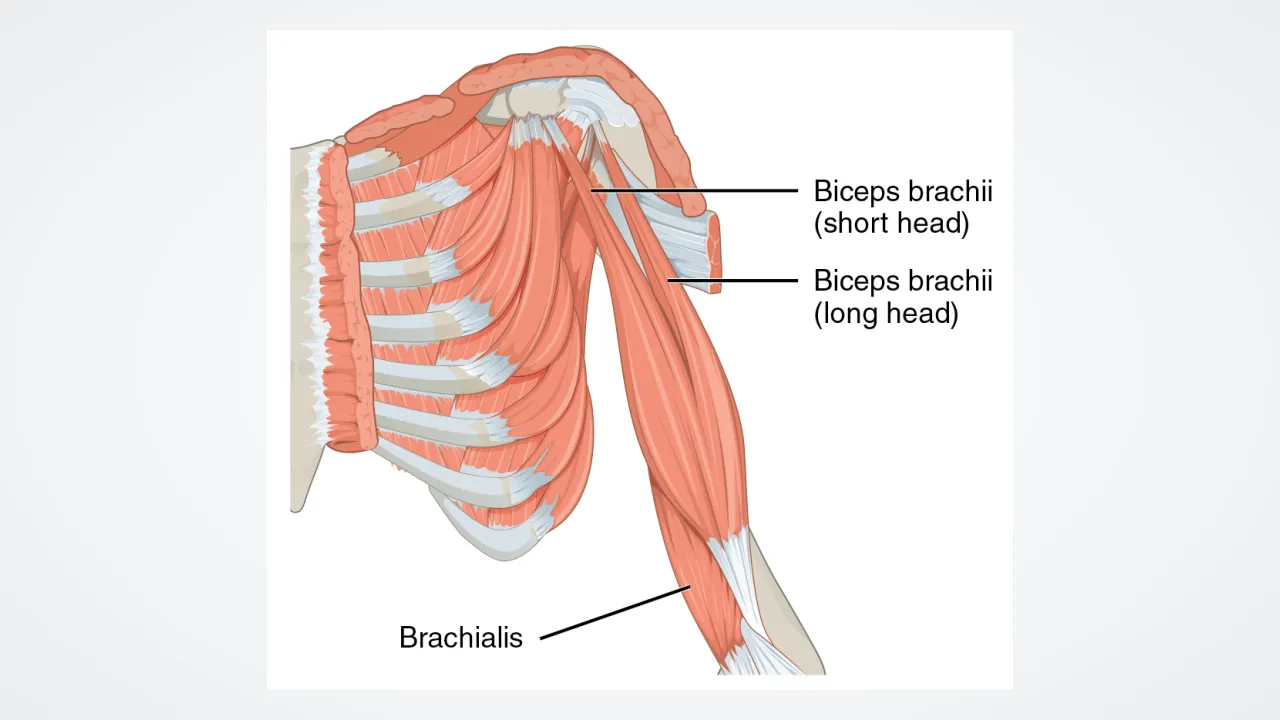
Both head tendons of your biceps—the long head arching directly over your shoulder ball and the short head anchored to a hook on the scapula—skip past the humerus bone entirely and insert onto the radial tuberosity of your forearm! Because it crosses both the shoulder and elbow joints, the biceps helps lift your arm forward, flex the elbow, and (rotate palm-up—think holding a bowl of 'soup'!).
3
Three Heads of the Triceps
On the posterior arm, the triceps combines a long head anchored to the scapula with lateral and medial heads rooted along the back of the humerus. All three converge into a thick tendon inserting on the ulna's process—the hard point of your elbow—delivering explosive extension for gymnastics handstands, swimming strokes, and baseball throws.
4
Eccentric Braking Control
When you gently set a heavy bowling ball onto a rack instead of dropping it, your biceps actually lengthens slowly while still pulling—acting as a smooth hydraulic brake!
1. What does spinal 'reciprocal inhibition' automatically do the instant you flex your biceps?
2. How does your biceps help when you gently lower a heavy box down to a table?
🤯 Mind-Blowing Fact • Grade 5
British neuroscientist Sir Charles Sherrington won the 1932 Nobel Prize for discovering 'Sherrington's Law'—proving how spinal nerves automatically quiet an opposing muscle like the triceps the millisecond its partner contracts!
✨ Word Sparks (Grade 5 Glossary)
Tap 🔊 to hear
Biarticular
Crossing and acting across two separate joints
Co-Contraction
Tightening opposing muscles together to steady joints
Torque
Rotational twisting force around a pivot axis
🪝
Why did Charles Sherrington win a Nobel Prize studying antagonistic muscle pairs like the biceps and triceps?
1
Biarticular Architecture of the Brachium
Occupying the anterior and posterior compartments of the brachium (upper arm), the biceps brachii and triceps brachii exemplify antagonistic skeletal muscle mechanics. Remarkably, neither muscle acts strictly across a single hinge: the entire biceps brachii and the long head of the triceps brachii are —crossing both the triaxial glenohumeral shoulder joint and the uniaxial elbow complex to coordinate multi-joint upper-limb trajectories.
2
Supination Torque and the Synergy Trio
Although popular culture credits the biceps alone with elbow flexion, electromyography reveals a three-muscle synergy. Deep beneath the biceps, the broad brachialis inserts onto the non-rotating ulna to serve as the pure, tireless workhorse of elbow flexion regardless of wrist angle, assisted along the thumb side by the brachioradialis. Meanwhile, the biceps brachii wraps its distal tendon around the radial tuberosity; when the elbow is bent at ninety degrees, contracting the biceps uncoils the radius like a winch, generating peak forearm supination .
3
Tri-Headed Extension Mechanics
Posteriorly, the lateral, long, and deep medial heads of the triceps brachii account for roughly sixty percent of upper-arm muscle mass. Inserting onto the ulna's olecranon process just centimeters behind the trochlear fulcrum, this short lever arm sacrifices mechanical advantage in exchange for blistering hand velocity during overhead racquet serves, javelin releases, and basketball jump shots.
4
Isometric Co-Contraction Versus Concentric Speed
While rapid throws rely on reciprocal relaxation, fine motor tasks—such as carving wood or holding surgical instruments—command simultaneous of both biceps and triceps to tune joint impedance and damp hand tremor.
5
Sherrington's Law of Reciprocal Innervation
In the late 1890s, British neurophysiologist Sir Charles Scott Sherrington proved that sensory stretch spindles activating an agonist motor pool simultaneously excite spinal Ia inhibitory interneurons to quiet its antagonist—a foundational discovery in neural control that earned him the 1932 Nobel Prize in Physiology or Medicine.