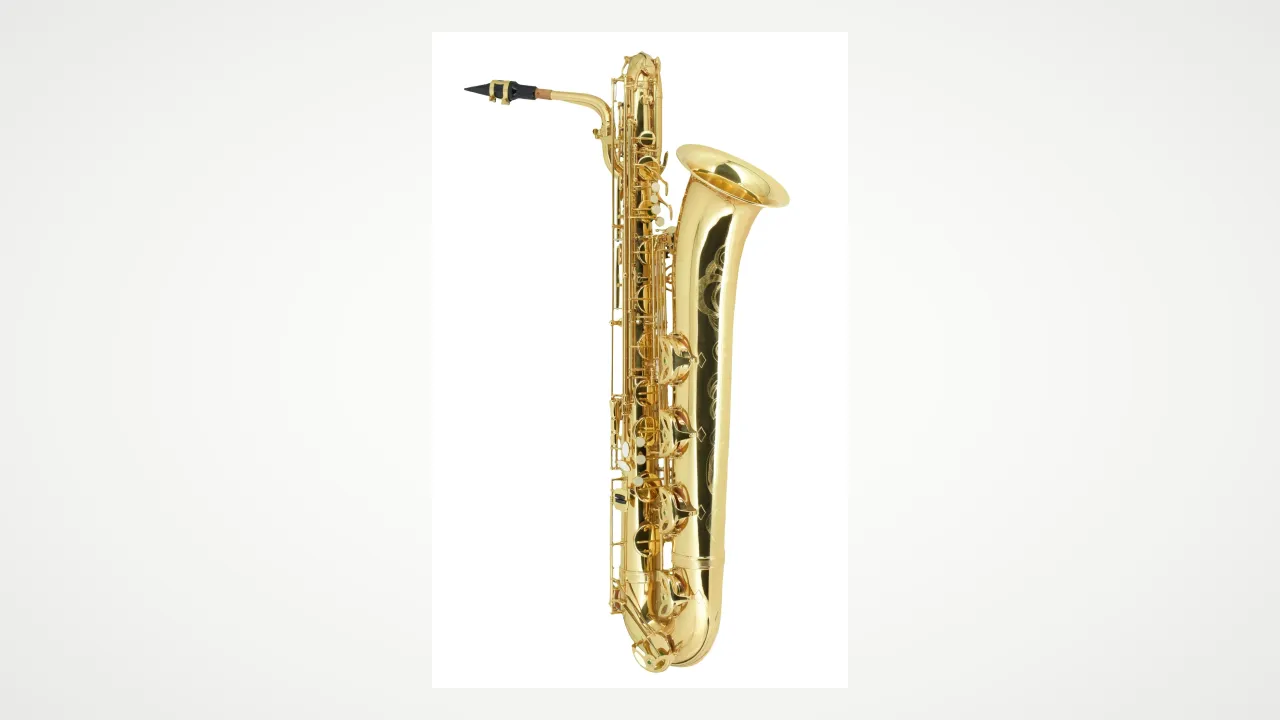
1. Why does a baritone saxophone have a round loop of brass tubing near the top?
2. What friendly nickname do band players often use for the baritone saxophone?
🤯 Mind-Blowing Fact • Grade 2
Most modern baritone saxophones have a special left-thumb key that unlocks a rumbling low A—matching the deepest C string on a cello!
✨ Word Sparks (Grade 2 Glossary)
Tap 🔊 to hear
riff
Short, catchy musical pattern repeated with energy
quartet
Musical group of four players performing together
anchor
Lowest voice supporting harmonies from underneath
🪝
How do you carry a fourteen-pound saxophone whose brass tunnel is taller than a basketball player?
1
Engine Room of the Band
Bwaaa-da-bum! Whenever a jazz big band or funk horn section drops a punchy bass that makes the whole crowd smile, listen for the unmistakable growl of the baritone saxophone!
2
The Clever Pigtail Coil
Unfold a bari sax and its brass cone would stretch over seven feet—taller than most NBA players! By coiling the narrow upper pipe into a full circle right below the neck, Adolphe Sax kept the mouthpiece at mouth height.
3
Harnesses and Floor Pegs
Weighing around thirteen to fifteen pounds, a bari sax uses a padded shoulder harness while marching or a detachable floor peg when seated onstage.
1. About how long would the brass tube of a baritone saxophone stretch if unfolded straight?
2. Which string instrument's lowest note matches the deepest note on a modern low-A baritone saxophone?
🤯 Mind-Blowing Fact • Grade 3
Unlike smaller saxophones, the baritone saxophone needs a little spring-loaded spit valve under its top loop because breath moisture collects in the bend!
✨ Word Sparks (Grade 3 Glossary)
Tap 🔊 to hear
big band
Large jazz ensemble with saxes and brass
spit valve
Spring lever draining moisture from curved tubing
conical bore
Air passage widening steadily toward the bell
🪝
What happens when you double the length of an alto saxophone and coil its upper brass tube in a circle?
1
Grit, Velvet, and Groove
Think big instruments can only plod slowly? Watch a skilled baritone saxophonist dance across rapid jazz runs while pumping out bass notes rich enough to rattle your ribcage! Combining single-reed speed with deep brass resonance makes the bari sax an unstoppable crowd favorite.
2
One Octave Below the Alto
Patented by Adolphe Sax in 1846, the baritone saxophone is pitched in E-flat—exactly one full octave deeper than the E-flat alto saxophone. Doubling the alto's conical air column to roughly 2.2 meters requires a signature 360-degree brass loop below the neck plus a tall upturned bell.
3
Water Key on the Loop
Because warm breath condenses inside that upper brass coil before reaching the main body, builders attach a trumpet-style spring water key right at the bottom of the loop!
4
Big Bands, Quartets, and City Streets
Harry Carney anchored Duke Ellington's famous jazz orchestra on baritone sax for forty-five years, Gerry Mulligan led cool-jazz quartets with it, and George Gershwin used it to paint bustling traffic in An American in Paris.
1. How does the pitch of an E-flat baritone saxophone compare to an E-flat alto saxophone?
2. Why is there a small spring-loaded water key right beneath the baritone saxophone's upper loop?
🤯 Mind-Blowing Fact • Grade 4
Written notes on a baritone saxophone sound thirteen scale steps—an octave plus a sixth—lower than printed, yet use the exact same fingerings as an alto sax!
✨ Word Sparks (Grade 4 Glossary)
Tap 🔊 to hear
ergonomic
Shaped comfortably to fit natural human movement
contrapuntal
Weaving two independent melodies together harmoniously
low-A bell
Extended bell unlocking cello-deep concert C2
🪝
How can a single-reed woodwind weighing fourteen pounds out-punch electric basses and sing with cello-like grace?
1
Thunder With Nimble Fingers
Drop the needle on a classic Duke Ellington swing chart, a Motown soul anthem, or a contemporary saxophone quartet, and listen to the bottom voice: crisp as a plucked string on short notes, gravelly as a muscle car when pushed, yet warm as a solo cello on slow melodies.
2
Two-Point-Two Meters of Coiled Conical Physics
Among the four core members of Adolphe Sax's 1846 family—soprano, alto, tenor, and baritone—the E-flat baritone commands the deepest standard seat, transposing an octave plus a major sixth below treble-clef notation. Unfolded, its wide conical brass bore stretches roughly 2.15 to 2.25 meters! Coiling the narrow upper taper into a graceful 360-degree loop solves two challenges at once: it places the broad cane-reed mouthpiece at height while preserving smooth acoustic expansion without sharp mitered corners that would scatter sound waves.
3
The Low-A Bell Extension
Adolphe Sax's original nineteenth-century baritones descended to written low B-flat (sounding concert D-flat2). During the mid-twentieth century, makers lengthened the upturned bell by several inches and added a dedicated left-thumb spatulate key for written low A—dropping the bottom note to concert C2 (65.4 Hz) and giving classical quartets and studio players the exact bass anchor of a cello!
4
Icons From Ellington to Modern Brasshouse
Harry Carney gave Duke Ellington's reed section unmistakable majesty for nearly five decades, Gerry Mulligan proved its light agility in pianoless jazz quartets, Pepper Adams blazed bebop solos on it, and classical composers from Gershwin to Philip Glass prized its dark foundation.
1. Why did mid-twentieth-century makers lengthen the baritone saxophone's bell and add a left-thumb key?
2. Which legendary baritone saxophonist anchored Duke Ellington's orchestra for forty-five years?
🤯 Mind-Blowing Fact • Grade 5
Baritone sax pioneer Harry Carney mastered 'circular breathing'—puffing air from his cheeks while inhaling through his nose—allowing him to hold single bass notes for several uninterrupted minutes onstage!
✨ Word Sparks (Grade 5 Glossary)
Tap 🔊 to hear
transient attack
Crisp split-second burst starting a musical note
circular breathing
Blowing cheek air while inhaling through nose
semitone
Smallest half-step interval between adjacent piano keys
🪝
Why does a wide-bored brass cone driven by a three-inch cane reed project sharper rhythmic punch than almost any other acoustic bass instrument?
1
Sub-Harmonic Growl and Articulative Bite
Compare a bowed double bass, a brass tuba, and an E-flat baritone saxophone playing the exact same concert C2 at 65.41 Hz: the bass murmurs warmly, the tuba blooms roundly, and the baritone saxophone snaps into focus with percussive, buzz-saw clarity! That instantaneous paired with chest-thumping richness makes the 'bari' indispensable from classical saxophone quartets to funk, soul, and symphonic wind ensembles.
2
Wide-Cone Impedance and Harmonic Spectrum
Classified organologically as a single-reed conical aerophone (422.212), a modern low-A baritone saxophone folds roughly 2.23 meters of yellow or rose brass into a ~105-centimeter frame weighing 5.8 to 6.8 kilograms. Transposing down an octave plus a major sixth (21 ) from treble-clef notation, its keyed compass spans concert C2 (65.41 Hz, on low-A models) or D-flat2 (69.30 Hz, on vintage low-B-flat horns) up to A4 (440 Hz), with vocal-tract-coupled altissimo vaulting past concert G5 (~784 Hz). Because a ~3.5-degree conical bore supports all integer harmonics and a broad Arundo donax reed (~80 mm long, ~17 mm wide) snaps shut cleanly against the mouthpiece facing, low notes radiate dense clusters of upper partials between 400 and 2,500 Hz—giving crisp rhythmic definition even without amplification.
3
Curvature Fluid Dynamics and Low-A Tradeoffs
Sweeping the narrow upper bore through a smooth 360-degree coil right beneath the short neck minimizes acoustic wave reflections while collecting breath moisture at a dedicated bottom water key. Interestingly, many jazz purists still debate low-A versus vintage low-B-flat bells: removing those extra centimeters of flare on older B-flat horns slightly lightens response, whereas modern low-A bells match the cello's bottom C2—unlocking J.S. Bach's Cello Suites and modern quartet scores.
4
Adolphe Sax's Quartet Vision Realized
When Adolphe Sax patented his family in 1846, French classical pioneers like Jean-Baptiste Singelée immediately composed string-quartet-inspired works for soprano, alto, tenor, and baritone saxophones—establishing the baritone as the ensemble's harmonic cello.
5
From Big-Band Bedrock to Modern Virtuosity
Elevated by Harry Carney's circular-breathing marathon tones with Duke Ellington, Gerry Mulligan's airy West Coast counterpoint, Pepper Adams's hard-bop fire, Doc Kupka's syncopated funk stabs, and contemporary athletic soloists, the baritone saxophone proves massive bores can dance on a dime.