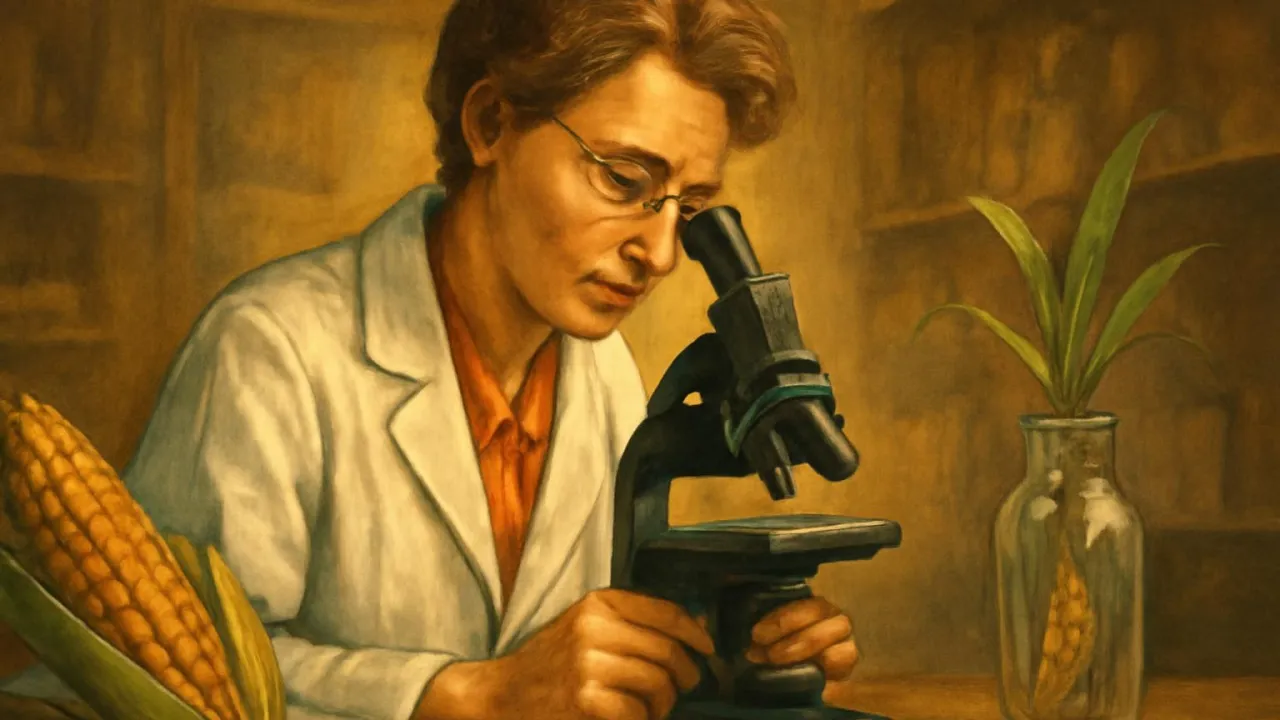
2. What special thing did Barbara discover about genes?
🤯 Mind-Blowing Fact • Grade 2
Barbara McClintock won the Nobel Prize for finding jumping genes.
✨ Word Sparks (Grade 2 Glossary)
Tap 🔊 to hear
microscope
A tool to see very tiny things up close
genes
Parts inside plants that decide their traits
Nobel Prize
A big award for important discoveries
🪝
Have you ever wondered if tiny parts inside plants can move around?
1
Curious About Plants
Barbara McClintock loved studying plants when she was young. She used a to look closely at corn. She asked many questions about how plants grow and change.
2
Hard Work and Discovery
She worked very hard to learn about inside corn plants. Barbara noticed that some genes could move from one place to another. This was a new idea that surprised many scientists.
3
A Big Achievement
Her discovery of jumping helped scientists understand genetics better. Barbara’s work showed how genes control traits in plants. She won a special prize called the for her discovery.
1. What did Barbara use to look at corn plants closely?
2. What was special about the genes Barbara found?
🤯 Mind-Blowing Fact • Grade 3
Barbara McClintock discovered transposons, also called jumping genes, changing genetics forever.
✨ Word Sparks (Grade 3 Glossary)
Tap 🔊 to hear
transposons
Genes that can move inside chromosomes
perseverance
Keep trying even when it is hard
hypothesis
A smart guess to explain something
🪝
What if tiny parts inside plants could move and change how plants look?
1
Early Curiosity and Study
Barbara McClintock showed great curiosity about plants and genetics from a young age. She used a microscope to study maize chromosomes carefully. Her helped her understand complex genetic patterns. She believed that genes control traits in living things.
2
Discovering Jumping Genes
While studying corn, Barbara discovered mobile genetic elements called . These jumping genes could move within chromosomes and change traits. This was revolutionary and challenged many scientists’ ideas about genetics. Her work introduced a new way to think about gene regulation.
3
Overcoming Challenges
Barbara faced skepticism because her ideas were ahead of her time. She continued her research with patience and strong belief in her findings. Her helped prove that genes are not fixed but dynamic. This changed the field of genetics forever.
4
Legacy and Impact
Barbara McClintock’s discovery of jumping genes earned her the Nobel Prize in Physiology or Medicine. Her work inspired future genetic research and biotechnology advances. She showed how careful observation and creative thinking can lead to big discoveries. Today, her legacy lives on in science classrooms worldwide.
1. What did Barbara call the genes that could move inside chromosomes?
2. How did Barbara show perseverance in her work?
🤯 Mind-Blowing Fact • Grade 4
Barbara McClintock was the first woman to win an unshared Nobel Prize in Physiology or Medicine.
✨ Word Sparks (Grade 4 Glossary)
Tap 🔊 to hear
cytogenetics
Study of chromosomes under a microscope
transposable
Able to move from one place to another
mutation
A change in a gene’s DNA sequence
🪝
How did Barbara McClintock’s discovery of jumping genes change science forever?
1
Historical Context and Early Life
During the early 1900s, genetics was a new field, and many scientists believed genes were fixed in place. Barbara McClintock grew up fascinated by plants and chromosomes, studying maize with great attention to detail. She used techniques to observe chromosomes under the microscope. Her curiosity and dedication set the stage for groundbreaking discoveries.
2
The Turning Point: Jumping Genes
Barbara’s discovery of elements, or jumping genes, revealed that genes could move within chromosomes and influence traits dynamically. This finding challenged the traditional view of genetics and gene stability. Her innovative techniques allowed her to track these movements in corn plants. This turning point expanded the understanding of genetic regulation and .
3
Signature Innovations and Techniques
McClintock developed new cytogenetic methods to visualize chromosome behavior and gene movement. She combined careful observation with experimental breeding of maize to prove her hypothesis. Her approach was unique, blending microscopy, genetics, and plant biology. These techniques became foundational tools in molecular genetics and biotechnology.
4
Global Impact and Legacy
Barbara McClintock’s work earned her the Nobel Prize in 1983, making her the first woman to win unshared in Physiology or Medicine. Her discovery influenced genetic research worldwide, opening doors to understanding gene regulation in many organisms. Today, her legacy inspires scientists to explore genetic complexity with creativity and perseverance. Her story highlights the power of questioning and discovery.
1. What did Barbara’s discovery of jumping genes challenge?
2. What field did Barbara’s techniques help develop?
🤯 Mind-Blowing Fact • Grade 5
Barbara McClintock’s discovery of jumping genes reshaped modern genetics and earned her a Nobel Prize.
✨ Word Sparks (Grade 5 Glossary)
Tap 🔊 to hear
cytogenetics
Study of chromosomes under a microscope
transposable elements
Genes that can move inside chromosomes
genome plasticity
How genes can change and move around
🪝
How did Barbara McClintock’s discovery of jumping genes revolutionize genetics and inspire future scientists?
1
Early Life and Education
Barbara McClintock grew up in Hartford, Connecticut, where she developed a passion for botany and genetics. She attended Cornell University, earning her PhD in botany in 1927. Her early work focused on maize , studying chromosomes with innovative microscopy techniques. Her academic path combined deep curiosity with rigorous scientific training.
2
Scientific Discoveries and Methods
McClintock’s most famous discovery was , or jumping genes, which move within chromosomes and affect gene expression. She used cytogenetic mapping and breeding experiments on maize to track these movements precisely. Her hypothesis that genes are dynamic elements challenged the static gene model of her time. This breakthrough laid the foundation for modern molecular genetics.
3
Career Achievements and Recognition
Despite initial skepticism, Barbara’s perseverance led to widespread acceptance of her findings. In 1983, she was awarded the Nobel Prize in Physiology or Medicine, becoming the first woman to receive this prize unshared. Her career included numerous publications and mentorship of future geneticists. Her quantitative analyses of chromosome behavior remain influential today.
4
Historical Legacy and Global Impact
McClintock’s discovery transformed the understanding of genetic regulation, mutation, and . Her work influenced biotechnology, medicine, and evolutionary biology worldwide. She demonstrated how genes could control traits by moving, reshaping genetic theory fundamentally. Her legacy continues to inspire scientists to explore genetic complexity and innovation.
5
Inspiration and Takeaways
Barbara McClintock’s story teaches the power of curiosity, perseverance, and creative thinking in science. She showed that questioning established ideas can lead to revolutionary discoveries. Her dedication reminds us that science requires patience and belief in one’s work. Her life encourages young scientists to explore boldly and never give up.