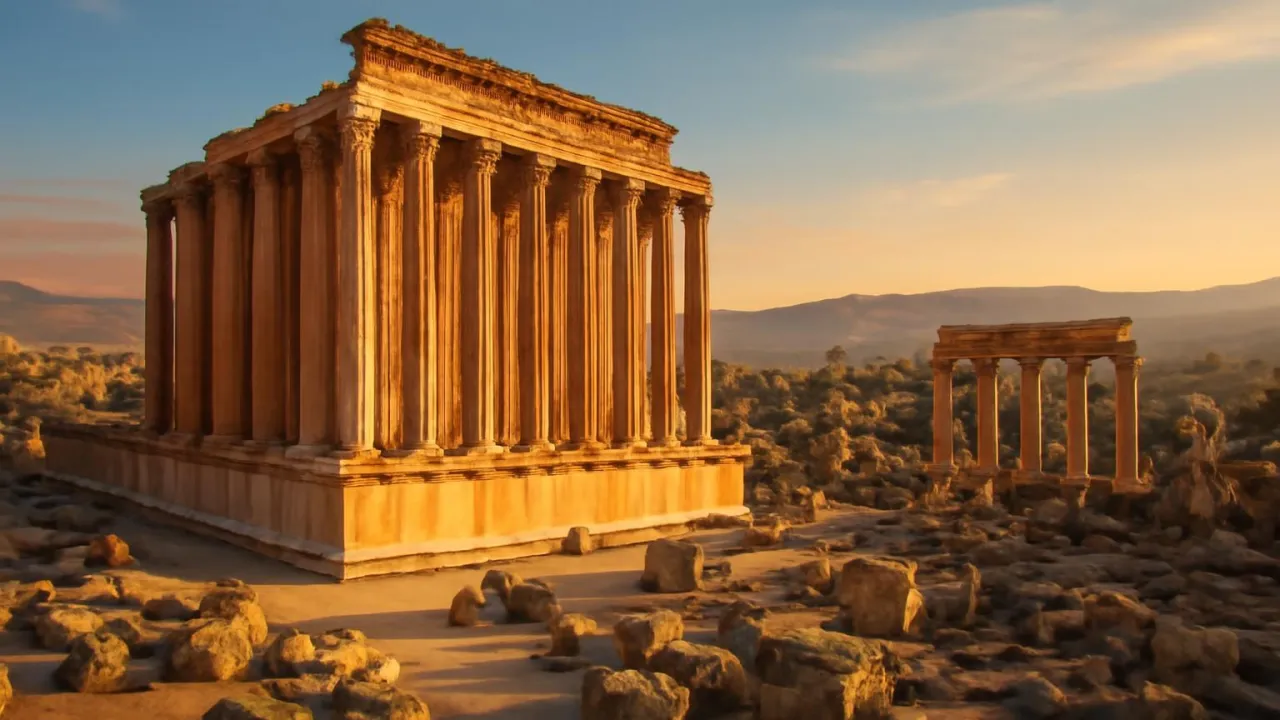
The columns at Baalbek are taller than a three-story building!
✨ Word Sparks (Grade 2 Glossary)
Tap 🔊 to hear
ruins
Broken parts of old buildings.
carvings
Pictures cut into stone or wood.
builders
People who make buildings.
🪝
Can you imagine building with blocks as big as trucks?
1
A Place of Giants
Baalbek has giant stones and tall columns that reach high. People walk between the and look up in wonder. The stones are so big, they look like they could touch the clouds.
2
Old Builders, Big Ideas
Long ago, used huge blocks to make these temples strong. They carved beautiful shapes and pictures into the stone walls. Visitors can see these even today.
3
Exploring the Temples
Visitors climb steps and explore the big open spaces. Birds fly over the and the sun shines on the old stones. Many people visit Baalbek to see its amazing history.
Some Baalbek stones are among the largest ever used in any building on Earth!
✨ Word Sparks (Grade 3 Glossary)
Tap 🔊 to hear
arch
A curved shape that holds up buildings.
vibration
A shaking or moving back and forth.
foundation
The strong base of a building.
🪝
What secrets do the tallest Roman columns in the world hold?
1
Welcome to Ancient Baalbek
When you enter Baalbek, you see giant stone columns rising high above you. The ruins are filled with carvings and that tell stories from long ago. Sunlight shines through the broken roofs, making patterns on the ground. People visit to imagine how the temples looked in Roman times.
2
Building with Super Stones
Roman builders used enormous limestone blocks, some weighing over 800 tons each. These blocks were stacked to create tall platforms and strong . The columns of the Temple of Jupiter are the tallest of any Roman temple in the world. Engineers today still wonder how such huge stones were moved and lifted.
3
Amazing Arches and Carvings
The temples have beautiful and detailed carvings showing gods, animals, and plants. These decorations were made by skilled artists using special tools. The arches help support the heavy stone roofs and keep the buildings standing. Visitors can see how ancient design and engineering worked together.
4
A Place for Festivals
Long ago, people gathered at Baalbek for music, feasts, and ceremonies. Today, the site hosts concerts and festivals that fill the air with music. The old stones vibrate with sound, just as they did in Roman times. Baalbek is a place where history and celebration meet.
The Trilithon stones at Baalbek each weigh more than a fully loaded jumbo jet!
✨ Word Sparks (Grade 4 Glossary)
Tap 🔊 to hear
Trilithon
Three giant stones in Baalbek’s base.
acoustics
How sound moves in a space.
UNESCO
A group that protects world treasures.
🪝
Imagine standing beneath columns taller than a giraffe’s stack of friends—how did they get there?
1
A Marvel of Roman Engineering
Baalbek’s temples are famous for their gigantic stone blocks and towering columns, which were built during the Roman Empire’s height. The Temple of Jupiter’s columns, each nearly 98 feet tall, are the tallest of any Roman temple ever constructed. Ancient engineers used ramps, rollers, and teams of workers to move and lift stones weighing hundreds of tons. Even today, experts debate exactly how the largest stones, called the , were transported and placed so precisely.
2
Artistry in Stone
The temples’ walls and arches are covered in intricate carvings of Roman gods, eagles, and grapevines, reflecting both religious and cultural life. Craftsmen used chisels and hammers to create detailed images that have lasted for nearly 2,000 years. The arches distribute the weight of the heavy stone roofs, making the buildings stable and strong. These artistic and structural features show how Roman builders combined beauty with science.
3
A Center for Gatherings
Baalbek was once a bustling center for Roman festivals, religious ceremonies, and trade. The site’s allowed music and voices to echo during grand celebrations. Today, Baalbek still hosts concerts and events, with sound vibrating through the ancient stone spaces. The ruins connect the past and present through music, art, and community.
4
A World Heritage Wonder
named Baalbek a World Heritage Site because of its outstanding architecture and history. The temples attract visitors and archaeologists from around the globe, who study their construction and meaning. Baalbek’s massive stones and columns inspire awe and curiosity about ancient technology. The site helps us understand how people long ago shaped the world with creativity and skill.
Baalbek’s largest stone, the Stone of the Pregnant Woman, weighs an estimated 1,000 tons—making it one of the heaviest stones ever quarried by humans.
✨ Word Sparks (Grade 5 Glossary)
Tap 🔊 to hear
megalithic
Made from extremely large stones.
Corinthian
A fancy style of column top with leaves.
resonance
When sound vibrates and echoes strongly.
🪝
What if you had to build a temple using stones heavier than a space shuttle?
1
Engineering the Impossible: Baalbek’s Colossal Stones
The Roman temples of Baalbek are renowned for their use of stones, some weighing more than 800 tons—far heavier than most modern construction equipment can handle. Ancient engineers likely used an ingenious system of earthen ramps, wooden rollers, and coordinated human labor to transport and position the Trilithon stones, each measuring over 64 feet long. The precision with which these stones were placed remains a subject of engineering debate, with some theories suggesting the use of levers and counterweights to fine-tune their alignment. The Temple of Jupiter’s podium stands as one of the most massive stone structures ever built in antiquity.
2
Architectural Grandeur and Symbolism
The Temple of Jupiter once boasted 54 towering columns, each rising nearly 98 feet and carved from single stone shafts. These columns not only supported the immense stone roof but also symbolized Roman power and the connection between earth and sky. The temples’ facades are adorned with intricate reliefs depicting gods, eagles, and mythological scenes, blending artistic mastery with religious meaning. The scale and detail of Baalbek’s architecture reflect the ambition of Roman imperial builders.
3
Acoustics and Ancient Gatherings
Baalbek’s temple courtyards and sanctuaries were designed to amplify sound, using the of stone to carry music and voices during ceremonies. The site’s acoustics allowed thousands of people to hear priests and musicians without modern amplification. Today, international music festivals take advantage of these natural acoustic properties, filling the ancient ruins with orchestral performances and echoing applause.
4
Historical Legacy and Archaeological Mystery
Construction at Baalbek began under Roman rule around 60 BCE, continuing for nearly two centuries as new temples and courtyards were added. The site was built atop earlier Phoenician and Hellenistic foundations, making it a layered record of ancient civilizations. Archaeologists study tool marks, quarry sites, and unfinished stones to uncover the techniques used by ancient builders. Despite centuries of earthquakes and invasions, Baalbek’s ruins remain remarkably well preserved.
5
A Global Heritage Site
Recognized as a UNESCO World Heritage Site, Baalbek attracts scholars, engineers, and tourists from around the world who marvel at its scale and artistry. The temples inspire research into ancient engineering, stone quarrying, and Roman religious practices. Baalbek’s enduring presence in Lebanon’s Beqaa Valley makes it a symbol of cultural resilience and human creativity. Its massive stones continue to spark questions about what people can achieve with teamwork, knowledge, and imagination.