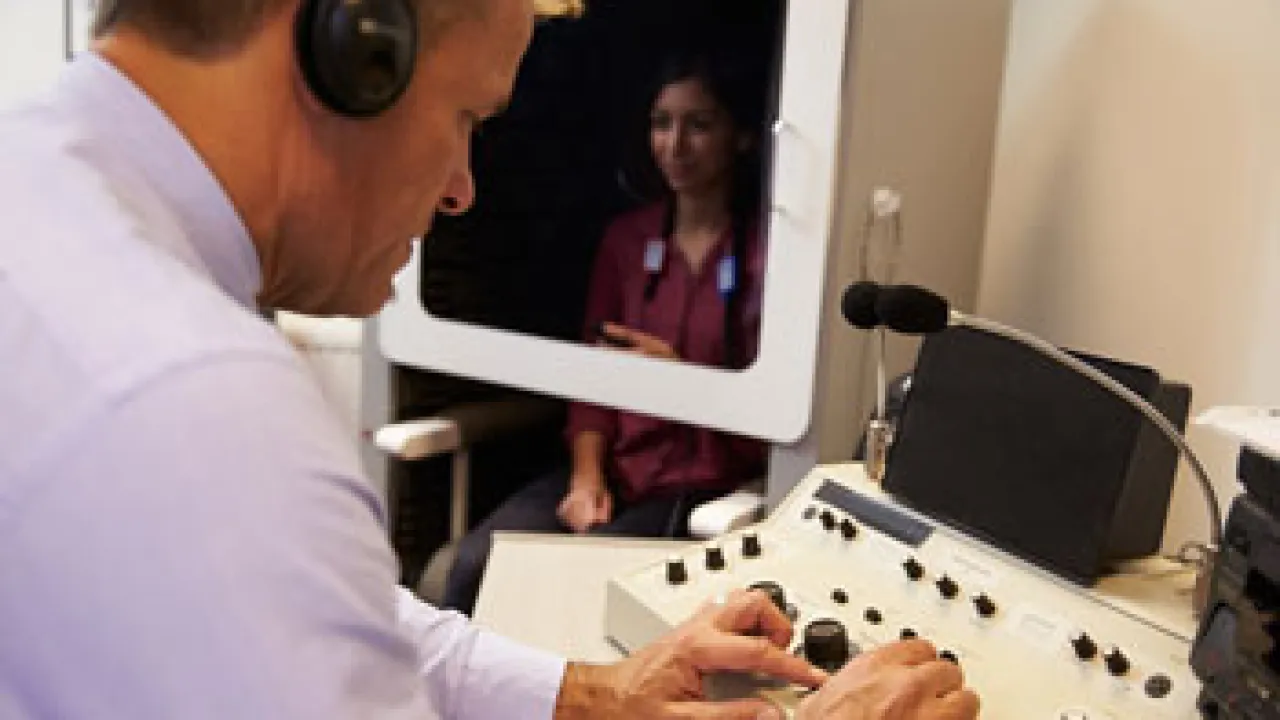
1. Why do you sit inside a special quiet booth during a visit with an audiologist?
2. Where are the three smallest bones in the entire human body located?
🤯 Mind-Blowing Fact • Grade 2
Healthy inner ears actually make their own microscopic 'echoes' when soft clicks play—allowing audiologists to screen a baby's hearing in minutes while the baby naps!
✨ Word Sparks (Grade 2 Glossary)
Tap 🔊 to hear
Otoscope
Lighted magnifying tool for viewing eardrums
Eardrum
Thin stretched skin vibrating when sound hits
Inner ear
Deep ear chamber handling hearing and balance
🪝
How can an audiologist check the hearing of a sleeping newborn baby who cannot raise a hand?
1
Peeking With an Otoscope
Click goes the gentle ear light! An audiologist begins by looking down the ear canal with a cone-tipped flashlight called an . That quick peek checks that the looks healthy and clear of wax.
2
Echoes From Tiny Sleeping Ears
Older kids play listening games in a sound booth, dropping blocks in a bucket each time a tone plays. For sleeping newborn babies, audiologists place a soft sponge tip in the ear that listens for tiny natural echoes bouncing right back from a healthy !
3
Balance Lives in Your Ears Too
Because fluid loops inside your also keep you from feeling dizzy, audiologists help dizzy patients regain steady balance.
1. What tool does an audiologist use to shine a gentle light and inspect the eardrum?
2. Besides hearing, what other important body skill is controlled inside the inner ear and tested by audiologists?
🤯 Mind-Blowing Fact • Grade 3
Unlike birds and frogs, humans cannot regrow damaged inner-ear hair cells—which is why audiologists teach everyone to keep headphone volumes safe!
✨ Word Sparks (Grade 3 Glossary)
Tap 🔊 to hear
Cochlea
Snail-shaped inner-ear organ turning sound electric
Decibel
Unit measuring how loud a sound is
Audiogram
Chart showing softest pitches each ear hears
🪝
How does a snail-shaped shell deep inside your skull turn air ripples into music in your brain?
1
Following the Journey of Sound
Clap your hands once and invisible waves ripple through the air! Those waves funnel into your outer ear, drum against your eardrum, and rock three tiny middle-ear bones—the hammer, anvil, and stirrup. Deep inside, fluid ripples through a snail-shaped tube called the , where microscopic hair cells spark signals to your brain.
2
Mapping an Audiogram
Inside a sound-treated booth, an audiologist tests pitches measured in hertz—from deep bass rumbles to high bird-like whistles—and loudness measured in . Plotting the softest sounds you hear creates a personalized hearing map called an .
3
Smart Hearing Aids and Cochlear Implants
Today's digital hearing aids contain tiny computers that quiet background restaurant clatter, lift clear speech, and even stream classroom microphones via Bluetooth! For profound hearing loss, audiologists program cochlear implants that send signals directly to the hearing nerve.
4
Protecting Ears From Loud Noise
Audiologists also craft custom earplugs for drummers, pilots, and construction workers so loud never harm delicate inner-ear hair cells.
1. What is the snail-shaped part of the inner ear filled with fluid and tiny hair cells?
2. Why do audiologists fit custom earplugs for concert musicians and airport crew?
🤯 Mind-Blowing Fact • Grade 4
Composer Ludwig van Beethoven famously pressed a wooden rod between his piano and his jawbone so bone vibrations let him 'hear' music even after losing air-conduction hearing!
✨ Word Sparks (Grade 4 Glossary)
Tap 🔊 to hear
Bone conduction
Sound vibrations traveling directly through skull bones
Tympanometer
Gentle air probe checking eardrum movement
Cochlear implant
Electronic device stimulating the hearing nerve directly
🪝
Why can tapping a vibrating fork gently behind your ear let you hear a tone even if your ear canal is blocked?
1
Air Conduction Versus Bone Conduction
Hum a tune while plugging both ears with your fingers—notice how your voice suddenly booms louder inside your head! Sound reaches your inner ear by two routes: air conduction through the ear canal and middle-ear bones, and straight through the skull. Clinical audiologists test both pathways to pinpoint whether hearing difficulty stems from temporary fluid behind a child's eardrum (conductive loss) or changes in inner-ear hair cells and nerves (sensorineural loss).
2
Pressure Checks With Tympanometry
Have your ears ever popped riding up Shenandoah mountain roads or descending in an airplane? A tiny passage called the Eustachian tube equalizes air pressure behind your eardrum. Using a gentle air-pressure probe called a , audiologists measure how freely the eardrum flexes, helping pediatricians spot middle-ear fluid without a single pinch.
3
Classroom Acoustics and Assistive Listening
In bustling classrooms where chairs scrape and heaters hum, educational audiologists set up remote microphone systems. A teacher wears a small clip-on transmitter that beams clear speech straight into a student's hearing aids or processors, cutting across room echo.
4
Doctoral Training in Sound and Vestibular Care
Modern audiologists earn a four-year Doctor of Audiology (Au.D.) degree after college, mastering acoustics, neuroanatomy, electronics, and compassionate family counseling.
1. Why does an audiologist compare air-conduction headphones with a bone-conduction vibrator behind the ear?
2. How does a teacher's remote clip-on microphone help a student with hearing aids in a noisy classroom?
🤯 Mind-Blowing Fact • Grade 5
Because decibels climb on a logarithmic scale, an 85-decibel lawnmower is safe for about eight hours, whereas a 100-decibel personal music player can stress delicate ear cells in just fifteen minutes!
✨ Word Sparks (Grade 5 Glossary)
Tap 🔊 to hear
Tonotopic
Organized neatly by pitch from high to low
Stapes
Stirrup-shaped tiniest bone inside middle ear
Logarithmic
Scale multiplying by ten with each step
🪝
How do audiologists program twenty-two microscopic electrodes inside a snail-sized cochlea to recreate the full spectrum of human speech?
1
Tonotopic Mapping and Impedance Matching
When airborne sound waves strike fluid directly, ninety-nine percent of their acoustic energy bounces off! The human middle ear solves this physics mismatch: the broad tympanic membrane concentrates force onto the tiny footplate via the malleus and incus lever chain, boosting pressure roughly twenty-five-fold so cochlear fluid moves. Inside the coiled cochlea, approximately 15,000 inner and outer hair cells sit arranged like a piano keyboard—high frequencies near the stiff base and bass frequencies at the flexible apex.
2
Objective Electrophysiology: OAE and ABR
Doctors of Audiology (Au.D.) diagnose auditory function without requiring a patient's behavioral response when evaluating infants. Otoacoustic Emissions (OAE) microphones detect faint acoustic echoes generated by healthy outer hair-cell motility, while Auditory Brainstem Response (ABR) surface electrodes record microvolt neural waves traveling from the eighth cranial nerve to the brainstem within ten milliseconds of a click.
3
Real-Ear Verification and Cochlear Implant Mapping
Because every ear canal resonates differently, audiologists slide a hair-thin probe microphone near the eardrum during hearing-aid fitting to verify amplification against acoustic targets across 250 to 8,000 hertz. Following surgical placement of a cochlear implant, the audiologist 'maps' electrical pulse thresholds across an array of up to twenty-two intracochlear electrodes, mimicking natural pitch zones.
4
Logarithmic Decibels and Vestibular Diagnostics
Because the decibel scale is , every ten-decibel rise multiplies sound energy tenfold—meaning 100-decibel concert speakers pack a hundred times the acoustic energy of 80-decibel city traffic! In balance labs, audiologists also track involuntary eye movements via videonystagmography to pinpoint displaced inner-ear crystals causing vertigo.
5
Lifelong Brain Health and Auditory Access
From universal newborn hearing screenings in hospital nurseries and classroom acoustics engineering to preserving auditory-cortex engagement and balance stability in older adults, audiologists unite wave physics, neurobiology, and compassionate clinical care across every stage of life.