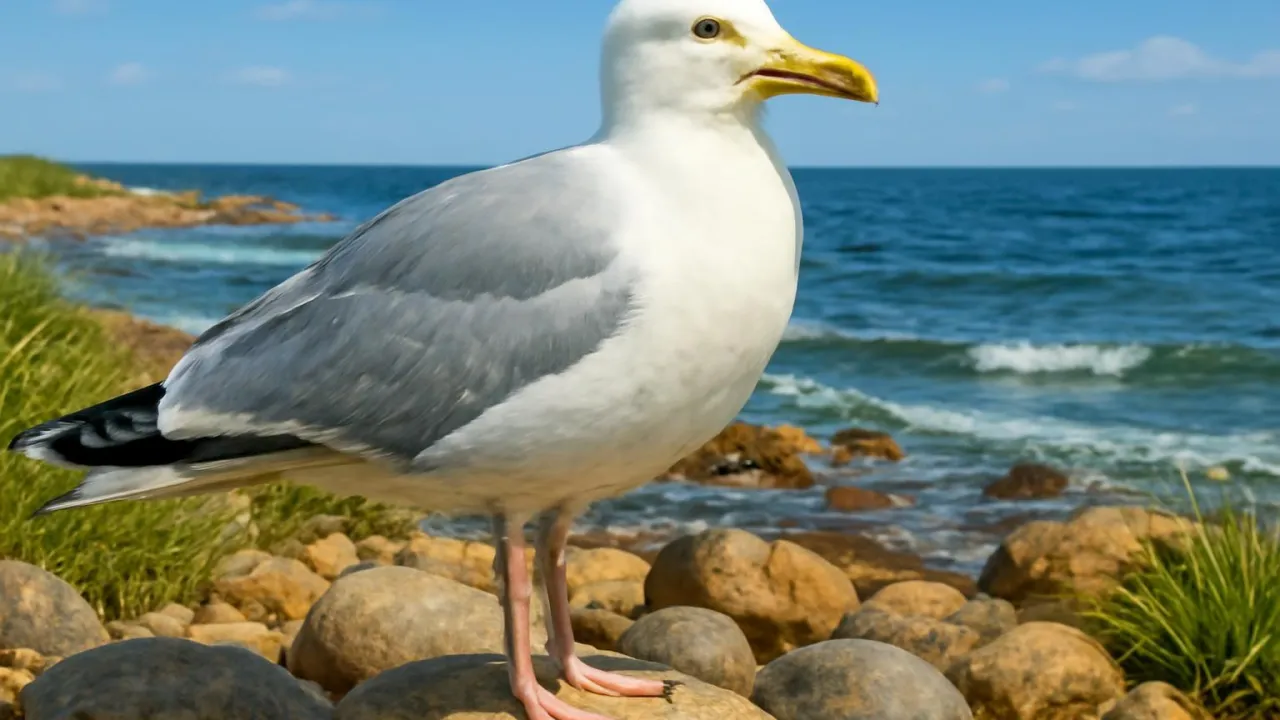
Atlantic Herring Gulls can live up to 30 years in the wild!
✨ Word Sparks (Grade 2 Glossary)
Tap 🔊 to hear
nest
A home birds build for their eggs and babies.
feathers
Soft coverings that keep birds warm and help them fly.
scavenger
An animal that finds and eats leftover food.
🪝
Have you ever watched a seagull catch food by the ocean?
1
Seagull’s Home
Atlantic Herring Gulls live near oceans and beaches where they find food easily. They build on cliffs or flat ground near water. These places keep their eggs safe from many animals. They often stay close to human areas to find scraps.
2
Growing Up
Baby gulls hatch from eggs after about a month of warmth. They are covered with soft gray at first. The parents feed them fish and small insects. The young gulls learn to fly and hunt by watching adults.
3
Special Features
These gulls have sharp eyesight that helps them spot food from high in the sky. Their strong yellow beaks can catch slippery fish easily. Their gray and white help them blend into the sky and sea. They use loud calls to talk to each other.
Atlantic Herring Gulls sometimes drop shellfish from heights to crack them open!
✨ Word Sparks (Grade 3 Glossary)
Tap 🔊 to hear
camouflage
Colors or patterns that help hide animals from others.
predator
An animal that hunts other animals for food.
scavenger
An animal that eats leftover or dead food.
🪝
How does the Atlantic Herring Gull survive near busy beaches and oceans?
1
Habitat and Range
Atlantic Herring Gulls live along North Atlantic coasts from North America to Europe. They prefer beaches, rocky shores, and harbors where food is plentiful. Their habitat provides safety from and easy access to fish and scraps. This wide range helps them adapt to many environments.
2
Physical Adaptations
These gulls have gray and white feathers that provide against the sky and ocean. Their strong yellow beaks are perfect for catching fish and cracking open shells. Their webbed feet help them swim and walk on slippery rocks. Sharp eyesight allows them to spot prey from great heights.
3
Feeding and Behavior
Atlantic Herring Gulls are and that eat fish, insects, and human leftovers. They use their beaks to snatch food from water or land quickly. Sometimes, they drop hard-shelled prey from heights to crack them open. Their loud calls warn others of danger or signal food nearby.
4
Life Cycle and Survival
Gulls build nests in colonies to protect eggs from through safety in numbers. Chicks hatch covered in down feathers and grow strong quickly. Parents teach young gulls to fly and find food by example. This learning helps them survive in changing coastal environments.
1. Why do Atlantic Herring Gulls have gray and white feathers?
2. How do gulls crack open hard-shelled food?
🤯 Mind-Blowing Fact • Grade 4
Atlantic Herring Gulls help keep beaches clean by eating leftover human food and waste.
✨ Word Sparks (Grade 4 Glossary)
Tap 🔊 to hear
ecosystem
A community of living things and their environment.
migration
Seasonal movement of animals to new places.
colony
A group of animals living closely together.
🪝
What role do Atlantic Herring Gulls play in coastal ecosystems and human areas?
1
Ecosystem and Distribution
Atlantic Herring Gulls inhabit coastal areas across the North Atlantic, including North America and Europe, where they thrive in diverse habitats such as beaches, harbors, and rocky shores. Their presence affects food webs by controlling populations of fish and insects, and by scavenging leftover human food, they help reduce waste. Seasonal allow them to exploit different food sources and climates, ensuring survival year-round.
2
Adaptations and Survival Strategies
These gulls have developed sharp eyesight and strong beaks to catch fish and crack open shellfish, which helps them secure food efficiently. Their gray and white plumage provides camouflage against predators and harsh weather conditions. They often nest in large colonies, which offers protection through collective vigilance against predators. Their ability to scavenge human food allows them to thrive near cities and ports.
3
Interactions with Humans
Atlantic Herring Gulls frequently interact with humans by scavenging food waste in coastal towns and cities, sometimes causing conflicts due to noisy behavior and stealing food. However, they also play a beneficial role by cleaning up organic waste and controlling pest populations. Conservation efforts focus on maintaining healthy coastal habitats to support gull populations and reduce human-wildlife conflicts.
4
Life Cycle and Reproduction
Gulls build nests on cliffs or flat ground in colonies to protect eggs and chicks from predators through group defense. The chicks hatch with down feathers and quickly learn survival skills by observing parents. Both parents share feeding duties and teach young how to find food and avoid dangers. This cooperative behavior improves chick survival in challenging coastal environments.
1. How do Atlantic Herring Gulls help coastal ecosystems?
2. Why do gulls nest in colonies?
🤯 Mind-Blowing Fact • Grade 5
Atlantic Herring Gulls can fly up to 40 miles per hour and live for 30 years in the wild!
✨ Word Sparks (Grade 5 Glossary)
Tap 🔊 to hear
binocular vision
Using both eyes to see depth and distance clearly.
thermoregulation
How animals keep their body temperature steady.
opportunistic feeder
An animal that eats many types of food available.
🪝
What makes the Atlantic Herring Gull a successful survivor in coastal and urban environments?
1
Taxonomy and Scientific Context
The Atlantic Herring Gull, scientifically named Larus argentatus, belongs to the Laridae family within the order Charadriiformes. This species is closely related to other large gulls found across the Northern Hemisphere. Their evolutionary adaptations have allowed them to exploit both marine and terrestrial food sources efficiently, contributing to their widespread distribution along North Atlantic coasts.
2
Physiological Mechanics and Adaptations
Atlantic Herring Gulls possess keen that enables them to detect prey from heights exceeding 100 meters. Their robust, slightly hooked yellow beaks are designed to grasp slippery fish and crack open mollusk shells by dropping them onto rocks. Webbed feet provide excellent swimming ability and stability on uneven surfaces. Their plumage, a combination of white and gray feathers, aids and camouflage against the sky and sea.
3
Conservation and Human Impact
While Atlantic Herring Gulls are currently classified as Least Concern by conservation organizations, their populations face threats from habitat loss, pollution, and human disturbance. Urbanization has led to increased gull-human interactions, sometimes resulting in conflicts over food scavenging. Conservation efforts emphasize habitat protection and public education to balance gull populations with human coastal activities.
4
Ecological Role and Behavior
As , Atlantic Herring Gulls play a vital role in coastal food webs by controlling fish and invertebrate populations and recycling organic waste. Their scavenging behavior helps reduce beach litter and limits disease spread. Seasonal migration patterns allow them to exploit various ecological niches, contributing to their resilience in fluctuating environmental conditions.
5
Quantitative Comparisons and Interesting Metrics
Adult Atlantic Herring Gulls measure between 61 and 66 centimeters in length, with wingspans ranging from 1.3 to 1.5 meters. They can fly at speeds up to 40 miles per hour (64 kilometers per hour) during foraging flights. Lifespans can reach 30 years in the wild, and their ability to consume a wide variety of food items, from fish to human refuse, demonstrates remarkable dietary flexibility essential for survival in diverse habitats.