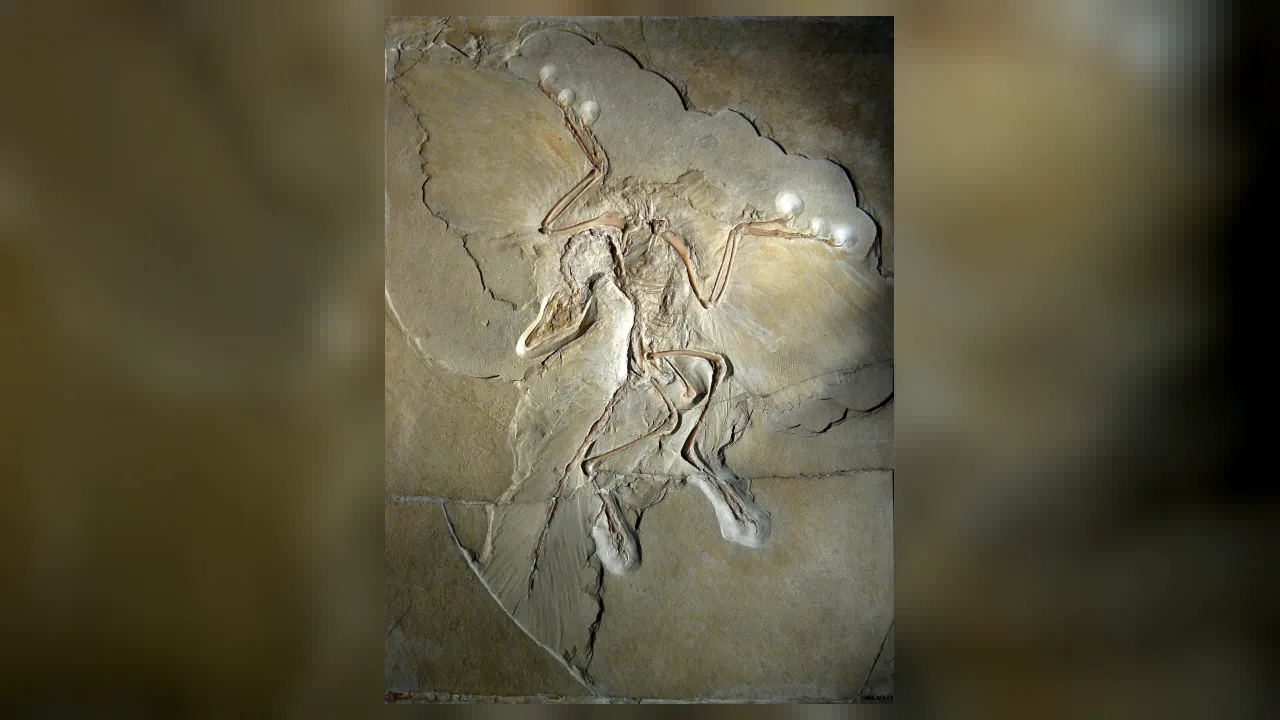
⚡ Survival SuperpowerBird flight wings combined with sharp dinosaur teeth, claws, and bony tail
🤯 Mind-Blowing Fact • Grade 1
Quarry workers in Germany found the very first Archaeopteryx feather pressed into smooth limestone way back in 1861!
✨ Word Sparks (Grade 1 Glossary)
Tap 🔊 to hear
flutter
To flap wings quickly in short bursts
ancient
From a very long time ago
feather
Light outer growth forming a bird's wings
🪝
Is it a dinosaur or a bird? Meet the famous fossil that is BOTH!
1
Flap Over Blue Lagoons!
Flap, glide! Across a sunny island lagoon a raven-sized creature. Look closely! Archaeopteryx had wide, feathered bird wings, yet its mouth held tiny sharp dinosaur teeth!
2
Claws on Its Wings
Each feathered wing still had three bendy fingers tipped with curved claws! Behind it trailed a long, bony dinosaur tail.
3
Ancient Wing
Its name means wing. Fine creamy stone in Germany saved every single line!
1. Which dinosaur traits did feathered Archaeopteryx still keep?
2. What does the name Archaeopteryx mean?
🤯 Mind-Blowing Fact • Grade 2
Before scientists noticed the faint feather impressions on one Archaeopteryx slab, a museum had accidentally labeled the skeleton as a small scaly Compsognathus dinosaur!
✨ Word Sparks (Grade 2 Glossary)
Tap 🔊 to hear
wishbone
Forked collar bone bracing a bird's shoulders in flight
impression
A detailed outline pressed into soft mud before hardening
shrubby
Dotted with low bushes rather than giant trees
🪝
Why is a crow-sized fossil from Germany called one of the greatest discoveries in science?
1
Halfway to Modern Birds
Imagine splitting open a smooth slab of cream-colored limestone in Germany in 1861 and gasping in amazement! Pressed into the rock lay a 150-million-year-old skeleton with clear wing and tail feathers. Scientists named it Archaeopteryx, and it became the most famous fossil link between reptiles and birds!
2
Mix-and-Match Body Plan
Like living birds, Archaeopteryx had a and stiff flight feathers. Yet unlike modern birds with toothless beaks and short tail stumps, it had jaws lined with cone-shaped teeth, three clawed fingers on each wing, and twenty tail bones!
3
Island Hopper
Living on dry, islands surrounded by warm shallow lagoons, Archaeopteryx flapped in short bursts to catch beetles, dragonflies, and small lizards.
1. What happened when a museum missed the faint feather outlines on one Archaeopteryx fossil?
2. What kind of Late Jurassic home did Archaeopteryx live in?
🤯 Mind-Blowing Fact • Grade 3
Only about thirteen skeletal specimens of Archaeopteryx have ever been found, and the famous 'Berlin Specimen' from 1874 is considered one of Earth's greatest natural treasures!
✨ Word Sparks (Grade 3 Glossary)
Tap 🔊 to hear
transitional fossil
Fossil preserving traits between an ancestor group and descendants
melanin
Dark natural pigment that colors and strengthens feathers
gastralia
Slender ribs protecting a dinosaur's belly wall
🪝
Did Archaeopteryx merely glide down from cliffs, or could it flap its wings into the sky?
1
Timing That Changed Science
Warm tropical breezes ripple across the turquoise Solnhofen lagoons of Late Jurassic Germany 150 million years ago. Skimming low over low-growing conifers with quick wingbeats is Archaeopteryx lithographica, weighing scarcely two pounds. When German stonecutters unearthed its fossils in 1861—just two years after Charles Darwin published his book on evolution—scientists marveled at a true in stone.
2
Dinosaur Bones Inside Bird Feathers
Biologist Thomas Henry Huxley noticed right away that Archaeopteryx's skeleton looked astonishingly like a miniature theropod dinosaur. It retained fifty small sharp teeth, separate clawed wing fingers for scrambling through branches, belly ribs called , and a long frond-shaped tail feathered down both sides.
3
Proof of Active Flapping
For years, scientists debated whether Archaeopteryx only glided. Then in 2018, X-ray synchrotron scans of its wing bones revealed thin-walled, twist-resistant arm tubes remarkably like modern pheasants and roadrunners—birds that launch into crisp, short-burst flapping flight!
4
Black Wingtips for Strength
Pigment studies also found black reinforcing its wingtips against wear and tear.
1. What did 2018 X-ray scans of Archaeopteryx wing bones prove about how it moved?
2. How did black melanin pigment help Archaeopteryx's wingtip feathers?
🤯 Mind-Blowing Fact • Grade 4
Because Solnhofen islands had no tall trees—only bushes under ten feet high—Archaeopteryx likely launched straight from the ground or low shrubs rather than gliding down from giant redwoods!
✨ Word Sparks (Grade 4 Glossary)
Tap 🔊 to hear
mosaic evolution
Some body traits evolving rapidly while others stay ancestral
furcula
Fused collarbones forming the springy wishbone of birds
sternum
Central chest breastbone where flight muscles attach
🪝
How could Archaeopteryx fly actively in the Late Jurassic without the big breastbone keel of modern birds?
1
Miracle of Lithographic Stone
Picture an archipelago of arid limestone islands dotting a shallow tropical sea across Tithonian-stage Bavaria 150 million years ago. Beneath surface waves, hypersaline, oxygen-poor lagoon bottoms lacked scavenging crabs or worms. Whenever an Archaeopteryx lithographica perished over water and sank into ultra-fine lime mud—the same silky stone later quarried for lithographic printing plates—every delicate barb of its flight plumage fossilized in exquisite detail.
2
Mosaic Evolution in Action
Archaeopteryx exemplifies , where different body parts evolve at different rates. Its asymmetric primary feathers, boomerang-shaped (wishbone), and bird-like braincase with enlarged visual centers pointed toward modern Aves. Simultaneously, it lacked a keeled to anchor deep flight muscles, couldn't raise its arms vertically via a modern pulley-like supracoracoideus tendon, and retained unfused metacarpals with three mobile claws and a twenty-vertebrae bony tail.
3
Butterfly-Stroke Flapping Mechanics
In 2018, Dennis Voeten and colleagues used European Synchrotron X-ray microtomography to examine bone cross-sections of three Archaeopteryx specimens. Thin, torsion-resistant humeral and ulnar walls closely matched burst-flying pheasants, suggesting forward-and-downward 'butterfly-like' wing strokes powered by shoulder deltoid and pectoral muscles.
4
Island Ecological Niche
Flapping across open scrubland and between lagoon islands, Archaeopteryx escaped small compsognathid predators while hunting insects and lizards.
1. Why did Solnhofen lagoon bottoms preserve Archaeopteryx feathers with microscopic precision?
2. What botanical clue from Solnhofen supports ground-up burst flapping rather than high-tree gliding for Archaeopteryx?
🤯 Mind-Blowing Fact • Grade 5
Ultraviolet and laser-fluorescence scans of the Thermopolis Archaeopteryx specimen revealed its second toe carried a hyperextensible sickle claw just like Velociraptor, rather than a backward-grasping perching toe!
✨ Word Sparks (Grade 5 Glossary)
Tap 🔊 to hear
pygostyle
Short plow-shaped bone formed from fused tail vertebrae in modern birds
eumelanin
Dark black-brown pigment that colors and mechanically strengthens feathers
apomorphy
A newly evolved trait setting a descendant group apart
🪝
Why does Archaeopteryx lithographica remain evolutionary biology's touchstone 165 years after its discovery?
1
Darwin's Timely Confirmation
In 1861—just two years after Charles Darwin published On the Origin of Species predicting transitional forms linking major vertebrate classes—quarrymen splitting Tithonian lithographic limestone (~150 MYA) near Solnhofen, Bavaria, uncovered a single asymmetric feather followed weeks later by the headless 'London Specimen.' Recognizing its revolutionary blend of avian plumage and reptilian osteology, Hermann von Meyer coined Archaeopteryx lithographica, while Thomas Henry Huxley championed its startling kinship with small theropod dinosaurs.
2
Avian Innovations Meets Theropod Heritage
Across thirteen skeletal specimens—highlighted by the celebrated 1874 Berlin Specimen and the 2005 Thermopolis Specimen—Archaeopteryx displays textbook mosaic evolution. Avian apomorphies include aerodynamically asymmetric remiges, a robust boomerang-shaped furcula, and an expanded endocranium with enlarged optic lobes and inner-ear balance organs. Conversely, plesiomorphic non-avian maniraptoran traits persist throughout: premaxillary and maxillary teeth lacking a keratinous beak, three unfused clawed manual digits, gastralia, a non-keeled sternum, and a long bony tail lacking a fused .
3
Synchrotron Bone Geometry and Flight Stroke
Lacking a modern triosseal canal to power steep dorsal wing recovery, Archaeopteryx puzzled biomechanists for decades. In 2018, phase-contrast synchrotron microtomography by Dennis Voeten and colleagues revealed thin-walled, high-polar-moment humeral and ulnar cross-sections statistically clustering with burst-flapping phasianids (pheasants and quail), indicating active flapping driven by deltoid-pectoral strokes.
4
Melanosome Toughening and Molting Strategy
Scanning electron and X-ray chemical analyses by Ryan Carney and Thomas Kaye demonstrated matte-black distal wing feather tips enriched in —thickening keratin barbules by up to thirty-nine percent against mechanical abrasion across Solnhofen's arid, shrub-covered carbonate archipelago.
5
Icon of the Dinosaur-Bird Continuum
Joined today by Jurassic Chinese paravians like Anchiornis, Archaeopteryx anchors Avialae and confirms that living birds are literally surviving feathered theropod dinosaurs.