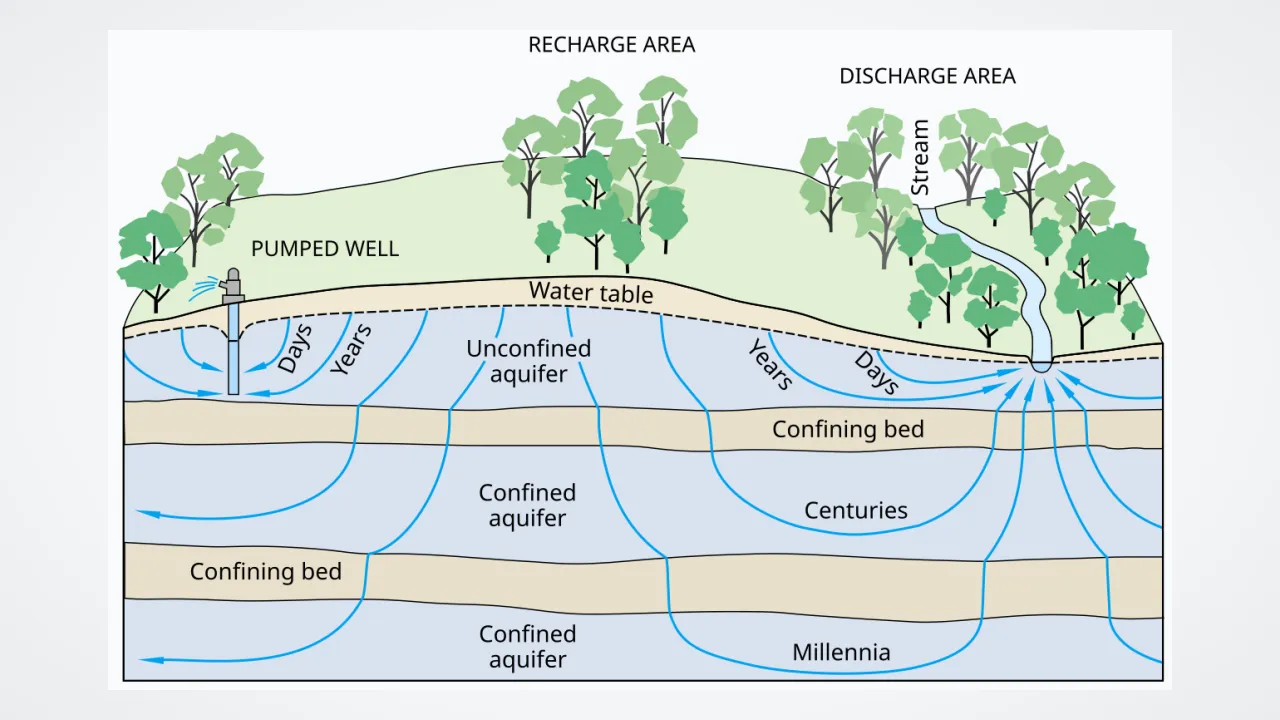
1. How do aquifers hold groundwater deep underground?
2. How do farms and towns bring groundwater up to the surface?
🤯 Mind-Blowing Fact • Grade 2
Natural sand and gravel layers act like giant water filters, trapping dirt and germs as rainwater trickles slowly downward!
✨ Word Sparks (Grade 2 Glossary)
Tap 🔊 to hear
Water Table
Top boundary line of soaked underground rock
Spring
Spot where groundwater bubbles naturally onto land
Sandstone
Gritty rock with tiny spaces that hold water
🪝
Do underground aquifers look like dark lakes, or more like wet sponges made of stone?
1
Surprise—Not Underground Lakes!
Pour a cup of water into a jar filled with pebbles and sand! Even when the jar looks full of stones, water slips into every tiny gap. Most aquifers work the exact same way—storing groundwater inside tiny rock spaces rather than open caves.
2
Meeting the Water Table
As rain trickles downward, it finally hits a level where every single gap in the rock is soaked full. The top edge of that soaked zone is called the !
3
Bubbling Springs and Wells
Sand and let water flow through easily, while tight clay blocks it below. Wherever the meets a hillside, cool groundwater bubbles out naturally as a sparkling !
1. What do scientists call the top level where every tiny underground space is completely filled with water?
2. What happens when an underground water table intersects the side of a hill?
🤯 Mind-Blowing Fact • Grade 3
While river water races miles in an hour, deep groundwater often creeps through sandstone pores at just a few inches or feet per year!
✨ Word Sparks (Grade 3 Glossary)
Tap 🔊 to hear
Porosity
Amount of tiny open space inside rock
Permeability
How easily water flows through connected rock spaces
Recharge
Refilling an aquifer with soaking rain or snowmelt
🪝
Why does water rush easily through gravel and sandstone, yet get stuck at a layer of solid clay?
1
Two Secret Superpowers of Rock
Drop a spoonful of water onto a brick of sandstone, and watch the wet spot soak right in! To build a great aquifer, underground rock or sediment needs two special traits: and .
2
Porosity vs. Permeability
measures how much empty pore space hides inside a material to hold water. measures how well those tiny pores connect so water can actually flow through! Gravel, sand, sandstone, and cracked limestone are permeable champions, whereas dense clay or uncracked granite traps water like a waterproof floor.
3
Zones Above and Below
Near the surface, soil pores hold both air and trickling water in the unsaturated zone. Below the water table sits the saturated zone, where groundwater fills every pore and creeps slowly toward streams and lakes.
4
Recharging Our Aquifers
Rain and melting snow refilling an aquifer is called . If wells pump water out faster than rain recharges it, the water table drops deeper underground!
1. What is the difference between porosity and permeability in an aquifer?
2. What happens to the water table when wells pump groundwater faster than rain can recharge it?
🤯 Mind-Blowing Fact • Grade 4
If all the water inside America's Ogallala Aquifer were spread evenly across all fifty U.S. states, it would cover the entire country more than one foot deep!
✨ Word Sparks (Grade 4 Glossary)
Tap 🔊 to hear
Confined Aquifer
Pressurized water layer trapped between tight clay layers
Artesian Well
Well where natural pressure pushes groundwater upward
Karst
Limestone landscape with caves, springs, and sinkholes
🪝
How can an artesian well shoot cool freshwater up to the surface without any electric pump at all?
1
Unconfined vs. Confined Aquifers
Travel from Virginia's Shenandoah Valley eastward to the Atlantic Coastal Plain, and the aquifers beneath your feet change dramatically! An unconfined aquifer sits right below permeable soil, so local rain recharges its water table directly. A , however, is sandwiched between two impermeable layers of tight clay or shale—called aquitards—that trap groundwater under natural pressure from higher ground miles away.
2
Self-Flowing Artesian Wells
Drill a well down through the upper clay seal into a pressurized , and water rises up the pipe all by itself! Named after the historic region of Artois in France, these flow without pumps whenever the aquifer's recharge hills sit higher than the wellhead.
3
America's Giant Ogallala Aquifer
Stretching beneath eight Great Plains states from South Dakota to Texas, the massive High Plains (Ogallala) Aquifer holds ancient Ice Age meltwater inside gravel and sand eroded from the Rocky Mountains. It irrigates nearly one-third of all irrigated U.S. farmland!
4
Protecting Groundwater From Pollution
In Virginia's Valley and Ridge limestone country, rainwater races into underground caverns through sinkholes with very little sand filtration. Keeping fertilizers, motor oil, and litter off the land protects shared drinking-water aquifers for everyone.
1. Why does water rise on its own inside an artesian well?
2. Why are limestone karst aquifers—like those in western Virginia—extra vulnerable to surface pollution?
🤯 Mind-Blowing Fact • Grade 5
Using gravity-measuring GRACE satellites orbiting 300 miles up in space, NASA scientists can detect tiny shifts in Earth's gravitational pull to measure when giant underground aquifers lose or gain water!
✨ Word Sparks (Grade 5 Glossary)
Tap 🔊 to hear
Baseflow
Steady groundwater seeping into streams between rainstorms
Cone of Depression
Funnel-shaped drop in water table around a well
Saltwater Intrusion
Seawater creeping inland into overpumped coastal aquifers
🪝
Why did pumping too much groundwater cause parts of California's Central Valley to sink nearly thirty feet—and why does groundwater keep rivers flowing during droughts?
1
Darcy's Law and Subsurface Residence Time
Hold a glass of clear well water from Virginia's Potomac Aquifer along the Coastal Plain, and you may be sipping rain that fell when woolly mammoths roamed North America! Hydrogeologists calculate groundwater movement using Darcy's Law, formulated by French engineer Henry Darcy in 1856, which shows flow rate depends on hydraulic gradient (pressure slope) multiplied by hydraulic conductivity (permeability). While river water completes its journey to the sea in days, deep confined groundwater can have a residence time spanning decades to tens of thousands of years.
2
Baseflow: How Aquifers Keep Rivers Alive
Ever wonder why creeks keep running weeks after the last rainstorm? Surface water and groundwater form one connected system! Whenever a valley's water table sits higher than a stream channel, groundwater seeps steadily through the streambed as —supplying more than half of annual streamflow in humid watersheds like the Chesapeake Bay basin.
3
Cones of Depression and Land Subsidence
Heavy pumping around a high-capacity well draws the surrounding water table downward into a funnel-shaped . Even worse, when overdraft drains pressurized water from fine-grained clay and silt layers inside an aquifer system, water pressure no longer props open microscopic sediment grains. The aquifer skeleton collapses permanently, causing land subsidence—sinking parts of California's San Joaquin Valley by nearly nine meters (twenty-nine feet) during the twentieth century!
4
Saltwater Intrusion Along Coastlines
In coastal cities from Norfolk, Virginia, to Miami, Florida, lighter freshwater aquifers meet denser salty seawater underground. Overpumping lowers freshwater pressure, allowing to creep inland and spoil municipal wells.
5
Managed Aquifer Recharge for the Future
To safeguard groundwater supplies and halt coastal sinking, hydrogeologists now practice Managed Aquifer Recharge—injecting purified stormwater or treated recycled water back into depleted sandstone aquifers like Virginia's SWIFT initiative, banking billions of gallons underground for future generations.