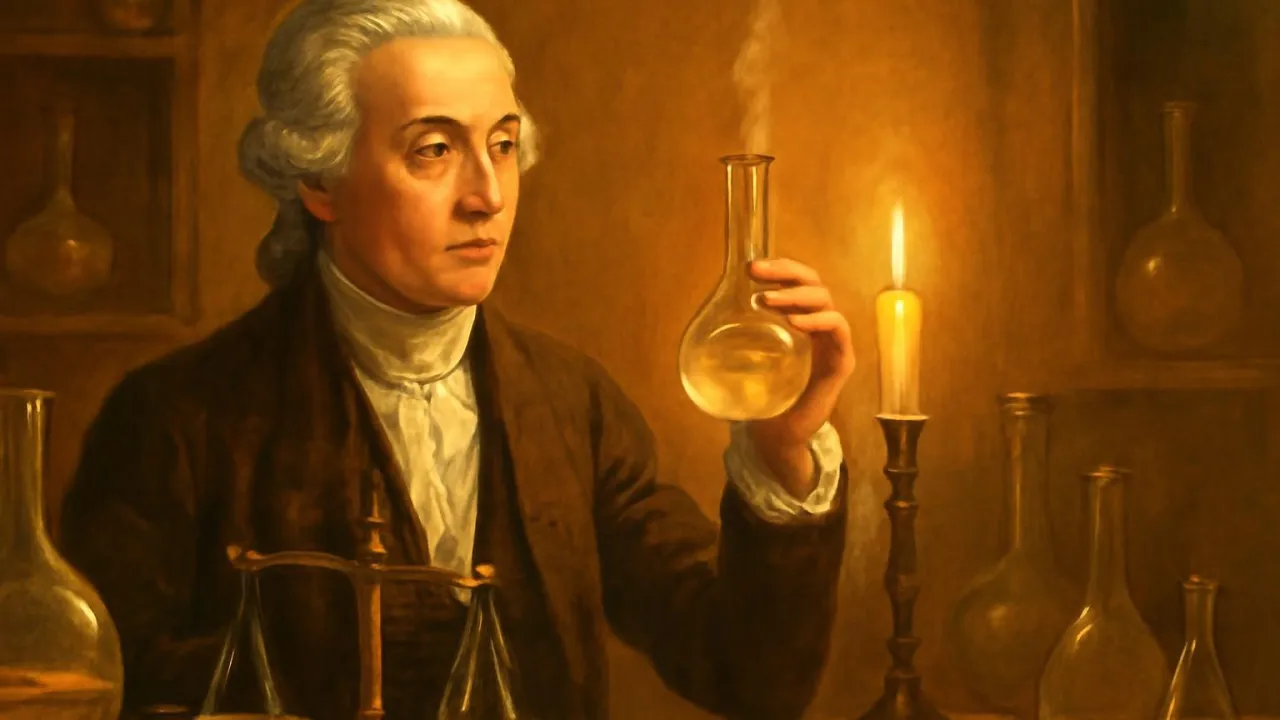
Lavoisier’s law says matter cannot be created or destroyed!
✨ Word Sparks (Grade 3 Glossary)
Tap 🔊 to hear
conservation
Keeping something from being lost
hydrogen
A light gas found in water
method
A careful way to do something
🪝
Imagine watching a candle burn and asking, 'Where does the wax go?'
1
A Curious Mind
As a boy, Antoine Lavoisier was fascinated by how things changed. He loved to observe burning candles and bubbling potions in glass jars. He always wondered what made things burn or disappear. His curiosity led him to ask questions few others dared to ask.
2
Careful Experiments
Lavoisier used precise scales and glassware to measure every part of his experiments. He believed that nothing could be lost or made from nothing. By weighing things before and after burning, he noticed that air played a big role. This careful work helped him find new answers.
3
Discovering Oxygen
Through his experiments, Lavoisier discovered that a part of air, called oxygen, was needed for fire. He also showed that water is made from and oxygen gases. These discoveries changed how scientists understood chemistry. His findings proved that old ideas about burning were wrong.
4
Changing Science Forever
Lavoisier wrote clear rules for experiments so others could repeat them. He helped create a new way to name chemicals, making science easier to share. His ideas about matter and shaped modern chemistry. Today, scientists still use his in labs around the world.
Lavoisier’s experiments helped end the idea of 'phlogiston,' a made-up burning substance.
✨ Word Sparks (Grade 4 Glossary)
Tap 🔊 to hear
phlogiston
An old, wrong idea about burning
balance
A tool to measure weight carefully
chemical
A substance used in science experiments
🪝
What if you could prove that nothing in the world ever truly disappears?
1
A World Full of Questions
In 18th-century France, Antoine Lavoisier grew up surrounded by new ideas and scientific wonder. He was fascinated by the mysteries of air, fire, and water, and he loved to ask questions that no one else thought to ask. Lavoisier spent hours observing how things changed when they burned or mixed together. His curiosity set him on a path to become a groundbreaking scientist.
2
Precision in the Laboratory
Lavoisier believed that science needed careful measurement and clear records, so he used the most advanced and glassware of his time. He weighed substances before and after burning them, noticing that the total weight stayed the same, even when things seemed to vanish. This led him to develop the Law of Conservation of Mass, which states that matter cannot be created or destroyed. His experiments showed that air is not just empty space, but is made of different gases.
3
Revolutionizing Chemistry
Through his experiments, Lavoisier discovered that oxygen is essential for burning and for life itself. He named both oxygen and hydrogen, and he was the first to show that water is made from these two gases. Lavoisier also helped invent a new naming system, making it easier for scientists everywhere to talk about their discoveries. His work replaced old, incorrect ideas about how things burned.
4
A Legacy That Lasts
Lavoisier’s careful methods and clear thinking changed science forever, earning him the title 'Father of Modern Chemistry.' He encouraged scientists to share their results and repeat each other's experiments, which is still important today. His discoveries helped future chemists unlock even more secrets of matter. Thanks to Lavoisier, we understand that nothing truly disappears—it just changes form.
Lavoisier’s careful notes and experiments helped inspire the entire scientific method used today.
✨ Word Sparks (Grade 5 Glossary)
Tap 🔊 to hear
nomenclature
A system for naming things in science
combustion
The process of burning something
Enlightenment
A time of new ideas in Europe
🪝
What if a single experiment could rewrite everything people believed about fire, air, and matter itself?
1
A Young Mind in a Changing World
In the bustling city of Paris during the Age of , Antoine Lavoisier was a curious child who loved observing the world around him. Fascinated by natural phenomena, he spent hours watching candles burn and wondering what truly happened to the wax and smoke. His early education was filled with science and mathematics, and he was inspired by the new ideas sweeping through Europe. Lavoisier’s drive to understand the hidden rules of nature led him to study chemistry, a field that was full of mysteries and old beliefs.
2
Transforming Chemistry with Precision
Lavoisier believed that true science required careful measurement and repeatable experiments, so he equipped his laboratory with the finest balances, glassware, and notebooks available. He meticulously weighed substances before and after chemical reactions, noticing that their combined mass always remained constant. This observation led him to formulate the Law of Conservation of Mass, which states that matter is neither created nor destroyed in chemical changes. His approach brought a new level of rigor and accuracy to chemistry, setting standards that scientists still follow today.
3
Discovering the Secrets of Air and Water
Through a series of groundbreaking experiments, Lavoisier demonstrated that air is not a single element but a mixture of gases, including oxygen and nitrogen. He showed that oxygen is essential for and respiration, overturning the old 'phlogiston' theory that had dominated science for centuries. Collaborating with other scientists, he also proved that water is not a basic element but a compound made from hydrogen and oxygen. By naming these gases and explaining their roles, Lavoisier helped create the foundations of modern chemical science.
4
Building a New Language for Science
Recognizing the confusion caused by inconsistent chemical names, Lavoisier worked with colleagues to create a systematic naming system for elements and compounds. This new chemical made it possible for scientists around the world to communicate their discoveries clearly and accurately. Lavoisier’s textbooks and scientific papers became models of clarity, inspiring generations of chemists to adopt precise methods and language. His insistence on sharing results and repeating experiments helped establish the scientific method as we know it.
5
A Legacy That Lives On
Antoine Lavoisier’s discoveries and methods revolutionized chemistry, earning him the title 'Father of Modern Chemistry.' His Law of Conservation of Mass remains a fundamental principle in science classrooms and laboratories everywhere. Lavoisier’s work ended centuries of confusion about burning, air, and water, and his influence can be seen in every modern chemistry book. Although his life ended during the French Revolution, his ideas continue to inspire scientists to question, measure, and discover. The next time you see a candle burn, remember that Lavoisier’s experiments helped unlock the secrets behind that simple flame.