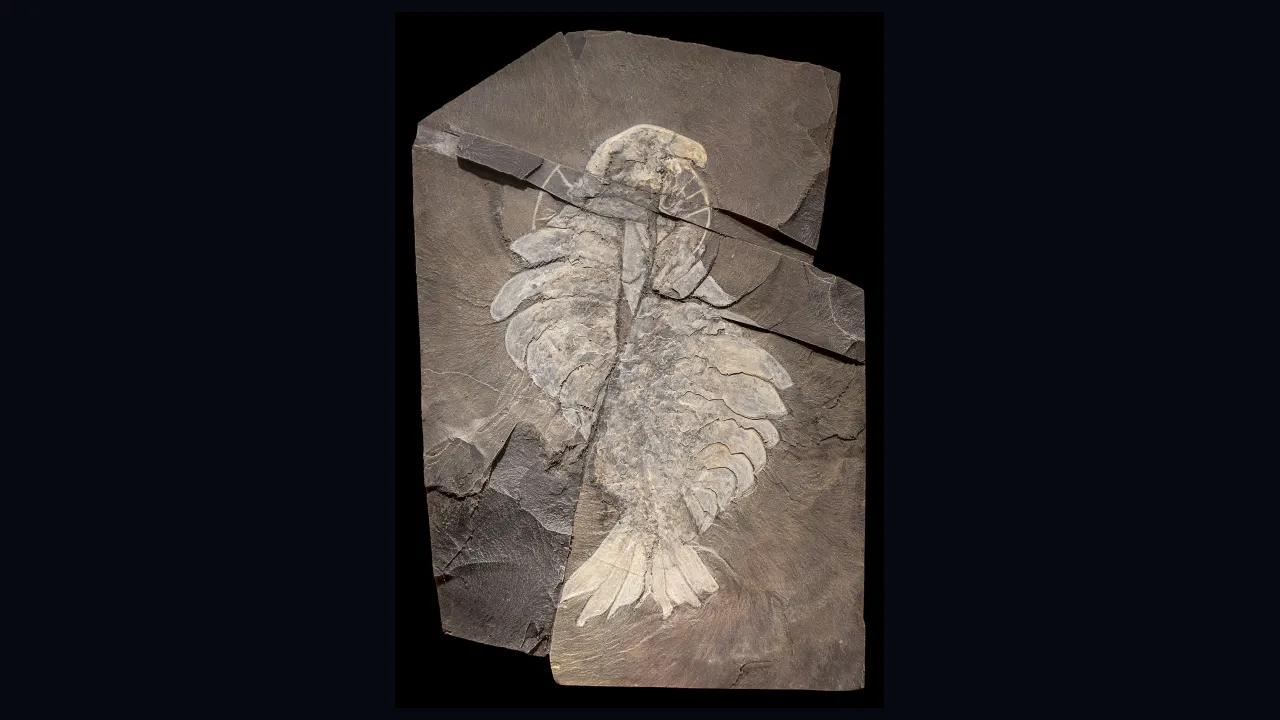
1. What shape was the mouth underneath Anomalocaris's head?
2. How did Anomalocaris swim smoothly above the ancient seafloor?
🤯 Mind-Blowing Fact • Grade 2
Because the name Anomalocaris ('odd shrimp') was published first in 1892, rules of science kept that name for the whole two-foot animal!
✨ Word Sparks (Grade 2 Glossary)
Tap 🔊 to hear
Cambrian
Ancient time when complex sea animals blossomed
compound eye
Eye built from thousands of tiny lenses
stalks
Slender stems holding eyes up high
🪝
How did three 'completely different' fossils turn out to be pieces of one single animal?
1
A 500-Million-Year-Old Mix-Up!
Imagine finding three weird fossil parts in Canadian mountain rocks! Scientists thought a spiky curly arm was a headless shrimp and named it Anomalocaris ('odd shrimp'). They thought a round ring was a squished jellyfish, and the body was a spongy sea cucumber!
2
Solving the Puzzle Together
Nearly a century later in the 1980s, paleontologist Harry Whittington chipped away thin rock layers on a complete fossil from the Burgess Shale. Surprise! The 'shrimp' arms and 'jellyfish' mouth were attached right to the same swimming body!
3
Super Sight in Cambrian Seas
Two perched on movable scanned sunlit reefs while flexible side flaps propelled Earth's earliest top predator.
1. What did early scientists think Anomalocaris's round mouth fossil was?
2. Where in Canada were complete fossils of Anomalocaris discovered?
🤯 Mind-Blowing Fact • Grade 3
Computer crash-tests in 2023 proved Anomalocaris's mouth and arms were built for grabbing squishy swimming prey in open water—not cracking rock-hard trilobites on the muddy bottom!
✨ Word Sparks (Grade 3 Glossary)
Tap 🔊 to hear
arthropods
Animals with jointed legs like crabs and insects
hexagonal
Shaped with six neat equal sides
oral cone
Ring of plates forming a circular mouth
🪝
Did Earth's first apex predator crunch armored trilobites—or hunt softer, faster swimmers instead?
1
Giant of the Cambrian Explosion
Travel back 508 million years to the Cambrian Explosion, when oceans suddenly burst with eyes, legs, shells, and claws! No fish with jaws swam yet, so a distant relative of named Anomalocaris canadensis ruled the reef. At nearly two feet long, it towered over thumb-sized neighbors like a whale among minnows!
2
Sixteen Thousand Lenses Per Eye
Fossils discovered on Kangaroo Island, Australia, preserved Anomalocaris's stalked compound eyes in exquisite 3D detail. Each pear-shaped eye held more than 16,000 lenses—outclassing houseflies and rivaling modern dragonflies—so it spotted prey darting through sunlit water.
3
Rethinking What It Ate!
Scientists long blamed Anomalocaris for bite scars found on hard trilobite shells. In 2023, engineering computer models tested its delicate spiny arms and soft —and discovered crunching hard mineral shells would snap its spikes! Instead, Anomalocaris swooped through open water snatching soft-bodied squid-like swimmers and worms.
4
Built Like an Underwater Fighter Jet
Thirteen pairs of overlapping side flaps rippled in smooth S-waves while a broad three-part tail fan steered bank turns.
1. Which living insect has super-sharp compound eyes comparable to Anomalocaris?
2. Why did 2023 computer tests clear Anomalocaris of crunching hard trilobite shells?
🤯 Mind-Blowing Fact • Grade 4
Before scientists united its body parts in 1985, museum dioramas accidentally displayed Anomalocaris's mouth floating past its own headless body as a jellyfish!
✨ Word Sparks (Grade 4 Glossary)
Tap 🔊 to hear
Radiodonta
Extinct early arthropod cousins with ring-shaped mouths
arms race
Predators and prey evolving sharper tricks together
nekton
Animals that swim actively through open water
🪝
How did Anomalocaris spark an evolutionary arms race that shaped modern animal life?
1
Igniting an Evolutionary Arms Race
Half a billion years ago, peaceful microbial mats vanished as Earth's first active, visual predators took to the water column! Leading that revolution was Anomalocaris canadensis, centerpiece of the extinct group ('radiating teeth') near the evolutionary trunk of Arthropoda. By combining high-speed swimming, stereoscopic compound eyes, and raptorial appendages, radiodonts pressured smaller creatures to evolve hard shells, spines, camouflage, and burrowing habits!
2
Solving the Burgess Shale Chimera
When Joseph Frederick Whiteaves named a jointed claw Anomalocaris in 1892 and Charles Doolittle Walcott later described isolated circular mouths as Peytoia jellyfish and trunks as Laggania sea cucumbers, nobody suspected they belonged together. Careful micro-excavation by Harry Whittington and Derek Briggs in 1985 united all parts—revealing a streamlined predator propelled by thirteen pairs of flexible lateral swimming flaps and a wide V-shaped tail fan!
3
Biomechanics of Flexible Flaps and Raptorial Arms
Fluid-dynamics models and robotic swimmers confirm that passing a traveling wave down overlapping side flaps generated effortless hover stability and rapid forward thrust. Up front, fourteen-segmented frontal appendages bristling with forked ventral spines uncurled and snapped inward like jackknives.
4
2023 Finite-Element Diet Breakthrough
Using 3D finite-element stress analysis in 2023, researcher Russell Bicknell demonstrated that Anomalocaris's slender appendage spines experienced dangerous strain against calcified trilobite exoskeletons, whereas its triradial (three-axis) oral cone couldn't close tightly enough to crush armor—recasting Anomalocaris as a swift pelagic hunter of soft !
1. How did predators like Anomalocaris accelerate the Cambrian Explosion?
2. How many major large plates formed the main symmetry of Anomalocaris canadensis's oral cone?
🤯 Mind-Blowing Fact • Grade 5
Fossils prove Anomalocaris evolved 16,700-lens compound eyes millions of years before arthropods ever evolved hard jointed walking legs—meaning super-vision came before armor!
✨ Word Sparks (Grade 5 Glossary)
Tap 🔊 to hear
Lagerstätte
Fossil site preserving extraordinary soft body tissues
ommatidial
Individual optical units inside a compound eye
metachronal
Coordinated wave motion passing down a row
🪝
What do 515-million-year-old compound eye lenses and 3D biomechanical models reveal about stem-arthropod evolution?
1
Stem-Arthropod Architecture in the Burgess Shale
Preserved as silvery aluminosilicate and carbonaceous compressions inside British Columbia's 508-million-year-old Burgess Shale (and older Emu Bay and Chengjiang Lagerstätten), Anomalocaris canadensis stands as an evolutionary Rosetta Stone. Positioned within Radiodonta along the lower stem lineage of Euarthropoda, it illuminates how segmented lobopod-like ancestors evolved sclerotized jointed appendages prior to full body arthrodization.
2
Historical Taxonomic Reconstruction
Described from detached raptorial appendages found on Mount Stephen in 1892 by Joseph Whiteaves, Anomalocaris remained an anatomical jigsaw for ninety-three years while isolated oral cones ('Peytoia') and bodies ('Laggania') occupied separate phyla! Harry Whittington and Derek Briggs's landmark 1985 dissection of complete Burgess specimens united the radiodont body plan—later refined further in the 2010s when paleontologists distinguished true Anomalocaris (bearing a triradial oral cone and prominent three-vane tail fan) from blunt-headed cousin Peytoia.
3
Compound Optics from Emu Bay Shale
Spectacular phosphatized fossils recovered in 2011 from South Australia's 515-million-year-old Emu Bay Shale preserved three-centimeter stalked eyes studded with at least 16,700 lenses apiece! This discovery proved acute compound vision evolved BEFORE hardened jointed legs or exoskeletons in arthropod history.
4
Hydrodynamics and Finite-Element Feeding Mechanics
Computational fluid dynamics shows waves rippling along thirteen pairs of flexible lateral flaps maximized thrust efficiency while broad dorsal caudal vanes enabled tight banking maneuvers. Meanwhile, 2023 finite-element analysis (FEA) and kinematic range-of-motion modeling by Russell Bicknell and colleagues overturned decades of durophagy assumptions: delicate, elongated endites on its fourteen-podomere appendages risked structural failure against mineralized trilobite cuticles, confirming Anomalocaris hunted agile, soft-bodied pelagic prey in well-lit waters.
5
Radiodont Diversity Beyond Predation
Far from one single blueprint, Anomalocaris's radiodont relatives radiated into benthic sediment-sifters like Hurdia and even two-meter Ordovician suspension-feeders like Aegirocassis—mirroring modern whales and whale sharks half a billion years ahead of schedule!