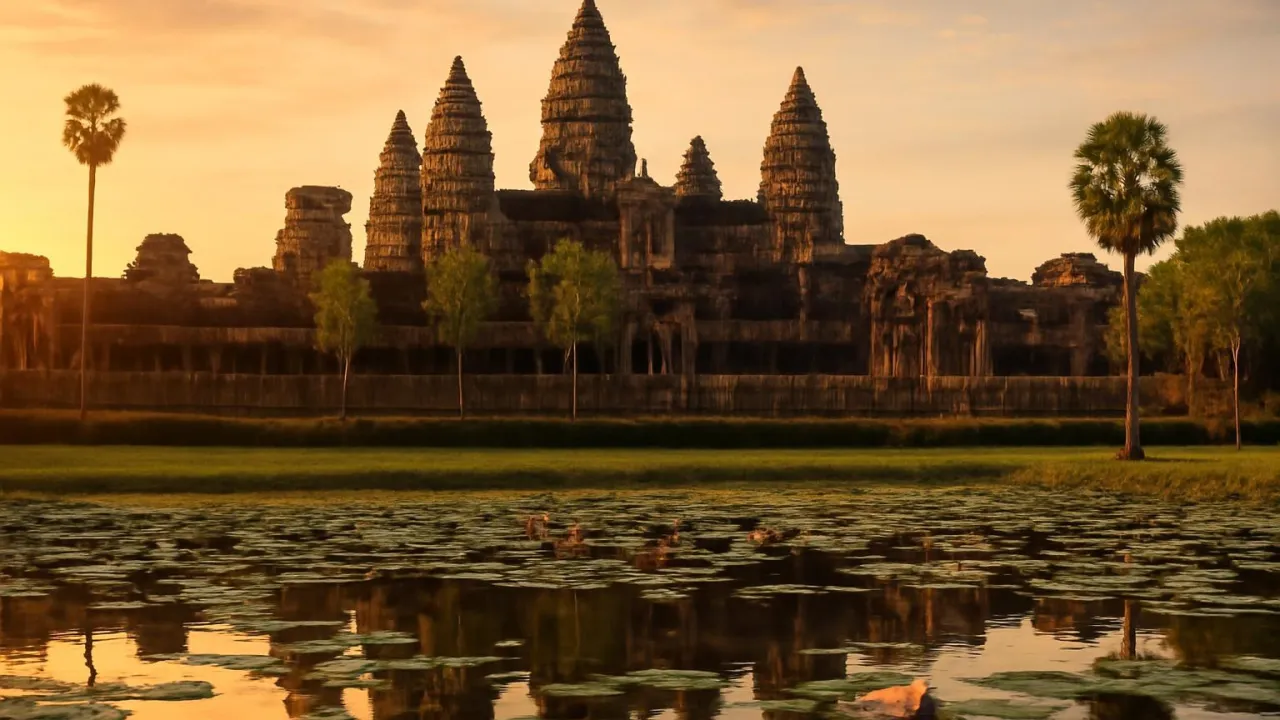
Angkor Wat’s tallest tower is as high as a 20-story building!
✨ Word Sparks (Grade 2 Glossary)
Tap 🔊 to hear
moat
A water-filled ditch around a building
carvings
Pictures or shapes cut into stone
ancient
Very, very old
🪝
Can you imagine walking through a giant stone temple at sunrise?
1
A Temple in the Jungle
Angkor Wat sits in the green jungle of Cambodia. Its stone towers glow gold when the sun rises. People come from all over the world to see it. Monkeys sometimes play near the old walls.
2
Walls Full of Stories
The temple walls are covered with stone . These carvings show stories of kings and gods. Visitors love to look for hidden animals in the pictures. The carvings are hundreds of years old and still clear.
3
Moats and Bridges
A wide surrounds Angkor Wat like a blue ribbon. People cross a long stone bridge to get inside. The moat helps protect the temple from floods. Lotus flowers and fish live in the calm water.
Angkor Wat’s moat is over 600 feet wide—wider than a football field!
✨ Word Sparks (Grade 3 Glossary)
Tap 🔊 to hear
bas-relief
A carving that sticks out a little
symmetry
When both sides look the same
erosion
Wearing away by water or wind
🪝
What secrets could be hidden in a stone temple bigger than a city park?
1
A Wonder in Cambodia
Angkor Wat rises from the jungle, its five towers shaped like blooming lotus flowers. When the sun rises, the whole temple glows with golden light. It was built nearly 900 years ago by the Khmer Empire. Today, it is the world’s largest religious monument.
2
Stone Stories and Ancient Kings
The walls are covered with carvings called . These carvings tell stories of Hindu gods, epic battles, and royal parades. Each picture was carefully chiseled into sandstone by skilled artists. Some carvings even show dancers called apsaras with swirling skirts.
3
Moats, Bridges, and Engineering
A wide moat surrounds Angkor Wat, protecting it from and floods. Visitors cross a causeway, a special stone bridge, to reach the inner temple. The builders used sandstone blocks, fitting them together without mortar. The temple’s design uses , making each side a mirror image.
4
A Place for People and Nature
Monks in orange robes still pray at Angkor Wat today. Birds, butterflies, and monkeys live among the stones and trees. Tourists from around the world come to explore its halls and towers. The temple is both a sacred place and a home for wildlife.
Angkor Wat’s main tower stands 213 feet tall—taller than a 20-story building!
✨ Word Sparks (Grade 4 Glossary)
Tap 🔊 to hear
bas-relief
A raised picture carved into stone
quarry
A place where stone is cut out
symmetry
When both sides are exactly alike
🪝
What would you discover if you explored the world’s largest stone temple at sunrise?
1
The Temple That Touches the Sky
As dawn breaks, Angkor Wat’s central towers glow gold above the Cambodian jungle, reflecting in the moat’s still water. Built in the early 1100s by King Suryavarman II, it was originally a Hindu temple dedicated to Vishnu. The temple complex covers over 400 acres, making it the largest religious monument ever constructed. Its five towers are designed to look like lotus buds, a symbol of purity and creation.
2
Engineering Marvels of the Khmer Empire
Angkor Wat’s builders used sandstone blocks weighing up to 3,300 pounds each, transported from quarries over 25 miles away. The temple’s walls are covered with intricate , some stretching for hundreds of feet, depicting Hindu myths and Khmer history. Ingenious engineering, such as the wide moat and elevated walkways, protects the temple from erosion and flooding during Cambodia’s rainy season. The entire structure is perfectly symmetrical, with each side mirroring the other along a central axis.
3
A Living Monument
Over the centuries, Angkor Wat transformed from a Hindu sanctuary to a Buddhist temple, and monks still worship there today. The site is alive with wildlife: monkeys, birds, butterflies, and even lizards thrive among the ancient stones. Tourists from every continent visit to marvel at its size, beauty, and mysterious carvings. Angkor Wat is a source of pride for Cambodia and appears on the country’s national flag.
4
Global Importance and Preservation
Recognized as a UNESCO World Heritage site, Angkor Wat is protected for future generations to study and enjoy. Archaeologists and engineers work together to repair damage from weather and plant roots. The temple inspires artists, writers, and architects around the world with its harmony and grandeur. Its stories and secrets continue to spark curiosity and wonder in everyone who visits.
1. Why did builders make Angkor Wat so symmetrical?
2. How do people help protect Angkor Wat today?
🤯 Mind-Blowing Fact • Grade 5
Angkor Wat’s moat holds over 52 million gallons of water—enough to fill 80 Olympic swimming pools!
✨ Word Sparks (Grade 5 Glossary)
Tap 🔊 to hear
iconography
The use of special symbols in art
monsoon
A season with heavy rainstorms
restoration
Fixing and caring for old buildings
🪝
How did ancient engineers design Angkor Wat to last for centuries and inspire the world?
1
A Monumental Sunrise in Stone
Imagine standing before Angkor Wat as the first rays of sunlight ignite its sandstone towers, casting golden reflections across the vast moat. Commissioned by King Suryavarman II in the early 12th century, Angkor Wat was constructed as a grand Hindu temple honoring Vishnu, later becoming a Buddhist sanctuary. The temple complex spans an astonishing 402 acres, making it the largest religious monument in existence. Its five central towers, shaped like lotus buds, symbolize Mount Meru, believed in Hindu and Buddhist traditions to be the center of the universe. Every year, millions of visitors witness the breathtaking sunrise, a tradition that connects the ancient past with the present.
2
Architectural Genius and Advanced Engineering
The builders of Angkor Wat used over five million sandstone blocks, some weighing up to 3,300 pounds, transported from quarries located more than 25 miles away. Ingeniously, they constructed a massive moat—650 feet wide and nearly four miles long—to protect the temple from flooding and erosion during Cambodia’s intense seasons. The temple’s design is a masterpiece of symmetry, with each side mirroring the others along a precise east-west axis, aligning perfectly with the equinox sunrise. Notably, the entire structure was assembled without mortar, relying on the precise cutting and placement of stones to create enduring strength.
3
Artistry in Stone: Bas-Reliefs and Symbolism
Angkor Wat’s walls are adorned with over half a mile of intricate bas-reliefs, depicting legendary Hindu epics like the Ramayana and Mahabharata, as well as historical events from the Khmer Empire. These carvings feature thousands of figures, including gods, warriors, and celestial dancers called apsaras, each rendered with remarkable detail and expression. The temple’s layout and are filled with astronomical and spiritual symbolism, reflecting the Khmer people’s deep understanding of cosmology and religious philosophy. Even the number of towers and steps has symbolic meaning linked to ancient beliefs about the universe.
4
A Living Heritage and Global Inspiration
Over the centuries, Angkor Wat shifted from a Hindu temple to a Buddhist monastery, and today, saffron-robed monks continue to worship within its halls. The site is a sanctuary for wildlife, hosting monkeys, birds, butterflies, and lizards among its stones and trees. Angkor Wat is not only a symbol of Cambodia, appearing on its national flag, but also a UNESCO World Heritage site recognized for its cultural, historical, and architectural significance. Its grandeur inspires architects, artists, and travelers worldwide, serving as a reminder of human creativity and resilience.
5
Preservation, Challenges, and the Future
Modern archaeologists and engineers face ongoing challenges in preserving Angkor Wat from threats such as erosion, plant roots, and tourism-related wear. efforts use both traditional techniques and advanced technology, including 3D scanning and digital mapping, to document and repair the monument’s intricate details. International cooperation ensures that future generations can study and appreciate this ancient wonder. Angkor Wat’s enduring presence continues to spark curiosity, inviting us to explore the mysteries of history, engineering, and art. Its legacy teaches the importance of protecting our world’s shared heritage for centuries to come.