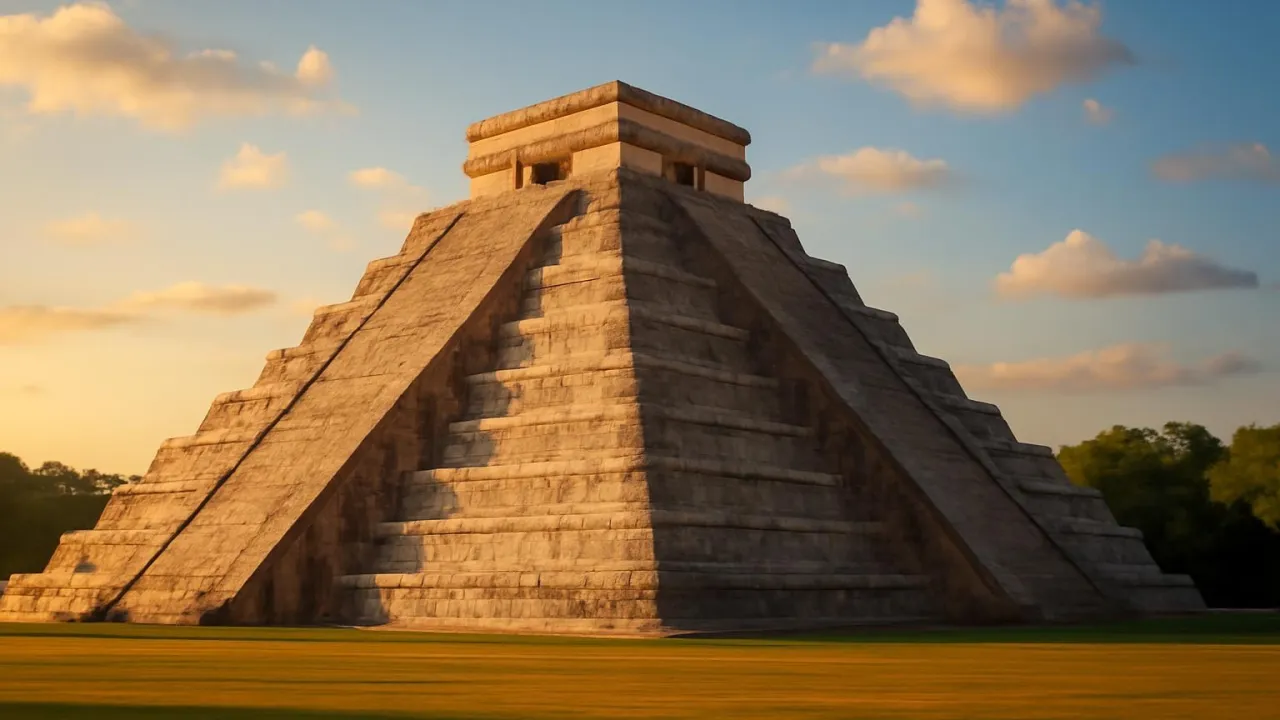
Chichen Itza’s pyramid has 365 steps, one for each day of the year!
✨ Word Sparks (Grade 2 Glossary)
Tap 🔊 to hear
Maya
People who lived in Mexico long ago
clap
To hit your hands together
view
What you see from a place
🪝
What if a pyramid could sing like a bird?
1
A Pyramid in the Jungle
Chichen Itza stands tall in the green Yucatán jungle. Its stone steps go up and up, reaching high into the sky. People climb the steps to see the .
2
Echoes Like a Bird
If you your hands near the pyramid, you hear a special echo. The sound bounces off the steps and makes a chirp, like the quetzal bird. This bird was very important to the people.
3
A Place to Explore
Visitors come from all over the world to see Chichen Itza. They take photos and wonder how the built such a big place. The pyramid’s secrets make it exciting to explore.
During the spring and fall equinox, the pyramid’s shadow looks like a snake slithering down the steps!
✨ Word Sparks (Grade 3 Glossary)
Tap 🔊 to hear
acoustic
How sound moves and echoes
limestone
A kind of white rock
monument
A special building from long ago
🪝
What secrets do the pyramid’s echoing steps hold?
1
A City of Stone Wonders
Chichen Itza was once a busy Maya city filled with stone buildings and temples. The most famous building is El Castillo, a giant pyramid with four staircases. Each staircase has 91 steps, and the top platform makes 365 steps in all.
2
Echoes of the Quetzal
If you clap your hands at the base of El Castillo, the sound bounces up the steps. This vibration creates an echo that sounds like the call of the quetzal, a sacred bird. Scientists believe the Maya designed the pyramid to make this special effect.
3
How the Pyramid Stands
The pyramid is built from massive blocks stacked in layers. Its square base and steep sides help it stay strong through rain and sun. The Maya used careful planning and tools to make sure each stone fit perfectly.
4
A Place for People and Stories
Today, people visit Chichen Itza to learn about Maya history and culture. They see carvings of warriors, jaguars, and feathered serpents on the stones. The pyramid’s echo and ancient stories make it a world-famous .
1. What happens during the equinox at Chichen Itza?
2. Why did the Maya use limestone?
🤯 Mind-Blowing Fact • Grade 4
The pyramid’s steps and terraces were built to align with the sun during the equinoxes, creating a shadow serpent.
✨ Word Sparks (Grade 4 Glossary)
Tap 🔊 to hear
erosion
Wearing away by wind or rain
astronomy
The study of stars and planets
ritual
A special ceremony or tradition
🪝
If you could travel back in time, what mysteries would you discover at Chichen Itza?
1
A Marvel of Maya Engineering
Chichen Itza rose as a powerful Maya city between 600 and 1200 CE, featuring impressive stone structures and temples. El Castillo, the main pyramid, was built with 365 steps to track the solar year, showing the Maya’s deep understanding of . The pyramid’s four sides and staircases reflect the Maya calendar and their respect for the sun.
2
The Pyramid’s Acoustic Magic
When visitors clap at the pyramid’s base, the sound vibrates up the stone steps, creating an echo that mimics the quetzal bird’s call. This unique acoustic effect is believed to be intentional, demonstrating Maya expertise in sound and design. The quetzal was a sacred bird, and its echo may have been used in or ceremonies.
3
Building with Strength and Precision
The Maya constructed El Castillo using massive limestone blocks, carefully cut and stacked to form steep, stable sides. Its square base and layered terraces help distribute weight and resist from rain and wind. The pyramid’s design has helped it survive for over a thousand years, even through earthquakes and storms.
4
A Legacy for the World
Chichen Itza is now a UNESCO World Heritage Site and one of the New Seven Wonders of the World. People from all over the globe visit to learn about Maya culture, mathematics, and engineering. The pyramid’s shadows, echoes, and carvings continue to inspire curiosity and respect for ancient civilizations.
2. What helps the pyramid survive weather and time?
🤯 Mind-Blowing Fact • Grade 5
Acoustic scientists have measured the pyramid’s echo frequency and found it matches the real quetzal bird’s chirp almost exactly!
✨ Word Sparks (Grade 5 Glossary)
Tap 🔊 to hear
resonance
When sound waves bounce and combine
balustrade
A row of small columns on stairs
symmetry
When both sides are the same
🪝
Imagine standing at Chichen Itza—could you decode the secrets built into every stone?
1
The Rise of a Maya Metropolis
Chichen Itza flourished as a major city and ceremonial center from around 600 to 1200 CE, blending Maya and Toltec influences. Its strategic location on the Yucatán Peninsula allowed for control of trade routes and access to cenotes, or natural wells, which provided vital water in the dry landscape. The city’s urban layout features grand plazas, ball courts, temples, and the iconic pyramid, El Castillo, which dominates the site’s skyline.
2
El Castillo: Architecture and Astronomy Intertwined
El Castillo, also known as the Temple of Kukulcán, stands 98 feet (30 meters) tall and is meticulously aligned with the cardinal directions. Each of its four staircases contains 91 steps, and when combined with the top platform, totals 365 steps—mirroring the solar year. During the spring and fall equinoxes, sunlight casts a series of triangular shadows along the pyramid’s , creating the illusion of a serpent slithering down the steps, symbolizing the feathered serpent god Kukulcán.
3
Acoustic Engineering: The Quetzal’s Echo
The pyramid’s stepped terraces and limestone surfaces were engineered to create a unique acoustic effect. When a person claps at the base of the staircase, the sound waves reflect off the stone, producing a chirping echo that closely resembles the call of the quetzal, a bird sacred to the Maya. Modern acoustic studies confirm that this effect is not accidental, but a result of intentional architectural designed by Maya engineers.
4
Materials, Mechanics, and Endurance
El Castillo was constructed from locally quarried limestone blocks, stacked in receding terraces to form a stable, self-supporting structure. The pyramid’s square base measures approximately 180 feet (55 meters) on each side, and its design distributes weight evenly, helping it withstand centuries of weathering, earthquakes, and erosion. The Maya used stone tools, wooden scaffolding, and precise measurements to achieve remarkable and durability.
5
Cultural Legacy and Global Recognition
Today, Chichen Itza is recognized as a UNESCO World Heritage Site and one of the New Seven Wonders of the World, drawing over two million visitors annually. Its blend of architectural innovation, astronomical precision, and cultural symbolism continues to captivate historians, engineers, and tourists alike. The site stands as a testament to the Maya’s scientific achievements, religious beliefs, and enduring impact on world heritage.