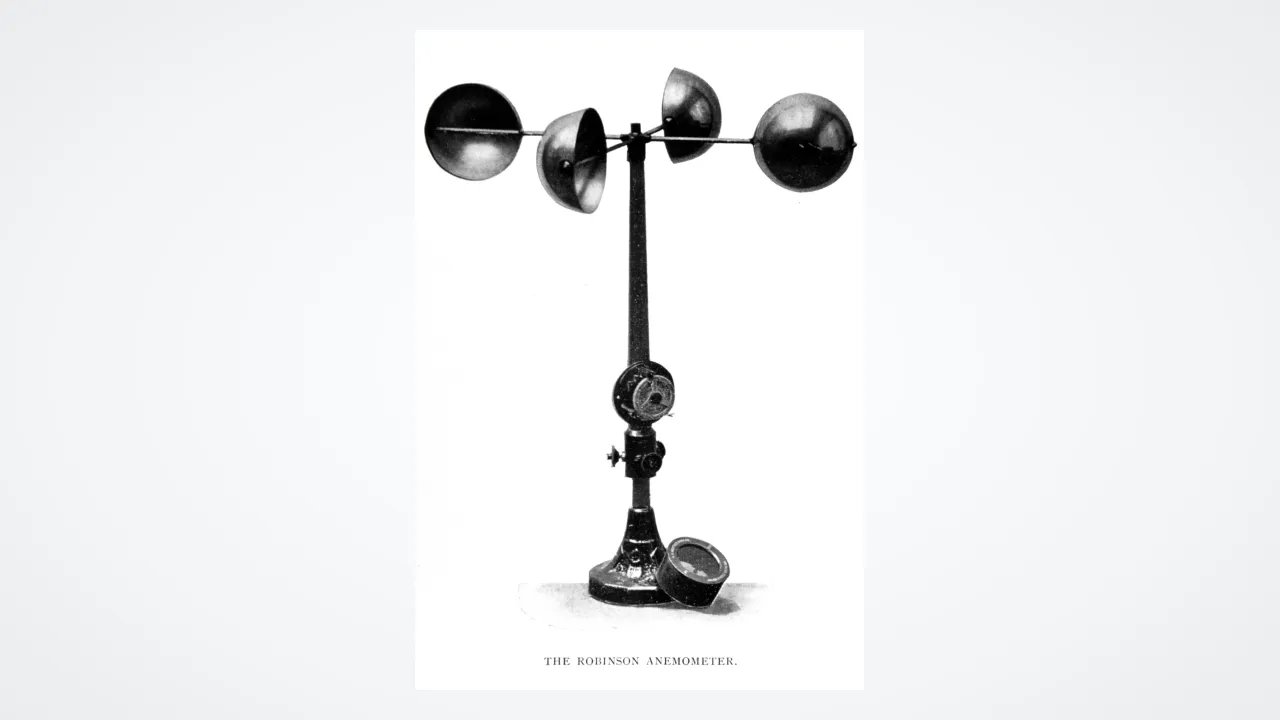
1. What job does a spinning-cup anemometer do at a weather station?
2. What job does a wind vane arrow do?
🤯 Mind-Blowing Fact • Grade 2
The word anemometer comes from anemos, the ancient Greek word for wind!
✨ Word Sparks (Grade 2 Glossary)
Tap 🔊 to hear
pivot
Turn smoothly on a center point
compass
Tool showing North, South, East, West
hollow
Curved inward with open space inside
🪝
Why does a wind vane need a bigger tail at the back than its pointer at the front?
1
How a Wind Vane Turns
Look up at a barn roof and watch a rooster weathervane smoothly in the breeze! Builders make the back tail fin much wider than the narrow front pointer, while balancing the weight evenly on a center pin.
2
Pointing Toward the Source
When wind blows against the vane, it pushes harder on the wide tail fin, swinging the tail downwind until the arrow points straight INTO the wind! If the arrow points north, you are feeling a chilly north wind.
3
Catching Wind in Cups
Meanwhile, an anemometer uses three or four cups on spinning arms. Wind pushes harder inside the cupped side than against the smooth rounded back, making the wheel whirl!
1. If a school's wind vane arrow is pointing straight WEST, which wind is blowing?
2. Why do the cups on an anemometer always spin in one direction instead of getting stuck?
🤯 Mind-Blowing Fact • Grade 3
On an official airport windsock, each orange and white stripe that straightens out horizontally represents roughly three knots (about 3.5 mph) of wind speed—so a fully straight sock signals at least 15 knots!
✨ Word Sparks (Grade 3 Glossary)
Tap 🔊 to hear
knot
Aviation and ocean speed unit (1.15 mph)
torque
Twisting force that makes wheels spin
windsock
Fabric cone showing wind speed and direction
🪝
How did Renaissance thinkers and astronomers invent the spinning tools on today's weather towers?
1
Inventing Wind Speed Tools
People used wind vanes for thousands of years, yet nobody could measure exact wind SPEED until 1450! That year, Italian architect Leon Battista Alberti hung a flat swinging disk that tilted higher in stronger gusts. Four centuries later in 1846, Irish astronomer Thomas Romney Robinson invented the famous spinning cup anemometer still seen around the world.
2
Three Cups Beat Four!
Robinson first built his anemometer with four cups, thinking more cups meant smoother spin. Later wind-tunnel tests in the 1920s proved that THREE cups spaced evenly apart react faster to sudden gusts and spin with steadier !
3
Airport Windsocks
At airports and helicopter pads, bright orange fabric cones called combine both jobs at a glance: the wide mouth turns toward wind direction while the striped tail straightens horizontally as wind speed climbs!
4
Classroom DIY Science
Students can build working anemometers and wind vanes using paper cups, straws, a pencil eraser, and a straight pin!
1. Who invented the classic spinning-cup anemometer in 1846?
2. What does a fully straightened-out horizontal airport windsock tell a pilot?
🤯 Mind-Blowing Fact • Grade 4
On April 12, 1934, observers atop Mount Washington in New Hampshire measured a howling 231-mile-per-hour wind gust using a specially heated rooftop anemometer!
✨ Word Sparks (Grade 4 Glossary)
Tap 🔊 to hear
friction
Rubbing force that slows moving air
mast
Tall upright pole holding weather tools
yaw
Swivel horizontally to face oncoming wind
🪝
Why must every official weather station mount its anemometer and wind vane thirty-three feet up on a tower?
1
The Ten-Meter Global Rule
Hold a handheld anemometer three feet above playground grass, and from grass, fences, and school buildings slows the breeze dramatically! So meteorologists in Virginia can compare wind speeds fairly with stations in Kansas or Japan, the World Meteorological Organization requires official anemometers and wind vanes to sit on open exactly ten meters—thirty-three feet—above flat ground away from trees.
2
Why Wind Direction Predicts Tomorrow
Virginia fourth-grade science highlights both tools because wind speed and wind direction solve different halves of the forecast puzzle. An anemometer warns when high gusts approach severe levels (58 mph or faster in thunderstorms). Meanwhile, a wind vane reveals WHICH air mass is arriving: southerly winds pump warm, humid air northward, whereas northerly winds bring crisp, dry Canadian air!
3
Mount Washington's Heated Sensors
Ordinary spinning cups freeze solid inside icy mountain blizzards. Atop windy Mount Washington in New Hampshire, engineers use electrically heated pitot-static tubes—similar to airplane nose sensors—that clocked a legendary 231-mph gust in 1934!
4
Powering Wind Farms
Every giant white wind-turbine tower carries its own anemometer and wind vane on back so computers can the massive blades squarely into the breeze!
1. Why are official weather-station anemometers mounted 10 meters (33 feet) high in open clearings?
2. How do wind vanes and anemometers on top of giant wind turbines help generate clean electricity?
🤯 Mind-Blowing Fact • Grade 5
On April 10, 1996, an automatic weather station on Barrow Island, Australia, recorded Earth's fastest non-tornado wind gust—253 miles per hour—during Tropical Cyclone Olivia!
✨ Word Sparks (Grade 5 Glossary)
Tap 🔊 to hear
azimuth
Compass direction measured in 0–360 degrees
ultrasonic
Sound waves pitched above human hearing
concave
Curved inward like a hollow bowl
🪝
How can modern ultrasonic anemometers measure 3D wind gusts twenty times per second with zero moving parts?
1
Aerodynamic Drag Differential in Cup Anemometers
Classical three-cup hemispherical or conical anemometers operate via differential aerodynamic drag: the open face presents a high drag coefficient ($C_d \approx 1.4$), whereas the convex rear face presents a streamlined drag coefficient ($C_d \approx 0.4$). That asymmetric torque spins a vertical shaft monitored by optical encoders or magnetic reed switches. Engineers calibrate the 'anemometer factor'—the ratio of true wind speed to cup tip speed, typically around 2.5 to 3.0—and guard against 'overspeeding,' a subtle mechanical quirk where spinning cups accelerate faster into a gust than inertia lets them decelerate afterward!
2
Azimuth Angles and Propeller Aerovanes
Meteorologists record wind direction not merely as eight compass points, but as precise three-digit degrees clockwise from true north: $090^{\circ}$ for an east wind, $180^{\circ}$ for a south wind, $270^{\circ}$ for a west wind, and $360^{\circ}$ for a north wind ($000^{\circ}$ denotes calm air). Many marine buoys and airports combine both sensors into a single streamlined 'aerovane'—a nose propeller spinning for speed mounted directly on a directional tail fin.
3
Ultrasonic Anemometers With Zero Moving Parts
At modern ASOS airport stations, polar observatories, and flux towers, solid-state anemometers replace spinning bearings altogether! Pairs of transducers face each other across a 10-to-20-centimeter gap, firing high-frequency sound pulses back and forth. Wind blowing WITH a pulse shortens transit time, while wind opposing the return pulse lengthens it—computing 3D wind speed, , and sonic air temperature up to 20 to 100 times per second without ever freezing or wearing out!
4
Laser Lidar and World Records
Offshore wind developers even aim Doppler lidar lasers skyward to measure wind profiles 200 meters up, while a cup anemometer on Barrow Island, Australia, set Earth's non-tornadic surface wind record at 408 km/h (253 mph) during Tropical Cyclone Olivia in 1996!
5
From Beaufort Sails to Space Landers
From Admiral Francis Beaufort's 1805 sea-state wind scale to thermal-film wind sensors aboard NASA's Perseverance rover on Mars, measuring wind remains fundamental across worlds.