🎵 INSTRUMENTS
🎶 Continuous-Voltage Electronic Instrument (Electrophone) • Electronic / Keyboard
VA Music, Fine Arts & Sound Physics SOL 5.5
Analog Synthesizer
Sculpting Pure Electricity Into Living Sound
Grade 4 • Expanding • 218 words
🎶 Instrument Family & OriginElectronic family • Mid-20th-century studios, revolutionized in the 1960s by Robert Moog and Don Buchla
🪵 Materials & RangeAnalog oscillator, filter, and envelope circuits with knobs, patch cords, and keys • 20 Hz to 20,000 Hz
🔊 How Sound Is MadeContinuous electrical voltages wave inside circuits, get carved by filters, and vibrate speaker cones
⚡ Signature Sound SparkBuilds brand-new sounds from scratch using flowing electricity instead of wood, strings, or wind
🤯 Mind-Blowing Fact • Grade 1
Iconic space-movie robot beeps, roaring synth basslines, and whooshing starship sounds were originally sculpted by twisting knobs on analog synthesizers!
✨ Word Sparks (Grade 1 Glossary)
Tap 🔊 to hear
knob
Round dial you turn to change settings
speaker
Cone that shakes air using electrical signals
electricity
Flowing energy moving through wires and circuits
🪝
How can an instrument with zero strings, drums, or pipes sound like outer space?
1
Bzzzt, Whoosh, Boing!
Bzzzt, whoosh, zing! Press a key and twist a shiny round . Suddenly a deep laser hum zooms up like a rocket! Meet the analog synthesizer.
2
Music From Electricity
No strings or hollow tubes hide inside this wooden box. Instead, tiny waves of race through wires and push a to shake the air!
3
Twist and Shape
Turn dials and plug colorful cords in. You can invent brand-new sounds nobody has ever heard before!
1. What flows inside an analog synthesizer to create its musical sounds before reaching a speaker?
2. What happens when a player twists the round knobs while holding down a note?
🤯 Mind-Blowing Fact • Grade 2
Early 1960s analog synthesizers were as tall and wide as wall-sized closets, tangled with dozens of telephone-switchboard cables!
✨ Word Sparks (Grade 2 Glossary)
Tap 🔊 to hear
circuit
Path of parts through which electricity flows
patch
Connect sound parts together using plug-in cables
filter
Circuit that trims away bright or low frequencies
🪝
What makes an 'analog' synthesizer different from a computer or tablet music app?
1
Painting Sound With Knobs and Wires
Bwaaaah—zwoooop! Imagine mixing musical sounds the way a chef blends ingredients in a kitchen! An analog synthesizer lets musicians build rumbling bass notes, singing leads, or thunderstorm whooshes right from raw electricity.
2
Real Circuits, Zero Computer Code
Modern phones and computers make digital music using millions of tiny numbers. An analog synthesizer uses zero computer code for its voice! Instead, real, continuous electrical currents flow smoothly through metal parts, switches, and colorful cables.
3
Wave Shapes You Can Hear
Flipping a switch changes the shape of the electrical wave—smooth waves hum gently like flutes, while jagged waves buzz brightly like brass horns until a knob rounds them off!
1. How does a true analog synthesizer generate sound compared to a digital computer app?
2. How does a jagged electrical wave sound compared to a smooth wave?
🤯 Mind-Blowing Fact • Grade 3
In 1968, composer Wendy Carlos astonished the entire music world by recording Johann Sebastian Bach masterpieces note-by-note on a Moog modular synthesizer for the smash-hit album Switched-On Bach!
✨ Word Sparks (Grade 3 Glossary)
Tap 🔊 to hear
oscillator
Circuit generating repeating electrical waves for pitch
voltage
Electrical push or pressure moving through circuits
envelope
Shape of how a note swells and fades
🪝
How does carving away parts of a buzzy electrical wave work just like chiseling a marble statue?
1
Sculptors of Invisible Waves
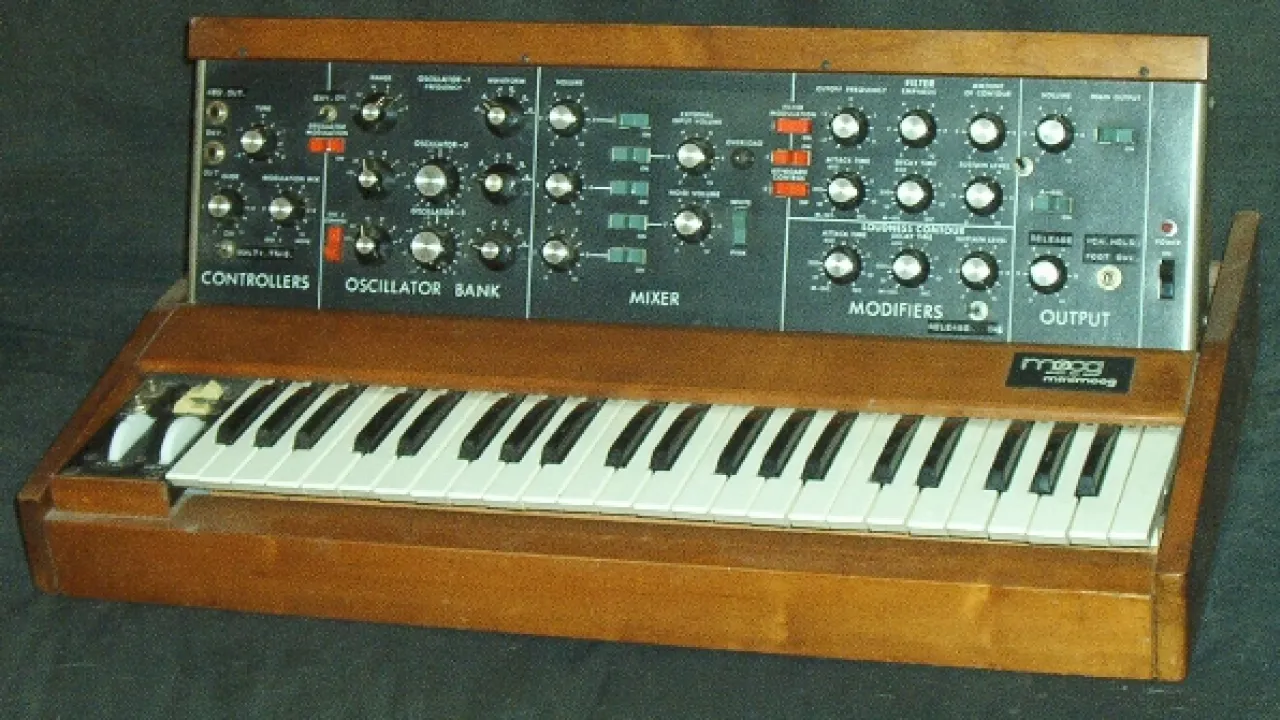
Vvvvzzz—wooooow! Step up to a wood-trimmed analog synthesizer, press a low key, and sweep the big filter knob slowly to the left: a bright, brassy buzz melts before your ears into a round, velvety rumble! Musicians call this clever method subtractive synthesis.
2
Oscillators: The Heartbeat of Pitch
Every note starts inside an electronic circuit called an . By changing —electrical pressure—from the keyboard, the oscillator wiggles electricity back and forth hundreds of times per second in shapes named after how they look on a screen: pure sine waves, mellow triangle waves, hollow square waves, and buzzy sawtooth waves!
3
Filters and Envelopes Shape the Story
Next, just like a sculptor chisels away extra stone, a filter trims away bright upper overtones to darken or brighten the timbre. Meanwhile, an circuit controls whether each note snaps fast like a plucked bass or swells slowly like violins!
4
Pioneers of the 1960s and 1970s
Inventive engineers Robert Moog in New York and Don Buchla in California revolutionized synthesizers in the 1960s, shrinking closet-sized lab gear into portable instruments heard across pop, rock, funk, and film!
1. Why is classic analog sound-shaping often called 'subtractive synthesis'?
2. Which two 1960s American inventors famously pioneered modern voltage-controlled analog synthesizers?
🤯 Mind-Blowing Fact • Grade 4
Because real analog transistor circuits warm up slightly as electricity flows through them, early analog synthesizers could drift slightly out of tune under hot stage spotlights—giving them a lively, organic warmth!
✨ Word Sparks (Grade 4 Glossary)
Tap 🔊 to hear
sawtooth
Ramp-shaped wave rich in all harmonic overtones
cutoff
Frequency point where a filter begins dimming overtones
modular
Built from separate units connected by patch cords
🪝
What do the mysterious letters VCO, VCF, VCA, and ADSR stamped across an analog synthesizer panel actually mean?
1
Decoding the Control Panel of Sound
Glance across the front panel of a classic 1970 Minimoog or synthesizer rack and dozens of silver knobs bear cryptic three-letter labels: VCO, VCF, VCA, LFO, and ADSR! Once you unlock that secret alphabet, you understand how nearly every synthesizer on Earth builds sound.
2
One Volt Per Octave: VCO → VCF → VCA
Robert Moog's breakthrough idea was 'voltage control'—letting small, steady electrical voltages steer every stage of sound automatically! Pressing higher keys sends an extra volt for each octave into the Voltage-Controlled Oscillator (VCO), doubling its wave speed and raising the pitch. That raw or pulse wave flows into the Voltage-Controlled Filter (VCF), which acts as an adjustable gatekeeper for overtones; turning up filter 'resonance' boosts frequencies right at the edge until the circuit whistles! Finally, the Voltage-Controlled Amplifier (VCA) shapes loudness before speakers turn electricity into air waves.
3
Sculpting Time With ADSR and LFOs
How does electricity imitate a snappy snare drum versus a dreamy bowed cello? Four sliders labeled ADSR—Attack, Decay, Sustain, and Release—command how fast a note rises when pressed, settles while held, and fades after release! Meanwhile, a slow-moving Low-Frequency Oscillator (LFO) wiggles pitch or filter brightness automatically for shimmering vibrato.
4
East Coast Keys vs. West Coast Touchplates
While Moog paired synthesizers with familiar piano keyboards ('East Coast' style), California pioneer Don Buchla ditched black-and-white keys for touch-sensitive metal plates and wavefolders ('West Coast' style), inspiring experimental electronic music worldwide.
1. In an ADSR envelope generator, what do the four letters stand for?
2. What is the job of a Low-Frequency Oscillator (LFO) spinning slowly below human hearing?
🤯 Mind-Blowing Fact • Grade 5
A symmetrical square wave generated by an analog oscillator contains ONLY odd-numbered harmonics (1st, 3rd, 5th, 7th...)—the exact same acoustic physics as a cylindrical clarinet tube closed at one end!
✨ Word Sparks (Grade 5 Glossary)
Tap 🔊 to hear
electrophone
Instrument generating sound primarily through electrical circuits
monophonic
Capable of sounding only one note at once
transduce
Convert energy from electrical form into sound waves
🪝
How do exponential transistor ladders, Fourier waveform spectra, and 1-volt-per-octave control voltages turn silent silicon and copper into boundless musical timbre?
1
Continuous Voltage as Acoustic Clay
Before microprocessors sampled audio into discrete binary numbers, mid-twentieth-century engineers discovered that continuous electrical potentials oscillating across capacitors, resistors, and transistors obey differential equations remarkably parallel to vibrating strings and air columns! Classified organologically as an (531), the analog synthesizer constructs sound directly in the electrical domain before transducing voltage into acoustic pressure via an amplifier and loudspeaker.
2
Fourier Spectra of Core VCO Waveforms
At the heart of analog synthesis sits the Voltage-Controlled Oscillator (VCO), typically calibrated to Robert Moog's exponential 1-volt-per-octave standard—where adding +1.000 volt doubles oscillation frequency across the 20-to-20,000-hertz audible spectrum. By charging and discharging timing capacitors, VCOs output canonical geometric waveforms with distinct Fourier harmonic profiles: a pure sine wave contains solely the fundamental (1f); a sawtooth wave contains both even and odd integer harmonics decaying in amplitude as 1/n (ideal for string and brass synthesis); and a symmetrical square wave contains exclusively odd harmonics (1f, 3f, 5f...) decaying as 1/n, imparting the hollow woody character of a stopped clarinet pipe, while pulse-width modulation (PWM) dynamically shifts duty cycle for chorus-like motion.
3
Moog Transistor Ladder Filters vs. Buchla Wavefolding
In East Coast subtractive architecture, harmonic-rich VCO waves enter a Voltage-Controlled Filter (VCF)—most famously Moog's patented 24-decibel-per-octave matched-transistor ladder low-pass filter—where feedback ('emphasis' or resonance) drives the circuit all the way into pure sinusoidal self-oscillation! Conversely, Don Buchla's West Coast paradigm starts with simple sine or triangle oscillators and injects complexity via frequency modulation (FM), low-pass gates, and nonlinear wavefolders that mirror-fold voltage peaks to generate rich new overtones.
4
Control Voltages, Gates, and Polyphonic Breakthroughs
Pressing a key emits both a pitch control voltage (CV) and a trigger/gate pulse firing ADSR envelope generators routed to the VCF and Voltage-Controlled Amplifier (VCA). While 1970's portable Minimoog was (one note at a time), late-1970s voice-allocation breakthroughs like Sequential Circuits' Prophet-5 (1978) and Roland's Jupiter-8 unlocked programmable polyphony.
5
From RCA Mark II to Eurorack Renaissance
Evolving from vacuum-tube lab giants and RCA's 1957 punch-paper synthesizer through Moog, Buchla, ARP, EMS, Serge, and Korg—catalyzed by Wendy Carlos, Stevie Wonder, Herbie Hancock, Kraftwerk, and Vangelis—analog circuitry thrives louder than ever today through Dieter Doepfer's modular Eurorack ecosystem.