🦴 PREHISTORIC
🦴 Mammut americanum • Mammutidae
VA Science SOL 2.5, 3.4, 3.5, 5.8 (Fossils, Adaptations & Earth History)
American Mastodon
Twig-Crunching Forest Cousin of Ice Age Mammoths
Grade 3 • Fluent • 155 words
🌋 Geologic Period & RegionLate Miocene–Late Pleistocene (5 MYA–11,000 YA) • Spruce Forests & Bogs from Alaska to Honduras
📏 Size & Weight8–10 ft (2.4–3 m) shoulder height • 5–7 tons (4,500–6,400 kg)
🦴 Diet & FossilsWoodland Twig & Cone Browser • Big Bone Lick, Snowmass & Hudson Valley Peat Bogs
⚡ Survival SuperpowerMountain-peak cone molars built to crunch whole spruce branches and pinecones
🤯 Mind-Blowing Fact • Grade 1
You can tell a mastodon tooth from a mammoth tooth in one second: mastodon molars have pointy mountain-peak bumps instead of flat washboard lines!
✨ Word Sparks (Grade 1 Glossary)
Tap 🔊 to hear
Browser
Animal that eats tree leaves, twigs, and cones
Stocky
Built wide, thick, and strong
Spruce
Evergreen cone-bearing tree in cool forests
🪝
Mammoth or Mastodon—how can one peek inside its mouth tell you right away?
1
Crunch in the Pine Woods
Snap, crackle, crunch! Evergreen branches pop inside a misty forest. Out steps an American Mastodon! At first it looks like a furry mammoth, yet it lived in shady woods instead of grassy plains.
2
Short, Stocky, and Strong
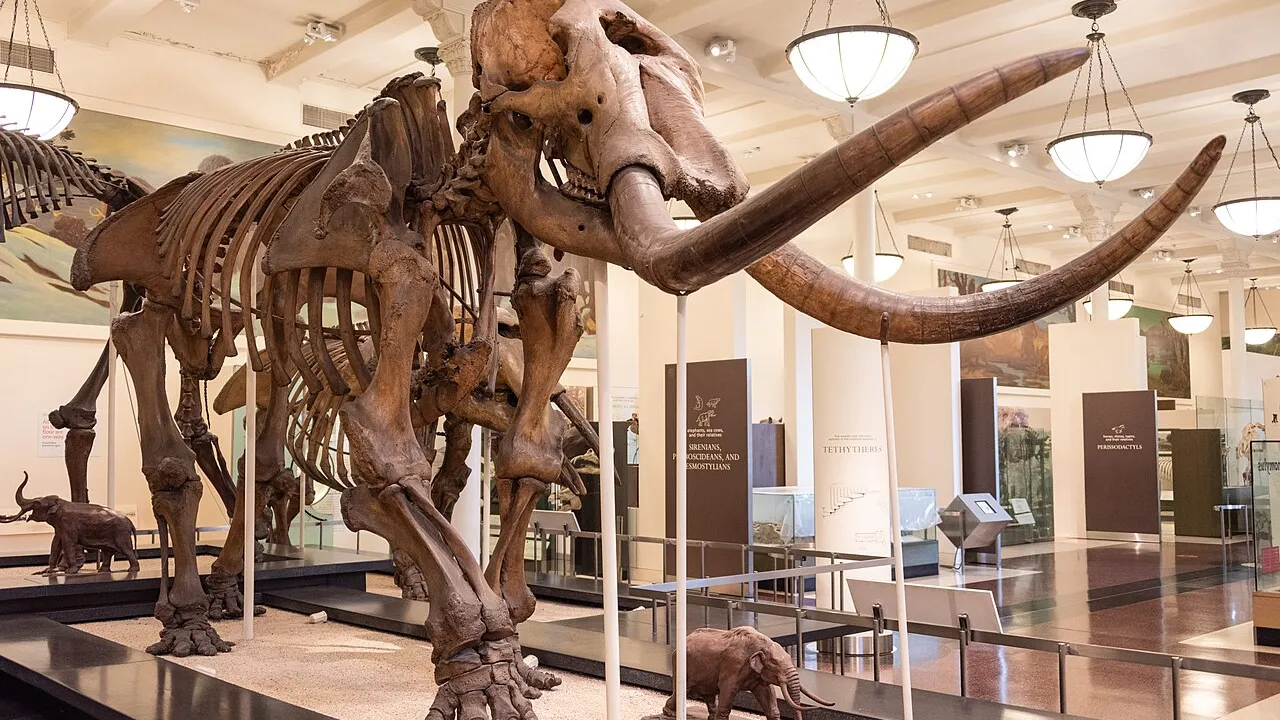
Its body was lower and longer like a furry bulldozer! Its head was flatter on top, and its tusks curved gently upward instead of twisting.
3
Mountain-Peak Teeth
Open wide! Mammoth teeth were flat for grass, while mastodon teeth had big bumpy cones for crushing woody twigs and pinecones!
1. What is the fastest way to tell an American Mastodon molar from a mammoth molar?
2. Where did the American Mastodon prefer to live and feed?
🤯 Mind-Blowing Fact • Grade 2
In 1801, artist Charles Willson Peale dug up an entire American Mastodon skeleton on a New York farm and put together America's very first museum fossil display!
✨ Word Sparks (Grade 2 Glossary)
Tap 🔊 to hear
Bog
Wet spongy ground rich in moss and peat
Cusp
Pointed or rounded bump on a tooth crown
Peat
Dark wet soil made of packed ancient plants
🪝
Why were early American presidents like Thomas Jefferson fascinated by 'mystery monster' teeth from Kentucky?
1
Distant Cousin on the Trunk Tree
Stroll into a mossy cedar in ancient New York or Indiana 14,000 years ago! Reaching its muscular trunk high into a spruce tree is an American Mastodon. Even though it wore shaggy brown hair and carried tusks, mastodons split away from the elephant-and-mammoth branch over twenty-five million years ago!
2
Built Like a Forest Tank
Compared with tall, high-shouldered mammoths, mastodons stood a bit shorter—about eight to ten feet—with longer backs, wider hips, and thicker legs. Gentle upward tusks snapped branches rather than sweeping prairie snow.
3
Solving America's First Fossil Mystery
In the 1700s, giant cusped molars found at Big Bone Lick, Kentucky, puzzled scientists like Benjamin Franklin and Thomas Jefferson—because they looked like meat-eating teeth on an elephant skeleton! French scientist Georges Cuvier finally proved they belonged to an extinct twig-crunching giant.
1. Why did early 1700s thinkers mistake American Mastodon teeth for the teeth of a giant meat-eater?
2. How did an American Mastodon's body shape differ from a Woolly Mammoth's?
🤯 Mind-Blowing Fact • Grade 3
Preserved mastodon gut contents dug from Ohio and New York peat bogs still smell faintly like crushed evergreen needles and swamp plants after 11,000 years!
✨ Word Sparks (Grade 3 Glossary)
Tap 🔊 to hear
Proboscidean
Order of trunked mammals including elephants, mammoths, and mastodons
Partitioning
Sharing a region by using different foods or habitats
Boreal
Northern forest zone dominated by spruce and pine
🪝
How did American Mastodons and mammoths live in the same states for thousands of years without fighting over food?
1
Sharing Ice Age North America
During the Pleistocene Ice Age, both mammoths and American Mastodons roamed North America—yet they belonged to completely separate families that parted ways roughly twenty-seven million years ago! In fact, a Woolly Mammoth was much more closely related to a modern Asian elephant than to an American Mastodon.
2
Niche Partitioning by Tooth Design
Ecologists call their secret to peaceful coexistence niche . Mammoths used flat, ridged molars to graze open grasslands, while Mammut americanum stayed in spruce woodlands, alder thickets, and wetlands. Its zygolophodont—yoke-crested—molars sheared woody twigs, pine needles, cones, and water lilies cleanly without wearing down on gritty grass soil!
3
Birthplace of Extinction Science
Studying Big Bone Lick mastodon bones in Paris between 1796 and 1817, naturalist Georges Cuvier coined the name 'mastodon' and proved to a skeptical world that whole species could truly go extinct.
4
Preserved in Cool Peat Bogs
Hundreds of skeletons—complete with gut piles of chopped spruce twigs—have emerged from oxygen-poor farm bogs around the Great Lakes and New York's Hudson Valley.
1. Which two animals are closer cousins on the evolutionary family tree?
2. How did niche partitioning allow mammoths and mastodons to inhabit Ice Age North America together?
🤯 Mind-Blowing Fact • Grade 4
Isotope maps inside the Indiana bull mastodon named 'Fred' proved he returned to the exact same summer mating grounds in northeastern Indiana year after year until a rival's tusk pierced his skull!
✨ Word Sparks (Grade 4 Glossary)
Tap 🔊 to hear
Zygolophodont
Molar crown with paired ridges formed from cones
Interglacial
Warmer period between major Ice Age glacier advances
How did chemical layers inside an Indiana mastodon's nine-foot tusk record annual summer trips and his final battle?
1
Twenty-Seven Million Years Apart
Step into a fragrant spruce-tamarack bog in Great Lakes North America 13,000 years ago. Pushing effortlessly through dense branches is Mammut americanum, standing nearly three meters at the shoulder and weighing six metric tons. Although laymen often confuse mastodons with mammoths, paleogenetics confirms Mammutidae diverged from Elephantidae during the Oligocene (~27 MYA)—making mastodons as evolutionarily distant from mammoths as housecats are from hyenas!
2
Zygolophodont Engineering and Chin Tusks
Instead of sliding single giant lamellar plates forward like mammoths, mastodons held two or three smaller, rooted molars in each jaw quadrant simultaneously. Paired transverse crests of rounded cones sheared fibrous woody stems into uniform two-centimeter matchsticks found preserved inside peat-bog gut masses. Some male American Mastodons even retained vestigial pair of short lower 'chin tusks' jutting from the tip of the mandible—a throwback to ancient Miocene ancestors!
3
Tusk GPS of the Buesching Mastodon
In 2022, Joshua Miller and Daniel Fisher analyzed strontium and oxygen isotopes inside the 2.9-meter right tusk of 'Fred,' the Buesching bull mastodon unearthed in Indiana. After dispersing from his mother's herd as a teenager, Fred migrated nearly a hundred miles north from central to northeastern Indiana every single summer mating season—where a rival bull's tusk punctured straight through his cheekbone at age thirty-four!
4
Arctic Journeys With Warm Climates
Ancient DNA from Yukon bones shows mastodons expanded north into Alaska only during warm intervals when boreal forests replaced treeless mammoth steppes, retreating south whenever glaciers returned.
1. Why did American Mastodons move into Alaska and the Yukon during warm interglacial periods rather than icy glacial peaks?
2. What throwback ancestral feature occasionally grew from the tip of a male American Mastodon's lower jaw?
🤯 Mind-Blowing Fact • Grade 5
In 2019, paleontologists studying narrower molars and complete lack of chin tusks in fossils from California's La Brea Tar Pits discovered that West Coast mastodons actually belonged to a distinct sister species: the Pacific Mastodon (Mammut pacificus)!
✨ Word Sparks (Grade 5 Glossary)
Tap 🔊 to hear
Mitogenomics
Sequencing complete ancient DNA from cell mitochondria
How did Mammut americanum spark the scientific discovery of extinction in 1796 and reveal migratory Pleistocene life histories through high-resolution tusk isotopes today?
1
Big Bone Lick and the Reality of Extinction
Unearthed by Native Shawnee observers and French soldiers along Ohio River salt springs at Big Bone Lick, Kentucky, in 1739, the enigmatic 'incognitum' ignited an Enlightenment scientific debate involving Buffon, Benjamin Franklin, and Thomas Jefferson. Comparing Kentucky's bunolophodont-zygolophodont molars and stocky postcrania against living Asian and African elephants in his landmark 1796 lecture (and coining 'mastodon' before Johann Friedrich Blumenbach formalized Mammut americanum in 1799), Georges Cuvier proved that neither mammoths nor mastodons survived in unexplored interiors—establishing species extinction as empirical fact.
2
Deep Oligocene Divergence and Browser Morphology
Mitogenomic and paleoproteomic phylogenies confirm that Mammutidae diverged from the Elephantidae stem ~26 to 28 million years ago during the Late Oligocene. Reaching 2.4 to 3.0 meters at the shoulder and 4.5 to 6.8 metric tons (with recently recognized gracile western Mammut pacificus in California and Idaho alongside widespread Mammut americanum), mastodons possessed an elongated, low-slung torso, sloping cranial vault, thick limb bones, upwardly arcing tusks lacking strong helicoidal torsion, and occasionally vestigial mandibular tusks. Low-crowned, rooted zygolophodont molars bearing paired transverse lophs clipped twigs of Picea (spruce), Larix, Abies, and wetland macrophytes without suffering severe phytolith abrasion.
3
Climate-Driven Latitudinal Oscillations
In 2020, Emil Karpinski, Hendrik Poinar, and colleagues sequenced thirty-five mitochondrial genomes spanning Alaska to Nova Scotia, demonstrating that mastodon populations surged northward into Beringia exclusively during warm Pleistocene interglacials (such as MIS 5e) when boreal forests expanded, then suffered regional as cold glacial stadials restored treeless Artemisia steppe—leaving genetically impoverished southern clades prior to terminal extinction.
4
Sclerochronology of Musth Combat and Migration
Micro-milled 87Sr/86Sr and δ18O profiles across incremental dentine growth bands of Indiana's 13,200-year-old Buesching bull tusk (Miller et al., 2022) mapped adolescent natal dispersal followed by clockwork annual 150-kilometer summer migrations into northeastern Indiana mating grounds—culminating in fatal perimortem tusk perforation of the right temporal fossa during combat, corroborated at dozens of Great Lakes sites studied by Daniel Fisher.
5
Terminal Extinction (~11,000 YA)
Confronting rapid end-Pleistocene forest restructuring alongside Paleoindian exploitation—evidenced by a bone projectile point embedded inside the Manis Mastodon rib in Washington State (~13,800 YA)—North America's five-million-year woodland browser vanished near the Pleistocene-Holocene boundary.