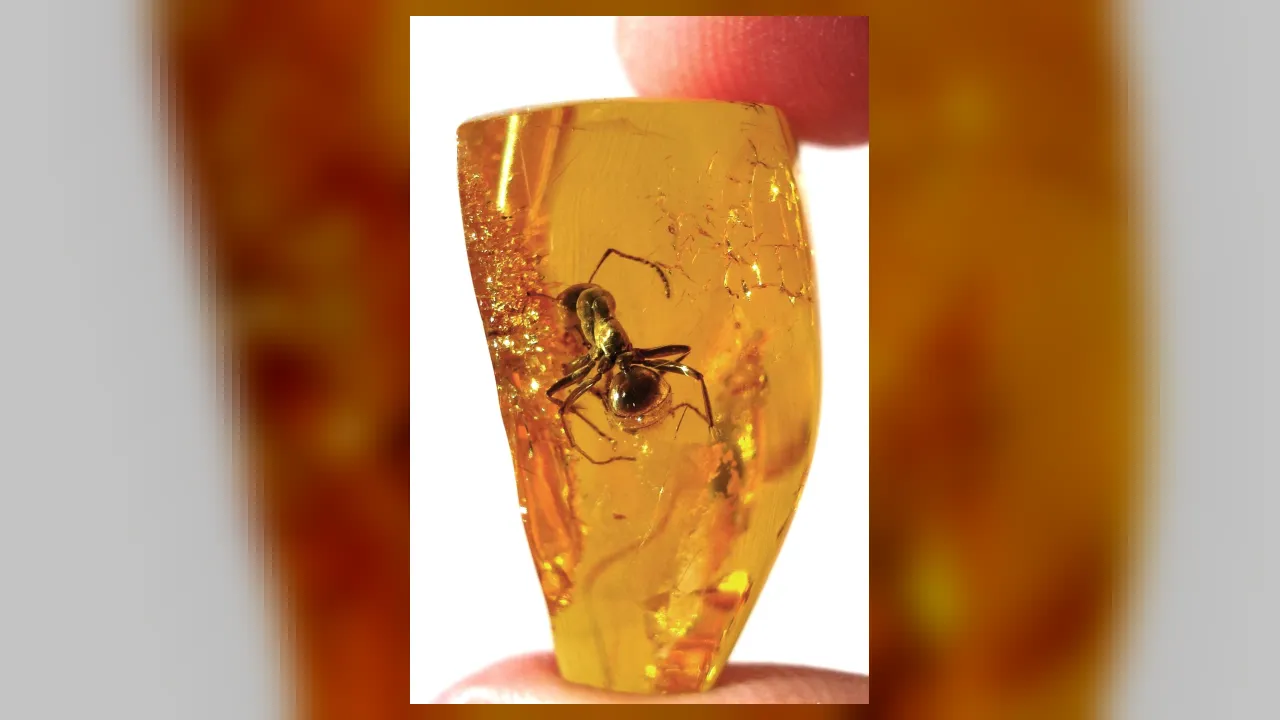
1. Where did golden amber originally come from millions of years ago?
2. Why are bugs inside amber preserved so clearly?
🤯 Mind-Blowing Fact • Grade 2
When ancient Greeks rubbed golden amber with wool cloth, static sparks made dry leaves jump to it—and their word for amber, 'elektron,' gave us the word 'electricity'!
✨ Word Sparks (Grade 2 Glossary)
Tap 🔊 to hear
Organic Gem
Precious gem made by living things, not rock
Buoyant
Able to float easily in liquid
Inclusion
Insect, plant, or bubble trapped inside amber
🪝
Why does real amber feel warm in your hand and float in salty ocean water?
1
Resin Is Not Watery Sap
People often call amber 'fossil tree sap,' yet trees actually make two different liquids! Sweet watery sap carries food inside trees and dissolves in rain, while thick sticky resin acts like a natural bandage on scratched bark and never dissolves in water.
2
Warm and Buoyant Gem
Unlike quartz or diamond crystals, amber is an made by living trees! Touch real amber to your cheek and it feels cozy and warm instead of icy cold like stone. Drop it into a cup of salty water, and amber floats right to the top!
3
Time Capsules of Forest Life
Inside clear honey-gold amber, scientists have found prehistoric mosquitoes, tiny tree frogs, flower petals, raindrops, and even delicate spiderwebs still beaded with morning dew!
1. Which modern science word comes from the ancient Greek word 'elektron,' meaning amber?
2. What happens when you place a genuine piece of amber into a cup of saltwater?
🤯 Mind-Blowing Fact • Grade 3
Paleontologists examining 99-million-year-old Cretaceous amber discovered a fluffy, feathered tail tip belonging to a sparrow-sized baby dinosaur!
✨ Word Sparks (Grade 3 Glossary)
Tap 🔊 to hear
Copal
Young hardened tree resin not yet true amber
Baltic Sea
Northern European sea famous for beach-washed amber
Pollen
Tiny flower or cone dust carried by bees
🪝
Why can flat mud fossils rarely save tiny insect wings, while golden amber preserves even an ant's microscopic eyelashes?
1
Why Soft Creatures Need Special Traps
Heavy dinosaur bones and thick clam shells fossilize well in river mud, yet fragile creatures like gnats, termites, and spiders usually get crushed flat or decay before rock can harden! Sticky tree resin solved that problem by flowing gently around tiny bodies and disinfecting them with natural pine-like oils.
2
From Sticky Copal to True Amber
Becoming true amber takes millions of years of underground patience! When resin-filled logs wash into oxygen-poor coastal lagoons and get buried under sand and clay, gentle heat and pressure link the resin molecules into tough chains. Young hardened resin—only thousands of years old—is called , while true amber is millions of years old!
3
Rainbow Colors Beyond Honey Gold
Most amber gleams warm orange, yellow, or cognac-brown. Millions of microscopic air bubbles turn 'butterscotch' amber milky yellow, while rare amber from the Dominican Republic glows tropical sky-blue in sunlight!
4
Whole Ecosystems in One Pebble
Sometimes a single chunk of amber captures an entire prehistoric action scene: a jumping spider pouncing toward a midge, grains clinging to an ancient bee, or tiny mites hitching a ride on a beetle's back!
1. What is the main difference between 'copal' and true fossil 'amber'?
2. Why are some pieces of golden Baltic amber cloudy and milky-white like butterscotch?
🤯 Mind-Blowing Fact • Grade 4
Using 3D X-ray scanners on opaque Cretaceous amber from France, paleontologists uncovered pristine feathers and tiny snails trapped in tree resin when giant dinosaurs roamed the land!
✨ Word Sparks (Grade 4 Glossary)
Tap 🔊 to hear
Polymerization
Linking small resin molecules into tough long chains
Amorphous
Solid material without a repeating crystal lattice
Micro-CT Scan
3D X-ray camera revealing hidden fossil details
🪝
Can scientists really extract intact dinosaur-era DNA from mosquitoes trapped in amber—or did science experiments reveal a surprising twist?
1
Polymerization: Nature's Original Plastic
Hold a polished cabochon of 44-million-year-old Baltic amber, and you are touching nature's own organic polymer! Living conifers and tropical flowering legume trees secrete sticky terpenoid resins to seal bark injuries against wood-boring beetles and fungi. Once buried in oxygen-free delta muds, volatile pine oils evaporate while geothermal heat and pressure cross-link the remaining carbon-hydrogen-oxygen rings—a chemical process called —creating a tough, organic substance with Mohs hardness 2 to 2.5 and specific gravity ~1.08.
2
X-Ray CT Scans Inside Cloudy Amber
What if a 100-million-year-old insect lies hidden inside dark, opaque amber coated with weathered crust? Today, paleontologists place amber specimens inside synchrotron X-ray micro-CT scanners! Without cutting or damaging the gem, computers slice thousands of X-ray images into rotatable 3D models subtle enough to view an extinct ant's jaws, internal muscles, and pollen-packed stomach.
3
The Truth About Ancient DNA in Amber
Science-fiction stories love the idea of drawing dinosaur blood from amber-trapped mosquitoes! When molecular biologists tested real amber inclusions in ultra-clean laboratories, however, they discovered that fragile DNA molecules break into unreadable fragments within roughly one to two million years—even inside sealed amber. While Cretaceous DNA does not survive, durable structural proteins, chitin cuticles, and microscopic pigment melanosomes DO survive, revealing true prehistoric feather and beetle colors!
4
Ancient Air Bubbles and Forest Climes
Amber deposits span the globe—from Cretaceous cedar resins in New Jersey and Canada to Eocene 'succinite' forests around the Baltic Sea and Miocene Hymenaea legume resins in the Dominican Republic—helping scientists map how flowering plants and pollinating insects co-evolved.
1. What did real laboratory studies discover about recovering dinosaur-age DNA from insects in amber?
2. How do paleontologists study tiny insects trapped inside dark, cloudy amber without cutting the stone open?
🤯 Mind-Blowing Fact • Grade 5
Rare 'blue amber' from the Dominican Republic owes its electric sky-blue glow to perylene molecules created when ancient forest fires roasted sticky tree resin 20 million years ago!
✨ Word Sparks (Grade 5 Glossary)
Tap 🔊 to hear
Mineraloid
Natural rock-like solid lacking a crystal structure
Taphonomy
Science studying how organisms decay and fossilize
Lagerstätte
Fossil site with extraordinary soft-body preservation
🪝
Why do mineralogists classify amber as a 'mineraloid' rather than a true mineral—and how does Caribbean 'blue amber' glow azure under ordinary sunlight?
1
Mineraloid Classification and Free-Radical Polymerization
Check an official International Mineralogical Association handbook, and you will see amber placed in a fascinating special category: an organic ! True minerals must be inorganic solids with a repeating crystalline atomic lattice and definite chemical formula. Amber breaks all three rules—it originates biologically from plant diterpenoids and triterpenoids (such as labdatriene carboxylic acids), lacks ordered crystal symmetry (amorphous), and varies slightly in C-H-O ratios across botanical sources. During diagenesis under anoxic marine or deltaic sediments, free-radical polymerization cross-links volatile monoterpenes and sesquiterpenes into insoluble macromolecular resinite resistant to organic solvents like acetone—a quick lab test separating insoluble true amber from sticky, acetone-softened Pleistocene copal!
2
Konservat-Lagerstätten of the Terrestrial Biosphere
In (the science of fossil preservation), amber deposits represent premier Konservat-Lagerstätten—sites of extraordinary soft-tissue fidelity. Rapid encapsulation in antiseptic terpenes dehydrates trapped arthropods while halting microbial decay, preserving compound-eye ommatidia, tracheal breathing tubes, fungal fruiting bodies, velvet worms, and Cretaceous angiosperm blossoms at sub-micron resolution. Often, what looks like a solid insect is a hollow carbonized cuticle mold lined with microscopic pyrite or resin casts of internal organs!
3
Photophysics of Dominican and Chiapas Blue Amber
Whereas Baltic 'succinite' amber (containing 3%–8% succinic acid) comes from Eocene conifer forests (~44 million years ago), Miocene amber from the Dominican Republic and Mexico (~15–20 million years ago) oozed from extinct tropical legume trees (Hymenaea protera). When ancient forest fires heated oozing resin, trace polycyclic aromatic hydrocarbons—specifically perylene—became locked inside! Under sunlight's ultraviolet wavelengths, perylene molecules fluoresce vivid cerulean blue along the amber's surface while transmitted light remains honey-gold.
4
Isotopic Fingerprints of Prehistoric Atmospheres
Although gases inside amber bubbles slowly exchange through microscopic resin pores over eons, carbon-13 to carbon-12 isotope ratios locked directly inside the polymerized resin hull faithfully record ancient atmospheric CO2 composition, drought stress, and global oxygen shifts across the Cretaceous and Cenozoic eras!
5
Infrared Spectroscopy in Cultural Heritage
Using Fourier-transform infrared spectroscopy (FTIR), archaeologists identify the exact 'Baltic shoulder' absorption peak in 3,500-year-old Bronze Age amber beads excavated in Greece and Egypt—mapping Europe's earliest long-distance 'Amber Road' trade networks without scratching a single artifact.