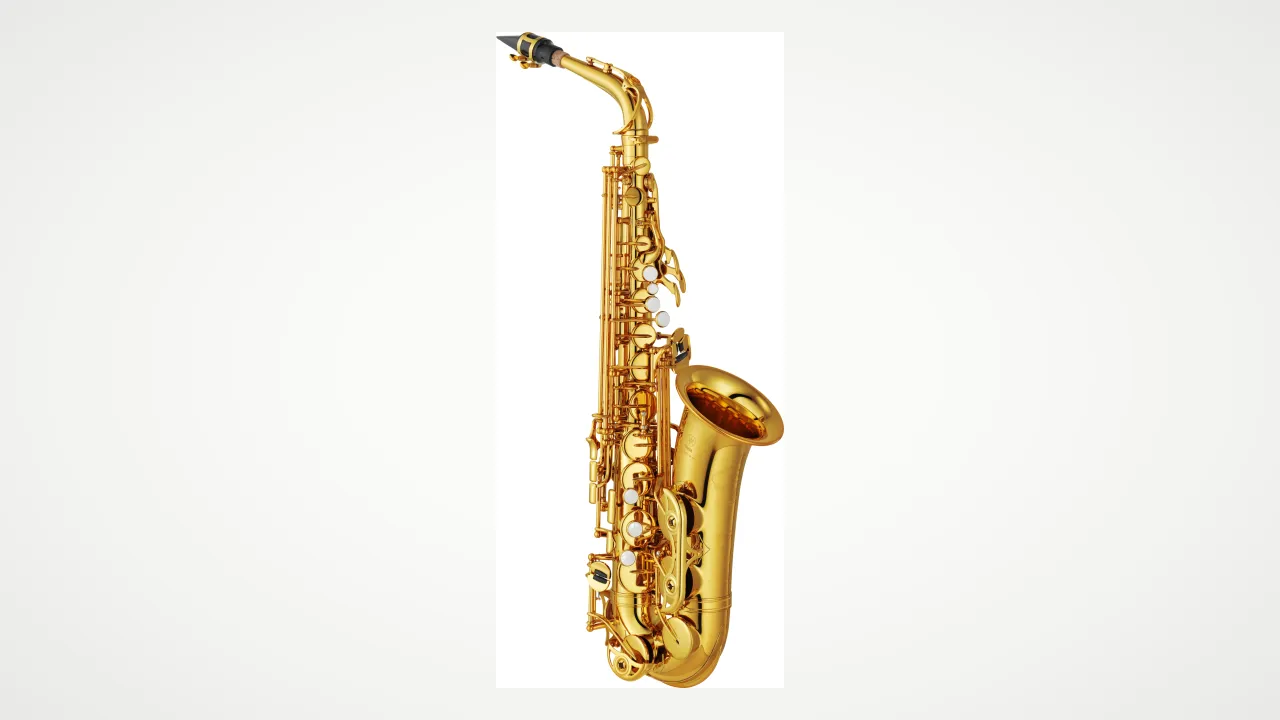
1. Why does the shiny gold alto saxophone belong to the woodwind family instead of the brass family?
2. Which capital letter does the curved body of an alto saxophone look like?
🤯 Mind-Blowing Fact • Grade 2
Adolphe Sax patented a whole family of fourteen saxophones in Paris in 1846, naming every single one after himself!
✨ Word Sparks (Grade 2 Glossary)
Tap 🔊 to hear
patent
Official paper protecting a brand-new invention
pad
Soft leather cushion sealing a tone hole
bow
U-shaped bottom curve before the upturned bell
🪝
What happened when an inventor combined a clarinet's reed with a shiny brass cone?
1
Best of Both Worlds
Close your eyes as a velvety, singing solo glides over snapping fingers and swinging drums. Back in the 1840s, Belgian maker Adolphe Sax dreamed up an instrument as quick as a woodwind yet as bold as a brass horn!
2
Reed on Top, Pearls Below
At the top sits a clarinet-style mouthpiece with one vibrating strip of cane reed. Below it, a wide cone of golden brass curves into a flared bell covered with leather-padded cups and smooth pearl buttons.
3
Star of Bands and Jazz
Because its medium size fits young arms comfortably with a neck strap, millions of beginners start on the alto saxophone before exploring marching bands, orchestras, and jazz!
1. Who invented the saxophone family in the 1840s?
2. What covers the large round holes along a saxophone's brass body when keys are pressed?
🤯 Mind-Blowing Fact • Grade 3
Pressing the thumb octave key on an alto saxophone actually opens one of two tiny pinhole vents automatically depending on which note you finger!
✨ Word Sparks (Grade 3 Glossary)
Tap 🔊 to hear
octave key
Thumb lever shifting fingerings one octave higher
bebop
Fast, complex jazz style led by soloists
hybrid
Clever blend combining traits from two families
🪝
Why does a saxophone jump cleanly by octaves while its single-reed cousin, the clarinet, jumps twelve steps?
1
Bridging Two Instrument Families
Listen to a concert band on a summer evening: woodwinds sparkle with nimble melodies, while brasses blaze with power. In the 1840s, Belgian craftsman Adolphe Sax bridged that gap by mounting a single-reed mouthpiece onto a wide, cone-shaped brass body.
2
The Conical Bore Difference
Even though clarinets and alto saxophones both use one vibrating cane reed, their insides look completely different. A clarinet is a straight cylinder, whereas the alto saxophone widens steadily like a megaphone. That conical bore lets the air column vibrate with both odd and even harmonics and overblow cleanly at the octave!
3
Pitched in E-Flat
Standing about sixty-five centimeters tall with a gently angled neck, the alto saxophone is pitched in E-flat. Pressing its left-thumb shifts fingerings smoothly into a singing upper register.
4
Classical Elegance to Bebop Speed
French composer Georges Bizet showcased its tender beauty in orchestral music, while jazz legends Charlie Parker and Paul Desmond turned its agile voice into pure gold.
1. Why does an alto saxophone overblow an octave instead of a twelfth like a clarinet?
2. Which legendary jazz saxophonist nicknamed 'Bird' dazzled the world with lightning-fast alto solos?
🤯 Mind-Blowing Fact • Grade 4
In 1845, Adolphe Sax won a giant outdoor musical showdown in front of 20,000 Parisians to prove his saxophone-equipped band sounded richer than traditional army bands!
How did Adolphe Sax's 1846 Parisian patent spark fierce rivalries while creating the modern world's most recognizable solo voice?
1
A Voice That Bends Like Human Speech
Whether floating a silken troubadour melody across a darkened symphony hall in Mussorgsky's Pictures at an Exhibition or blazing thirty-second notes in a smoky Manhattan jazz club, this golden E-flat woodwind bends pitch, tone color, and volume almost like human vocal cords.
2
Parabolic Cone Meets Single Reed
Patented in Paris on June 28, 1846 by Belgian-born Adolphe Sax, the saxophone married a clarinet-like single Arundo donax reed to a wide conical yellow-brass tube roughly 1.09 meters in unfolded acoustic length. Because its bore expands rapidly from neck tip to flared bell, acoustic energy radiates far more powerfully than from narrow wooden oboes or clarinets. Better still, a closed-tip cone supports the full odd-and-even harmonic series, meaning fingerings repeat logically at the octave from written B-flat3 to F-sharp6—sounding concert D-flat3 to A5.
3
Rivalries, Military Bands, and Orchestras
Jealous rival Parisian instrument makers fought Sax's patents in court and even sabotaged his workshop, yet composer Hector Berlioz praised the invention's expressive beauty. In 1845, a public outdoor band battle on Paris's Champ de Mars proved Sax's ensemble vastly outprojected traditional military bands, winning official adoption across France.
4
Two Worlds of Mastery
Classical soloists shape pure, centered tones in scores by Georges Bizet, Maurice Ravel, and Alexander Glazunov, while jazz pioneers from Johnny Hodges to Charlie Parker and Paul Desmond unlocked scooping bends, airy whispers, and soaring altissimo cries.
1. Why can a saxophone project much louder than a clarinet or oboe?
2. In what year did Adolphe Sax receive his historic French patent for the saxophone family?
🤯 Mind-Blowing Fact • Grade 5
High-speed acoustic imaging proves that to play extreme altissimo notes above the saxophone's normal keys, musicians literally tune the shape of their own throat and tongue to match the target frequency!
✨ Word Sparks (Grade 5 Glossary)
Tap 🔊 to hear
baffle
Interior mouthpiece slope shaping brightness and power
annealed brass
Heat-softened copper-zinc alloy shaped into tubes
vocal-tract coupling
Shaping throat air to control high pitches
🪝
How do mouthpiece chamber geometry and vocal-tract resonance let one brass-bodied woodwind whisper like dry silk or roar over a big band?
1
Vocal Plasticity in Brass and Cane
Listen back-to-back to Paul Desmond's dry-martini lyricism in 'Take Five,' Charlie Parker's incandescent bebop cascades, and a classical virtuoso performing Glazunov's Concerto in E-flat. Astonishingly, all three timbres emerge from identical bore dimensions—proof that no wind instrument responds more sensitively to chamber geometry and vocal-tract shaping than the E-flat alto saxophone.
2
Wide-Angle Conical Acoustics
Organologically a single-reed conical aerophone (Hornbostel-Sachs 422.212), the alto saxophone wraps an acoustic path of roughly 1.09 meters into a 65-centimeter J-shaped chassis of annealed yellow brass (typically 70% copper, 30% zinc). While brass walls provide structural durability for massive tone holes sealed by leather pads and metal resonators, wall vibration contributes negligibly compared to the wide-angle ~3-degree conical air column itself. Supporting both odd and even harmonics, this truncated cone overblows cleanly at the octave via an automatic dual-vent mechanism, spanning written B-flat3 to F#6—sounding concert D-flat3 (~138.6 Hz) to A5 (880 Hz).
3
Mouthpiece Baffles and Vocal-Tract Coupling
Why can two alto players sound worlds apart? Inside the hard-rubber or metal mouthpiece, a rounded interior chamber yields warm, dark classical fundamentals, whereas a raised 'high ' accelerates airflow behind the reed to ignite shimmering 2,000–4,000 Hz jazz harmonics. Above A5, acoustic research shows players tune their own throat and tongue resonances——to vault past the keyed range into a stratospheric altissimo exceeding concert F6 (~1,397 Hz)!
4
Adolphe Sax's 1846 Synthesis
Working in Paris after relocating from Brussels in 1842, Antoine-Joseph 'Adolphe' Sax sought to unite woodwind agility with brassy projection to cure the thin bass-middle balance of military wind bands. His June 28, 1846 patent envisioned two parallel series: one in F and C for symphony orchestras, and one in E-flat and B-flat for wind bands—from which the E-flat alto emerged as the supreme classical and quartet lead.
5
Symphonic Troubadour and Jazz Revolutionary
Championed early by Hector Berlioz and Georges Bizet (L'Arlésienne, 1872), immortalized by Ravel's orchestration of Mussorgsky's 'The Old Castle,' and reinvented across Harlem, Kansas City, and West Coast jazz by Johnny Hodges, Charlie Parker, Cannonball Adderley, and Ornette Coleman, the alto saxophone remains modernity's quintessential voice.