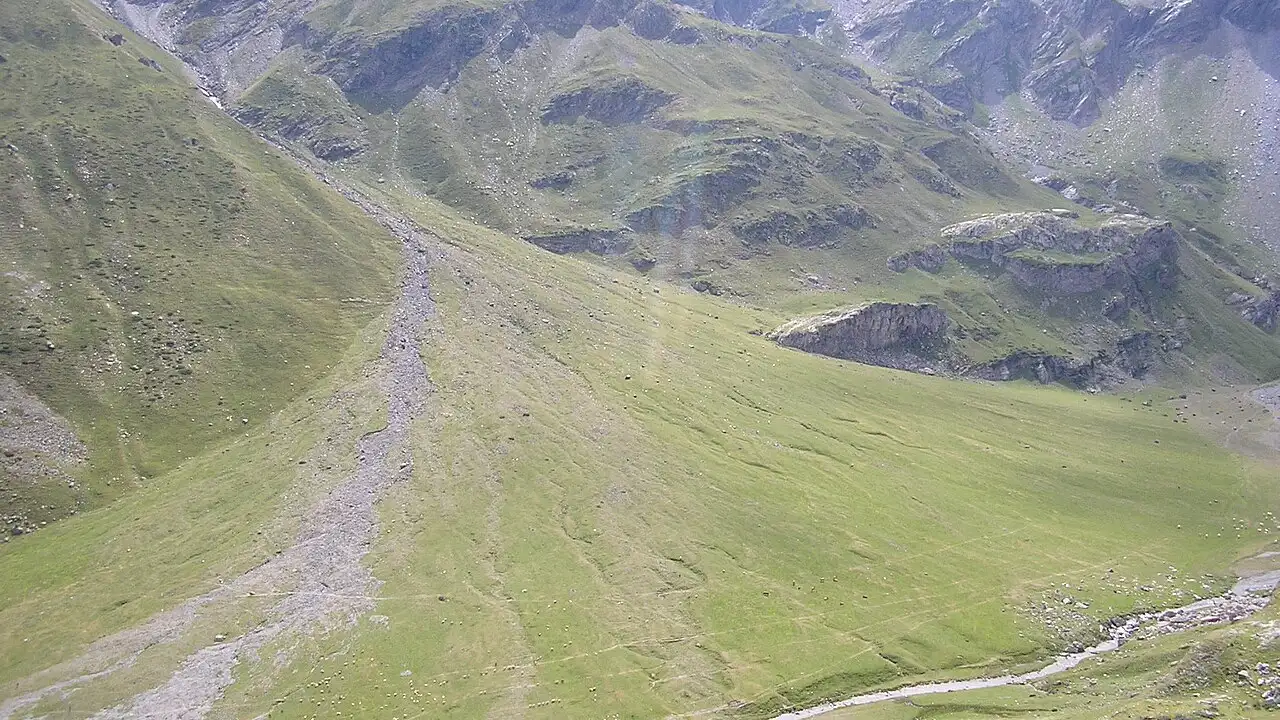
2. Why does the rushing water drop its stones and sand?
🤯 Mind-Blowing Fact • Grade 2
Some huge alluvial fans along the Himalayan Mountains cover thousands of square miles—bigger than the state of Rhode Island!
✨ Word Sparks (Grade 2 Glossary)
Tap 🔊 to hear
Flash Flood
Sudden fast flood right after heavy desert rain
Alluvial
Made of sand and gravel dropped by water
Valley Floor
Flat low ground sitting between tall mountain ranges
🪝
How are alluvial fans like river deltas—except built on dry land?
1
Dry-Land Cousins of Deltas
Pour a bucket of sandy water down a toy slide onto a flat driveway! Right where the slide ends, the sand spreads into a neat triangle. Mountain canyons build giant stone triangles called fans the exact same way.
2
Big Rocks First, Fine Sand Last
When a desert thunderstorm hits, a roars through a narrow canyon. Exiting onto the wide , the water loses speed fast. Heavy boulders drop near the canyon mouth, while lighter sand travels to the fan's outer edge.
3
Deltas vs. Alluvial Fans
River deltas form underwater where rivers meet lakes or seas. fans form right out in the open air at the base of steep mountains!
1. Where do the biggest, heaviest boulders drop on an alluvial fan?
2. How is an alluvial fan different from a river delta?
🤯 Mind-Blowing Fact • Grade 3
When neighboring alluvial fans grow wide enough to touch and merge along a mountain front, geologists call the giant combined apron a bajada!
✨ Word Sparks (Grade 3 Glossary)
Tap 🔊 to hear
Apex
Highest narrow tip of an alluvial fan cone
Cobbles
Fist-sized rounded stones bigger than small pebbles
Bajada
Wide rocky slope made of merged alluvial fans
🪝
Why are desert mountains in the American West lined with giant triangles of gravel?
1
Squeezed Tight, Then Set Free
Picture holding your thumb partly over a garden hose—water blasts out fast while squeezed! Inside a steep, narrow mountain canyon, storm runoff acts the same way, racing downhill with tremendous energy to haul boulders, , and sand.
2
Sudden Drop in Energy
The instant that torrent escapes the canyon walls onto a wide, flat desert basin, the water spreads out in every direction. Spreading thin steals the stream's speed and carrying power, triggering rapid deposition.
3
Natural Size Sorting
Alluvial fans sort rocks neatly from top to bottom. Coarse boulders and pile up at the steep upper point, called the , while medium gravel settles midway and fine sand and silt wash out to the gentle toe.
4
Why Deserts Show Them Best
Alluvial fans can form near any steep mountain range, even in wet climates. However, sparse desert plants and sudden cloudbursts make fans in places like Nevada, Utah, and California astonishingly clear to see.
1. Why are alluvial fans easiest to spot in desert landscapes like Death Valley?
2. What do geologists call the giant rocky apron formed when several alluvial fans merge side by side?
🤯 Mind-Blowing Fact • Grade 4
After Hurricane Camille dumped more than twenty-five inches of rain on Virginia's Blue Ridge Mountains in one night in 1969, debris flows raced down steep hollows to build fresh alluvial fans at the valley bases!
✨ Word Sparks (Grade 4 Glossary)
Tap 🔊 to hear
Alluvium
Loose gravel, sand, and silt dropped by streams
Braided Channels
Crisscrossing shallow streams weaving around gravel bars
Debris Flow
Fast downhill surge of mud, water, and boulders
🪝
Why can building a road or neighborhood on a quiet-looking alluvial fan require clever engineering?
1
Built One Storm at a Time
Stand at the base of the Panamint Mountains in Death Valley National Park on a sunny Tuesday, and the pale gravel slope beneath your boots looks bone-dry and peaceful. Yet every pebble around you rode out of that dark canyon above during violent flash floods! Over thousands of years, repeated storms stack half-cone layers of —water-deposited gravel, sand, and mud—into a sweeping alluvial fan.
2
Braided Channels That Jump Around
Unlike a single deep river channel, water crossing an alluvial fan splits into shifting . Whenever one shallow trench clogs up with freshly dropped boulders, the next flood jumps sideways down a steeper, clearer path—gradually distributing sediment evenly across a 180-degree arc.
3
Hidden Underground Water Tanks
Because coarse gravel and sand near the fan's upper and middle zones have large pore spaces between stones, melting mountain snow and rainwater sink quickly underground. Many oasis farms and desert towns tap clean groundwater stored deep inside ancient alluvial fans!
4
Engineering for Debris Flows
Gentle slopes and scenic views tempt cities in California, Utah, and Virginia's Blue Ridge foothills to build on old fans. Because intense mountain rainstorms can still trigger fast-moving mud and boulder , civil engineers construct wide catch basins and concrete flood channels to guide torrents safely past homes.
1. Why does an alluvial fan grow into an even half-cone shape instead of one tall narrow ridge?
2. How can coarse gravel inside an alluvial fan actually help desert communities?
🤯 Mind-Blowing Fact • Grade 5
India's Kosi River—nicknamed one of Earth's greatest megafan builders—shifted its main channel sideways by more than seventy miles over 250 years as its massive alluvial fan grew!
✨ Word Sparks (Grade 5 Glossary)
Tap 🔊 to hear
Proximal Fan
Steep upper fan zone nearest the canyon mouth
Playa
Flat dry lakebed at a desert basin center
Fanglomerate
Solid sedimentary rock cemented from ancient fan gravel
🪝
How do fault-block mountains, flash-flood physics, and Martian craters all tell their stories through alluvial fans?
1
Unconfined Expansion at the Mountain Front
Examine satellite imagery of the Basin and Range Province across Nevada and California, where tectonic faults drop flat valleys sharply beside rising mountain blocks. At every canyon mouth—known to geomorphologists as the hydrologic apex—ephemeral streams experience an abrupt transition from confined, steep bedrock channels to unconfined basin floors. As flow width expands tenfold and water depth thins, bed shear stress plummets and sediment cascades out of suspension.
2
Proximal-to-Distal Facies Grading
Geologists divide an alluvial fan into three radial zones from top to toe: the steep near the apex (sloping up to ten degrees), the mid-fan, and the gently inclined distal apron (often less than one degree). Proximal deposits contain poorly sorted boulders and cobbles dumped by high-viscosity debris flows, whereas sheetfloods and braided distributaries carry cross-bedded sands and fine silts out to the distal fringe, where fans often merge into a continuous bajada skirting a dry lake.
3
Humid Megafans vs. Arid Cones
Although steep, compact fans 1 to 10 kilometers across dominate deserts, perennial rivers exiting towering ranges in monsoon climates construct colossal fluvial megafans. Fed by Himalayan snowmelt and summer monsoons, India's Kosi Megafan spans more than 180 kilometers in length with a gentle, almost imperceptible slope—yet its shifting braided channels have migrated over 110 kilometers westward in just two centuries.
4
Reading Tectonics in Fanglomerate Rock
When ancient alluvial fans become buried and cemented by mineral-rich groundwater, their coarse, angular gravel turns into a sedimentary rock called or conglomerate. Finding thick wedges of fanglomerate in the rock record—such as the Triassic basins of central Virginia—tells geologists exact dates when ancient fault-block mountains uplifted nearby.
5
Martian Fans and Planetary Climate Clues
Orbiters circling Mars have photographed giant alluvial fans spilling down crater rims in regions like Holden and Saheki craters. Unlike deltas that require deep standing lakes, Martian alluvial fans prove that episodic rain or snowmelt surged down steep crater walls onto dry crater floors billions of years ago.