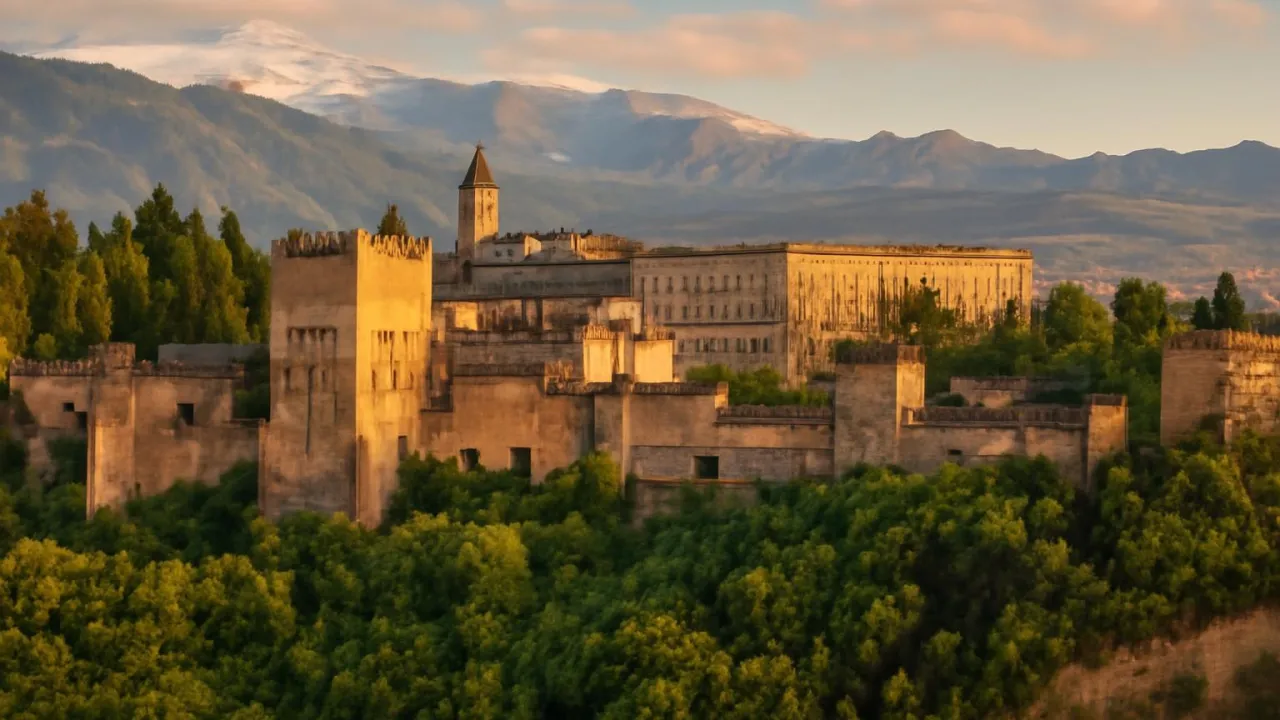
The palace’s clever builders made water run uphill using hidden channels!
✨ Word Sparks (Grade 2 Glossary)
Tap 🔊 to hear
tower
A tall, skinny building part
pattern
A design that repeats again and again
channel
A path for water to flow
🪝
What if you could wander through a palace filled with singing fountains?
1
A Palace on a Hill
The Alhambra sits high above the city of Granada. Its red walls shine bright in the sun, and tall reach for the sky. People from all over the world come to see its beauty. The palace looks like a storybook castle from far away.
2
Fountains and Gardens
Inside, fountains bubble and splash in cool, shady gardens. The water flows through long pools and makes soft music as it moves. Orange trees and flowers fill the air with sweet smells. Visitors love to walk and listen to the peaceful sounds.
3
Patterns Everywhere
Every wall and floor is covered with colorful tiles and shapes. The tiles make stars, flowers, and twisting lines in bright colors. Sunlight dances on the shiny tiles and makes the palace sparkle. It feels like a magical maze of color and sound.
Some fountains in the Alhambra are over 600 years old and still work today!
✨ Word Sparks (Grade 3 Glossary)
Tap 🔊 to hear
geometric
Made of shapes like circles and stars
vibration
A fast, tiny shaking or movement
dynasty
A line of rulers from one family
🪝
Imagine stepping into a palace where water whispers and walls sparkle with secret patterns.
1
A Fortress Above Granada
The Alhambra stands proudly on a hilltop, watching over the city of Granada. Its thick red walls and tall towers once protected kings and their families. Built during the Nasrid , the palace is a blend of fortress and fairy-tale castle. Visitors enter through ancient gates and feel like they’re traveling back in time.
2
Water’s Secret Path
Inside, water flows in every garden, courtyard, and hall. Engineers long ago designed clever channels to make water move uphill using gravity and pressure. Fountains create gentle and soothing sounds, making the palace feel peaceful. The sound of running water cools the air and fills the palace with calm.
3
A World of Patterns
Walls and floors are covered in colorful tiles called azulejos. These tiles form repeating patterns of stars, flowers, and twisting vines. Sunlight shines through carved windows, making the patterns shimmer and dance. The palace is famous for its dazzling tilework and detailed plaster carvings.
4
A Place for All People
People from many countries visit the Alhambra every year. Artists, scientists, and historians study its architecture and water systems. The palace is a symbol of Spain’s rich history and many cultures. Its beauty and clever engineering inspire visitors young and old.
The Alhambra’s main water channel is almost 4 miles (6 kilometers) long!
✨ Word Sparks (Grade 4 Glossary)
Tap 🔊 to hear
stucco
A smooth, decorative wall plaster
resonance
A sound that echoes and vibrates
calligraphy
Beautiful, artistic handwriting
🪝
What secrets would you discover if you wandered the echoing halls of a palace built for kings and poets?
1
A Jewel of Islamic Architecture
The Alhambra Palace rises above Granada, its walls glowing red at sunset and its towers standing tall against the sky. Constructed during the Nasrid Dynasty from 1238 to 1391 CE, it served as both a fortress and a royal residence. Its design blends strength and elegance, with thick defensive walls and airy courtyards. The Alhambra is now a UNESCO World Heritage site, admired for its artistic and historical value.
2
Water Engineering Wonders
One of the palace’s most astonishing features is its advanced water system, created centuries before modern plumbing. Engineers used gravity, sloped channels, and hidden pipes to bring water from the mountains to every courtyard and garden. Fountains and pools were designed to create soothing acoustic , filling the air with gentle sounds. The water also cooled the palace, making it a comfortable retreat in the hot Spanish summers.
3
Endless Patterns and Stories
Inside, the palace dazzles with geometric tilework, carved , and that covers nearly every surface. These repeating patterns and Arabic inscriptions celebrate art, science, and poetry. Sunlight streaming through lattice windows creates shifting patterns on the floors and walls. Each room tells a story, from the Lion Courtyard’s famous fountain to the Hall of the Ambassadors’ intricate ceiling.
4
A Legacy for the World
The Alhambra’s beauty and engineering have influenced artists, architects, and scientists across the globe. Its gardens and water systems are studied for their sustainable design and environmental harmony. Today, millions visit each year to experience its history and wonder. The palace stands as a symbol of creativity, culture, and peaceful coexistence.
1. Why did the Alhambra use so much water engineering?
2. What do the Arabic inscriptions celebrate?
🤯 Mind-Blowing Fact • Grade 5
Alhambra’s tilework displays all 17 mathematical wallpaper symmetry groups—more than any other building on Earth!
✨ Word Sparks (Grade 5 Glossary)
Tap 🔊 to hear
tessellation
A pattern made by fitting shapes together with no gaps
aqueduct
A bridge or channel that carries water
erosion
The slow wearing away of stone or earth
🪝
If you listened closely, could you decode the scientific secrets hidden in the Alhambra’s shimmering walls and echoing fountains?
1
A Fortress of Science and Splendor
Perched atop the Sabika hill, the Alhambra dominates Granada’s skyline with its formidable red ramparts and elegant towers. Constructed between 1238 and 1391 CE during the Nasrid Dynasty, the complex served as both a military fortress and the royal court of Muslim rulers. Its strategic hilltop location provided defense and breathtaking views of the surrounding valley and the distant Sierra Nevada mountains. Today, the Alhambra is celebrated as a masterpiece of medieval Islamic architecture and a living record of Spain’s multicultural history.
2
Hydraulic Genius: Water as Art and Engineering
The palace’s water system is a marvel of medieval engineering, channeling water from the Darro River nearly four miles away. Using gravity, sloped , and precisely angled channels, engineers delivered fresh water to every courtyard, fountain, and garden without pumps or electricity. The Court of the Lions features twelve marble lions supporting a central fountain, where water flows through four symbolic channels representing rivers of paradise. These fountains were designed to maximize acoustic resonance, creating a tranquil, cooling soundscape throughout the palace.
3
Mathematics in Mosaic: Geometry and Symmetry
Alhambra’s walls are covered with over 10,000 ceramic tiles arranged in complex geometric patterns. Artisans used mathematical principles such as symmetry, , and repetition to create starbursts, polygons, and arabesques that never exactly repeat. The intricate tilework, called azulejos, demonstrates advanced knowledge of geometry and artistic design, reflecting the scientific achievements of Islamic Spain. Sunlight filtering through lattice windows animates these patterns, changing their appearance throughout the day.
4
A Cultural Crossroads
The Alhambra is a testament to centuries of cultural exchange, blending Islamic, Christian, and Jewish artistic traditions. After the Christian conquest of Granada in 1492, new Renaissance-style buildings were added, yet the original Nasrid palaces were preserved for their beauty and innovation. The palace’s Arabic calligraphy celebrates poetry, science, and faith, while its gardens and water features embody harmony with nature. This fusion of styles and ideas has inspired architects, artists, and scientists worldwide.
5
Legacy and Preservation
Today, the Alhambra is one of the most visited monuments in Europe, attracting millions who marvel at its architecture and engineering. Ongoing restoration protects its fragile stucco, intricate tilework, and ancient hydraulic systems from and time. Scholars continue to study its sustainable design, which used natural resources efficiently and harmoniously. The Alhambra remains not only a symbol of Spain’s past but also a source of inspiration for future generations in art, science, and peaceful coexistence.