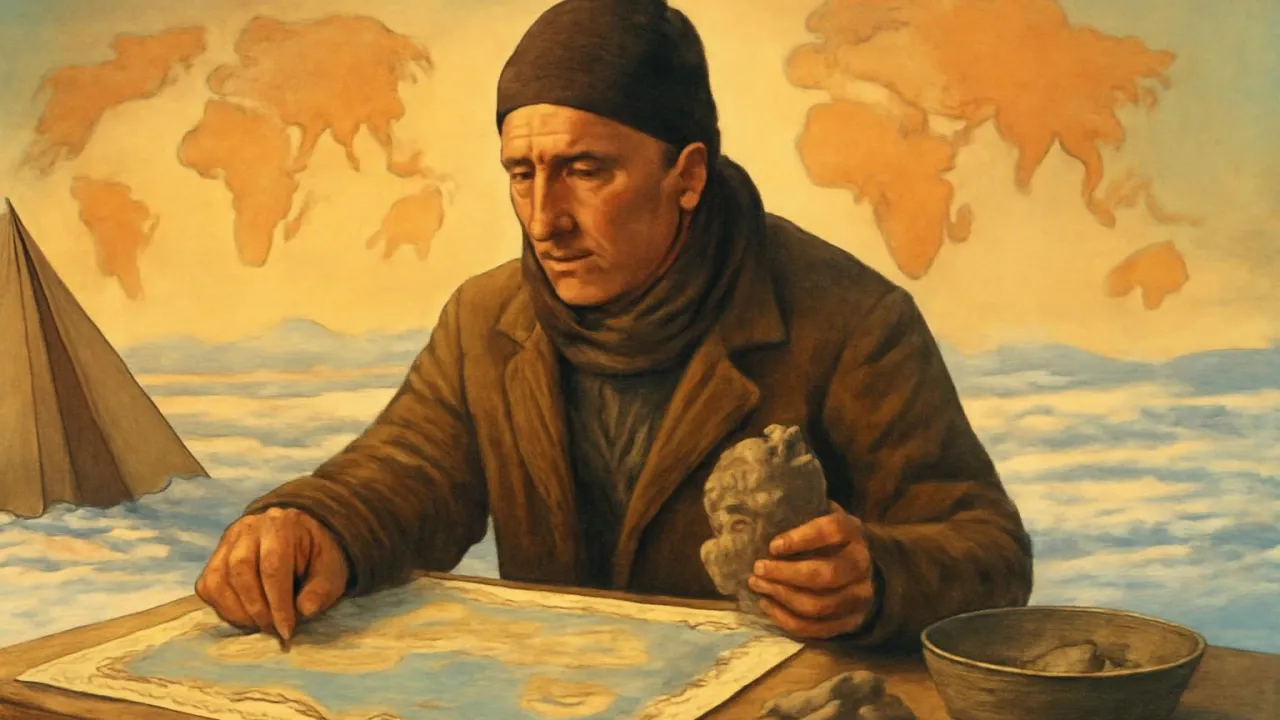
Alfred once launched a weather balloon to study the sky!
✨ Word Sparks (Grade 2 Glossary)
Tap 🔊 to hear
clue
A piece of helpful information
explorer
A person who finds new things
ocean
A huge body of salt water
🪝
Have you ever wondered why South America and Africa look like puzzle pieces?
1
Puzzle Piece Lands
Alfred noticed that continents looked like puzzle pieces and wondered if they once fit together. He studied maps, searching for that could explain the matching shapes. He imagined the continents drifting apart over a long time, and he wanted to find out if it was true.
2
Collecting Clues Everywhere
He collected rocks and fossils from faraway places and compared them. He saw that some fossils matched across , which made him think the lands had moved apart. He also found that some rocks were the same on different continents, giving him even more to support his idea.
3
Sharing His Big Idea
Alfred called his idea 'continental drift' and shared it with scientists everywhere. Many scientists did not believe him at first, but Alfred kept exploring and sharing his . He hoped that one day, people would see that his idea was right and understand how the continents move.
1. What did Alfred compare on different continents?
2. What was Alfred’s big idea called?
🤯 Mind-Blowing Fact • Grade 3
Wegener’s ideas inspired the science of plate tectonics, which explains earthquakes and volcanoes.
✨ Word Sparks (Grade 3 Glossary)
Tap 🔊 to hear
evidence
Facts that help prove something
theory
An idea that explains facts
perseverance
Keep trying, even when it’s hard
🪝
Imagine if the ground beneath your feet could slowly travel across the world!
1
A Curious Mind
As a boy, Alfred Wegener loved exploring nature and studying maps of the world. He noticed how the shapes of continents, like Africa and South America, seemed to fit together. This made him wonder if the land had once been joined. He started asking questions about how the world had changed over time.
2
Gathering Evidence
Alfred became a scientist and started collecting for his idea. He found that similar fossils and rocks appeared on continents separated by oceans. He also studied ancient climates and noticed patterns that matched his . Alfred worked with other scientists to gather even more clues from different places.
3
Continental Drift Theory
Alfred called his idea 'continental drift,' suggesting continents move slowly over time. Many scientists disagreed, thinking continents were fixed in place. But Alfred kept searching for proof and sharing his discoveries. He presented his findings at meetings and wrote papers to explain his .
4
A Lasting Impact
Today, scientists know Alfred was right, thanks to plate tectonics. His curiosity and changed how we understand Earth’s surface. He inspired others to look for new answers and keep asking questions. Wegener’s ideas helped create the science of how our planet changes.
Wegener’s supercontinent was called 'Pangaea,' meaning 'all the Earth' in Greek!
✨ Word Sparks (Grade 4 Glossary)
Tap 🔊 to hear
geology
The study of Earth’s rocks and land
paleontology
The study of fossils and ancient life
expedition
A journey to explore or discover
🪝
What clues would you look for if you wanted to prove the continents could move?
1
Connecting the Continents
Alfred Wegener grew up fascinated by the natural world and always questioned what he saw on maps. He noticed that the coastlines of continents such as South America and Africa appeared to fit together like giant puzzle pieces. This observation sparked his quest to find out if the continents had once been joined together in a supercontinent.
2
Clues Across Oceans
To support his idea, Alfred collected evidence from many fields, including , , and climate science. He discovered that identical fossils and rock layers existed on continents now separated by vast oceans, and he found signs of ancient glaciers in places that are now warm. These clues helped him build his theory of continental drift.
3
Facing Doubt and Danger
Although Alfred’s theory was bold, most scientists at the time rejected it because he could not explain how continents moved. Still, Alfred continued his research, even leading dangerous to Greenland to study Earth’s climate and ice. His dedication to science led him through many hardships and risky adventures.
4
A Theory Confirmed
Long after Alfred’s death, new discoveries about plate tectonics finally proved his ideas correct. Today, scientists understand that continents drift because of moving plates beneath Earth’s surface. Alfred Wegener’s curiosity and determination changed the way we study our planet forever.
1. What did Wegener name the ancient supercontinent?
2. Why did some scientists doubt Wegener’s theory?
🤯 Mind-Blowing Fact • Grade 5
Wegener’s 1915 book, 'The Origin of Continents and Oceans,' became a foundation for modern Earth science.
✨ Word Sparks (Grade 5 Glossary)
Tap 🔊 to hear
plate tectonics
The movement of giant pieces of Earth’s crust
mechanism
The way something works or moves
legacy
What someone leaves behind for others
🪝
How did one scientist’s curiosity about drifting continents reshape our understanding of Earth’s history?
1
A Puzzle on the Map
One day, while studying world maps, Alfred Wegener noticed that the coastlines of South America and Africa fit together almost perfectly, like pieces of a jigsaw puzzle. This observation led him to wonder if the continents had once formed a single landmass and later drifted apart. His curiosity drove him to gather clues from many scientific fields, including geology, meteorology, and paleontology, to support his bold idea.
2
Building the Case for Continental Drift
Wegener collected a wide range of evidence, such as identical fossils of extinct plants and animals found on continents separated by oceans, and matching rock formations across distant lands. He also studied ancient climate patterns, discovering evidence of glaciers in now-tropical regions. In 1912, Wegener published his revolutionary theory of continental drift, proposing that the continents had once formed a supercontinent called Pangaea before slowly drifting to their current positions.
3
Challenges and Expeditions
Despite his compelling evidence, Wegener’s theory was met with skepticism because he could not explain the that moved entire continents. Undeterred, he continued his research and led several dangerous expeditions to Greenland to study polar weather and ice sheets. Wegener’s work in extreme conditions demonstrated his scientific dedication and perseverance, even as he faced harsh criticism and life-threatening challenges.
4
A Legacy Confirmed by Plate Tectonics
Decades after Wegener’s death, the discovery of in the 1960s provided the missing explanation for continental movement. Scientists found that Earth’s outer shell is divided into plates that slowly shift, carrying continents with them. This breakthrough confirmed Wegener’s theory and reshaped the fields of geology and Earth science, proving that scientific ideas can take years to be accepted.
5
Inspiring Future Explorers
Alfred Wegener’s story teaches us the importance of curiosity, persistence, and open-mindedness in science. His willingness to challenge accepted beliefs and gather evidence from many sources changed our understanding of Earth’s past and future. Today, his inspires scientists and explorers to keep asking big questions and to never give up, even when their ideas seem impossible.