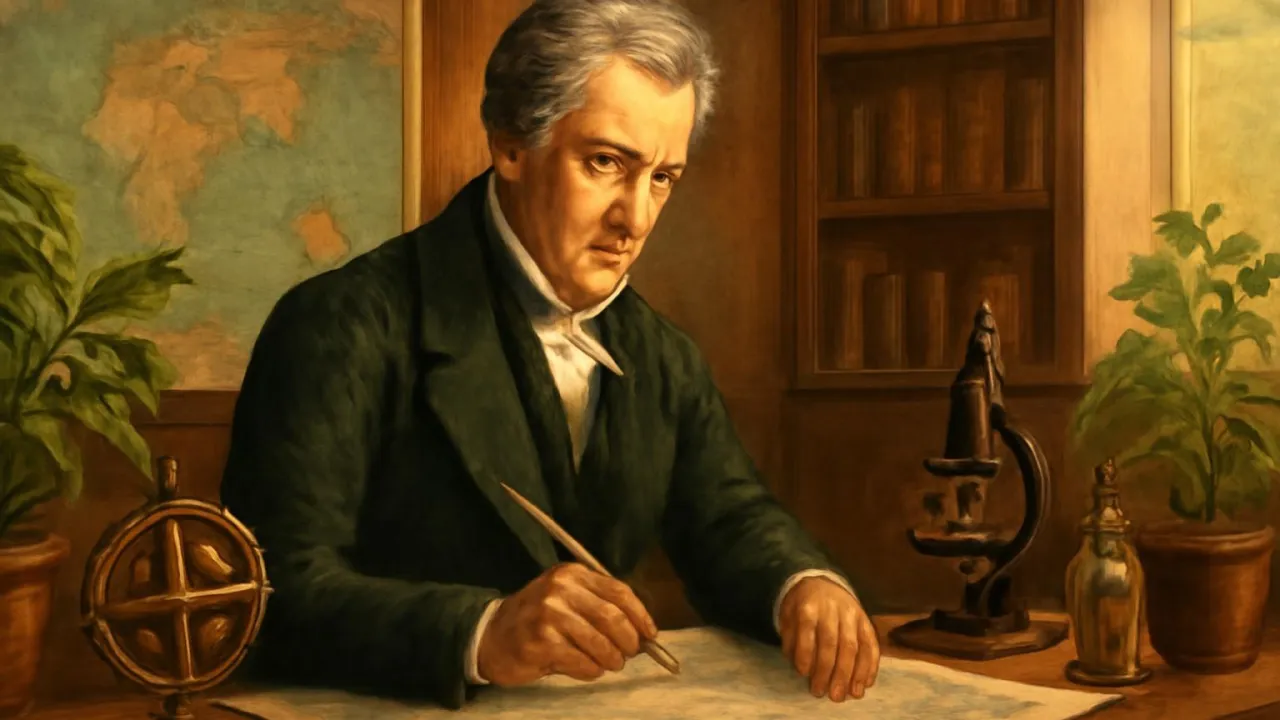
Alexander von Humboldt’s travels helped create the science of ecology.
✨ Word Sparks (Grade 2 Glossary)
Tap 🔊 to hear
climate
The usual weather in a place
scientist
A person who studies nature and experiments
explore
To travel and learn about new places
🪝
How do explorers learn about faraway plants and animals by traveling?
1
Curious About Nature
Alexander von Humboldt was curious about nature and wanted to the world. He studied plants, animals, and weather. As a boy, he read many books about science and maps.
2
Journey to Discover
He traveled to South America to mountains, rivers, and forests. He took notes and drew pictures every day. He worked hard to understand how nature works together.
3
Famous Achievements
Alexander’s discoveries helped learn about and plants worldwide. He showed how everything in nature connects. His work inspired many explorers and scientists after him.
Humboldt’s work helped start the field of ecology, studying how living things connect.
✨ Word Sparks (Grade 3 Glossary)
Tap 🔊 to hear
perseverance
Not giving up even when things are hard
biogeography
Study of where plants and animals live
hypothesis
An idea you test to learn more
🪝
What happens when you connect plants, animals, and climates in one big idea?
1
A Scientist’s Early Curiosity
Alexander von Humboldt showed great as a young scientist exploring nature’s mysteries. He studied many plants and animals, forming early hypotheses about how they lived. His curiosity led him to read about geography, physics, and natural philosophy.
2
Exploring the Natural World
During his travels in South America, Humboldt carefully recorded data on climate, altitude, and plant life. He used tools to measure temperature and air pressure, showing how different environments affected living things. His detailed observations helped develop the science of .
3
Overcoming Challenges
Humboldt faced many obstacles like rough terrain and weather, but his never wavered. He adapted his methods and worked with local guides to reach remote areas. His sportsmanship and respect for nature inspired others to continue his work.
4
Changing How We See Earth
His discoveries connected the dots between plants, animals, and climates worldwide, changing scientific philosophy forever. Humboldt’s work helped others understand Earth as a complex, interconnected system. His legacy remains important in environmental science today.
1. What helped Humboldt study different environments?
2. What did Humboldt’s discoveries connect?
🤯 Mind-Blowing Fact • Grade 4
Humboldt’s maps and climate studies helped start the science of ecosystems worldwide.
✨ Word Sparks (Grade 4 Glossary)
Tap 🔊 to hear
ecosystem
A community of plants, animals, and environment
humidity
How much water is in the air
innovation
A new idea or method that changes things
🪝
How did Alexander von Humboldt’s explorations change the way we understand our planet?
1
Science in a Changing World
During the late 1700s and early 1800s, science was growing fast, and Humboldt’s curiosity fit perfectly into this exciting time. He combined ideas from physics, geography, and biology to study Earth’s natural systems. His work came when people began exploring new continents and learning about unknown plants and animals.
2
Turning Points in Exploration
Humboldt’s journey to South America was a major turning point where he collected data on mountains, rivers, and tropical forests. He innovated by using precise instruments to measure climate factors like temperature and , which was new for explorers. This helped him create detailed maps and charts that showed how nature changes with altitude.
3
Signature Innovations
One of Humboldt’s signature techniques was connecting diverse observations into a single scientific view of the Earth’s environment. He introduced the idea that plants and animals depend on climate and geography, which was revolutionary. His approach inspired future scientists to study and environmental relationships.
4
Global Impact and Legacy
Humboldt’s work influenced scientists worldwide and helped launch modern environmental science. His books were translated into many languages, spreading his ideas across Europe and the Americas. Today, he is remembered as a pioneer who showed how everything in nature is connected.
1. What new idea did Humboldt introduce about plants and animals?
2. How did Humboldt’s work spread around the world?
🤯 Mind-Blowing Fact • Grade 5
Humboldt documented over 4,000 plant species and created foundational ideas for ecology and biogeography.
✨ Word Sparks (Grade 5 Glossary)
Tap 🔊 to hear
biogeography
Study of where plants and animals live on Earth
atmospheric pressure
The weight of air pressing down on Earth
interconnectedness
How things in nature are linked together
🪝
What can we learn from Alexander von Humboldt’s detailed studies of Earth’s natural systems?
1
Early Life and Intellectual Curiosity
Alexander von Humboldt was born into a wealthy Prussian family, which allowed him access to extensive education in natural sciences, languages, and geography. From a young age, he showed a deep curiosity about the natural world, reading widely and conducting early experiments in chemistry and physics. His intellectual curiosity was fueled by the Enlightenment ideals of reason and observation.
2
Scientific Methods and Exploration
Humboldt’s scientific approach combined meticulous data collection with innovative use of instruments like barometers and thermometers to measure and temperature accurately. During his five-year expedition across South America, he documented over 4,000 plant species and mapped vast regions, including the Orinoco River basin and the Andes mountains. His quantitative methods set new standards in natural history and geography.
3
Career Achievements and Legacy
Alexander von Humboldt’s published works, such as "Personal Narrative" and "Kosmos," synthesized his observations into a unified vision of nature’s . He influenced fields ranging from ecology to geology and inspired scientists like Charles Darwin. Humboldt’s career records include pioneering studies on plant distribution related to altitude and climate, which laid the groundwork for and environmental science.
4
Historical Impact and Recognition
Humboldt’s explorations coincided with a period of colonial expansion and scientific discovery, yet he advocated for respect toward indigenous peoples and nature. His global impact is seen in the naming of geographical features like the Humboldt Current and Humboldt University. Today, he is celebrated as a foundational figure in Earth sciences and environmental awareness.
5
Inspiring Takeaways
Alexander von Humboldt teaches us the power of curiosity, perseverance, and connecting ideas across disciplines to understand complex systems. His life shows how detailed observation and respect for nature can lead to discoveries that change how humans see their planet. Humboldt’s legacy encourages young scientists to explore, ask questions, and protect our environment.