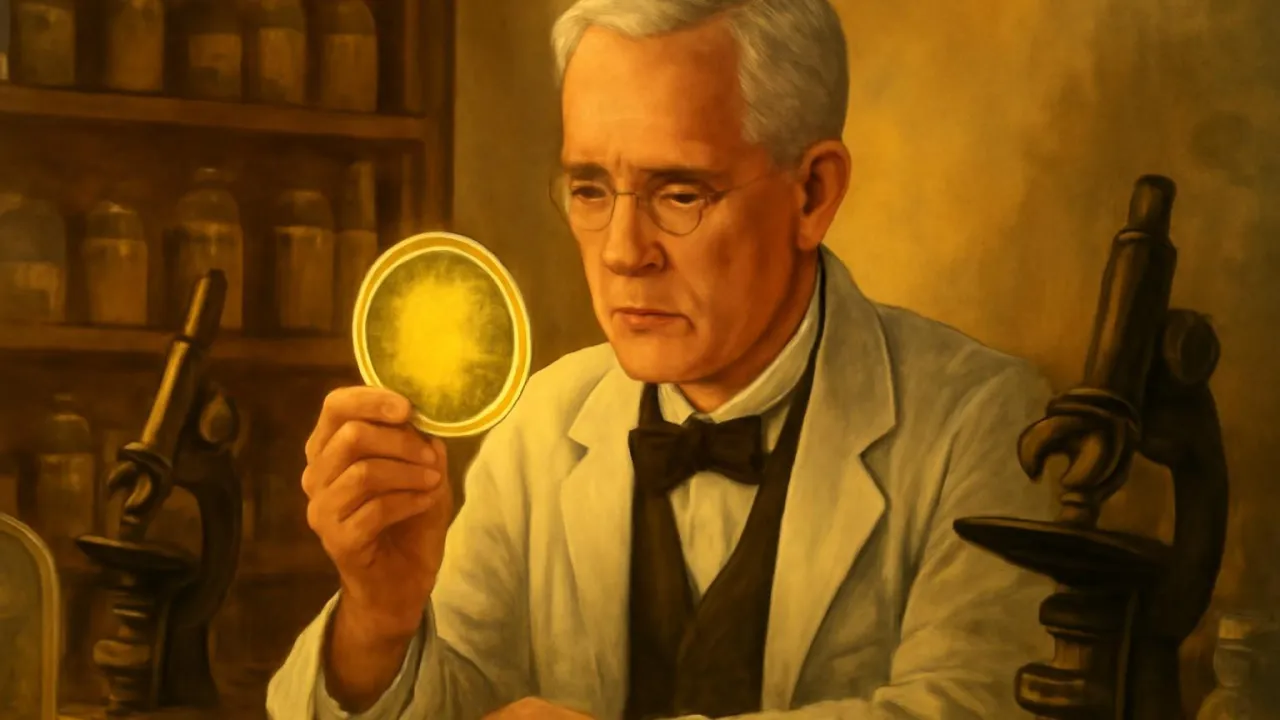
Penicillin helped doctors treat wounded soldiers during World War II.
✨ Word Sparks (Grade 2 Glossary)
Tap 🔊 to hear
mold
A fuzzy living thing, like on old bread
infection
When germs make a cut or body part sore
discovery
Finding something new and important
🪝
Have you ever found something amazing by accident?
1
A Curious Scientist
Alexander loved to look at things under his microscope. He liked to ask questions about how germs made people sick. He worked in a busy lab with many tools and glass dishes.
2
An Unexpected Discovery
One day, he noticed a green growing in a dish. The mold had killed the bad germs nearby, which surprised him. Alexander wondered if this mold could help sick people.
3
Penicillin Helps People
He tested the and found it could fight . He named the medicine penicillin and shared his . Soon, doctors used penicillin to save many lives.
Fleming’s discovery of penicillin began when he returned from vacation and noticed a forgotten dish!
✨ Word Sparks (Grade 3 Glossary)
Tap 🔊 to hear
bacteria
Tiny living things that can cause sickness
antibiotic
A medicine that kills harmful bacteria
hypothesis
A smart guess that scientists test
🪝
Can a tiny mistake lead to a giant breakthrough?
1
The Curious Boy
As a child in Scotland, Alexander loved exploring the outdoors and asking questions. He was fascinated by how things worked, especially living things too small to see. This curiosity led him to become a scientist and study . His careful observations would change medicine forever.
2
A Messy Lab Surprise
One day in his London laboratory, Alexander noticed a strange green mold growing in a dish of . He saw that the bacteria around the mold had disappeared, leaving a clear circle. This made him wonder if the mold could kill harmful germs. He decided to investigate this mystery further.
3
Testing a Hypothesis
Alexander tested the mold and found it could destroy many dangerous . He called the substance penicillin, after the mold Penicillium notatum. It became the first true , a medicine that kills bacteria without harming people. His discovery made it possible to treat deadly infections.
4
Changing the World
Penicillin saved millions of lives, especially during World War II, by treating infected wounds. Alexander became famous for his perseverance and scientific curiosity. He showed that paying attention to small details can lead to big discoveries. Today, are used all over the world to fight illness.
1. Why did Alexander name his discovery penicillin?
2. How did penicillin help during World War II?
🤯 Mind-Blowing Fact • Grade 4
Fleming received the Nobel Prize in Medicine in 1945 for discovering penicillin.
✨ Word Sparks (Grade 4 Glossary)
Tap 🔊 to hear
petri dish
A small round dish for growing germs
bacteriologist
A scientist who studies bacteria
Nobel Prize
A top award for important discoveries
🪝
What if a forgotten petri dish could change the course of history?
1
A Childhood of Curiosity
Growing up on a Scottish farm, Alexander Fleming was always fascinated by the natural world around him. He loved exploring streams, fields, and observing tiny creatures, which sparked his interest in science and medicine. After studying in London, he became a , determined to find ways to fight infections. His early curiosity and patient nature helped him notice things others might miss.
2
The Accidental Discovery
In 1928, after returning from a holiday, Fleming noticed a left on his cluttered lab bench. A greenish mold was growing, and around it, the bacteria had vanished, leaving a clear zone. Intrigued, Fleming realized the mold, Penicillium notatum, produced a substance that killed harmful bacteria. This accidental observation would soon revolutionize medicine.
3
Turning Mold into Medicine
Fleming carefully experimented with the mold to test its effects on different bacteria. He discovered that penicillin could destroy many dangerous germs without harming healthy cells, making it the first true antibiotic. Although it took years and help from other scientists to produce enough penicillin for hospitals, Fleming’s work laid the foundation for modern antibiotics.
4
A Legacy That Saves Lives
Penicillin became a vital medicine during World War II, saving countless wounded soldiers from deadly infections. Fleming’s discovery marked a turning point in medical history, leading to the development of more antibiotics. His story shows how curiosity, careful observation, and even accidents can lead to world-changing breakthroughs.
By the end of World War II, penicillin was saving tens of thousands of lives every month.
✨ Word Sparks (Grade 5 Glossary)
Tap 🔊 to hear
antibiotic resistance
When bacteria stop being killed by medicine
collaboration
Working together to solve a problem
insight
A new, smart idea or understanding
🪝
How can a scientist’s sharp eye and a bit of luck transform the entire world of medicine?
1
Roots of a Scientific Mind
As a boy on a rural Scottish farm, Alexander Fleming developed a keen sense of observation, spending hours watching insects, plants, and streams. This early curiosity drove him to pursue medical studies at St. Mary’s Hospital in London, where he became fascinated with bacteriology—the study of bacteria and their effects on human health. Fleming’s careful nature and relentless questioning prepared him for the groundbreaking discovery that would later define his legacy. His background taught him that even the smallest details could hold great importance.
2
The Laboratory Accident That Changed Everything
In September 1928, Fleming returned from vacation to find a petri dish of Staphylococcus bacteria he had accidentally left uncovered. To his amazement, a blue-green mold had grown on the dish, and all the bacteria near the mold were gone, leaving a clear ring. Fleming hypothesized that the mold, identified as Penicillium notatum, released a substance capable of destroying harmful bacteria. This moment of , born from a combination of luck and scientific curiosity, would lead to the dawn of the antibiotic era.
3
From Curiosity to Medical Revolution
Fleming’s experiments proved that penicillin could kill many dangerous bacteria without harming human cells, making it a safe and powerful antibiotic. However, producing penicillin in large quantities was a major challenge, requiring years of with scientists like Howard Florey and Ernst Chain. Their teamwork led to the mass production of penicillin during World War II, saving countless lives by treating infections that had previously been fatal. Fleming’s discovery reshaped modern medicine and made surgeries and treatments much safer.
4
Scientific Legacy and Global Impact
Penicillin’s success inspired the search for more antibiotics, fundamentally changing how doctors fight infectious diseases. Fleming received the Nobel Prize in Physiology or Medicine in 1945, sharing the honor with Florey and Chain for their collective achievement. His work not only saved millions of lives during the war but also continues to protect people from deadly infections today. Fleming’s story is a powerful reminder that careful observation, perseverance, and open-mindedness can lead to discoveries that benefit all of humanity.
5
Lessons for Future Scientists
Alexander Fleming’s journey teaches us that science is often about noticing the unexpected and asking the right questions. His accidental discovery shows that even mistakes can become opportunities for learning and innovation. Today, antibiotics remain essential tools in hospitals and clinics around the world, but scientists also warn about —a new challenge requiring the same curiosity and determination Fleming displayed. His life encourages young thinkers to stay curious, keep exploring, and always look closely at the world around them.