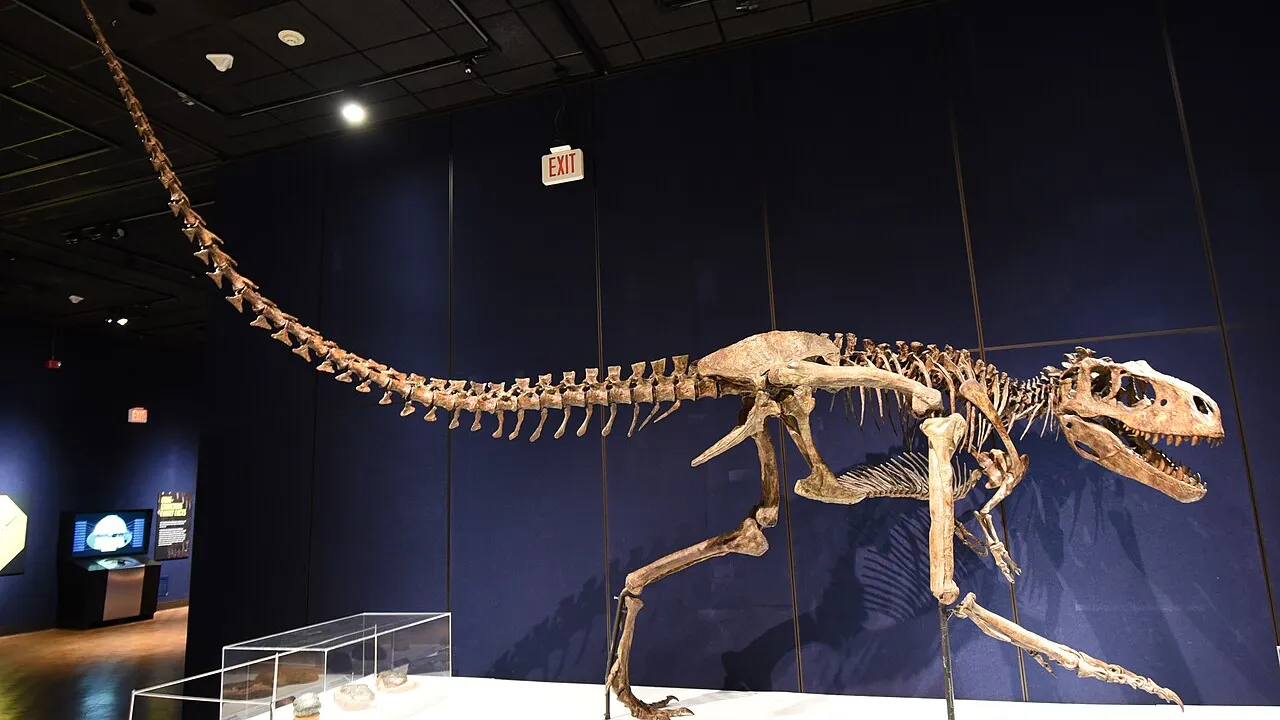
1. How did Albertosaurus compare to its famous relative T. rex?
2. Why do some scientists think Albertosaurus lived in groups?
🤯 Mind-Blowing Fact • Grade 2
Teenage Albertosaurus grew so rapidly that they packed on more than 250 pounds of muscle and bone every single year!
✨ Word Sparks (Grade 2 Glossary)
Tap 🔊 to hear
badlands
Dry, rocky hills carved deeply by wind and rain
bonebed
A rock layer packed with many fossil skeletons
shin
The front bone of the lower leg below knees
🪝
What did twenty-six tyrannosaurs buried together in Alberta's badlands reveal?
1
Named After Sunny Alberta
Imagine paddling a canoe down Canada's Red Deer River in 1884 and spotting a giant toothed skull sticking out of a steep cliff! Geologist Joseph Tyrrell had just found the dinosaur later named Albertosaurus after Alberta, Canada. Living 70 million years ago, this two-ton hunter ruled lush coastal forests a couple million years before T. rex.
2
Built Like an Ostrich-Legged Hunter
Albertosaurus had classic tyrannosaur traits: a big boxy skull, tiny two-fingered hands, and dozens of curved teeth. However, its and foot bones were extra long and locked tightly together to absorb pounding sprints.
3
Mystery of the Dry Island Bonebed
At Dry Island in Alberta, paleontologists uncovered at least twenty-two Albertosaurus individuals—from speedy two-year-olds to grizzled twenty-year-old elders—buried in one ancient storm flood!
1. Who discovered the first Albertosaurus skull along the Red Deer River in 1884?
2. What helped Albertosaurus run smoothly at high speeds?
🤯 Mind-Blowing Fact • Grade 3
Growth rings in Albertosaurus leg bones show most individuals reached adult size around age sixteen, while the oldest known elder lived to twenty-eight!
✨ Word Sparks (Grade 3 Glossary)
Tap 🔊 to hear
hadrosaur
A large, social plant-eating dinosaur with a duck-like bill
juvenile
A young animal that has not reached adulthood
impact
The strong force when two things hit together
🪝
Did nimble teenage Albertosaurus flush prey toward waiting adults like a wolf pack?
1
Prowling Swamp Cypress Forests
Mist curls around towering dawn redwoods in Late Cretaceous Alberta 70 million years ago. Stepping silently onto a fern meadow is Albertosaurus sarcophagus, a nine-meter tyrannosaurid weighing roughly 1.8 tons—less than a quarter the weight of a full-grown Tyrannosaurus rex. Above each eye rose a short, textured bony crest that likely wore bright colors.
2
Shock-Absorbing Feet
Like other advanced tyrannosaurs, Albertosaurus possessed an arctometatarsalian foot: its middle foot bone was pinched tightly between the two outer bones. When its foot struck the ground at twenty-five miles per hour, the bones flexed slightly to soak up energy and spring forward after duck-billed like Saurolophus.
3
Clues From Twenty-Six Skeletons
First found by Barnum Brown in 1910 and reopened by paleontologist Philip Currie in 1997, the Dry Island bonebed preserved between twenty-two and twenty-six Albertosaurus together with almost zero plant-eater bones.
4
Teamwork Across Ages
Currie proposed that fleet-footed could chase fast prey toward stronger, heavier adults, showing social behavior rarely seen in giant reptiles.
How do growth rings inside fossilized shin bones reveal the life story of an entire Albertosaurus group?
1
Cheetah of the Tyrannosaurs
Picture the cool, humid coastal wetlands of Alberta's Horseshoe Canyon Formation 70 million years ago, bordered by the retreating Western Interior Seaway. Patrolling these cypress swamps was Albertosaurus sarcophagus, named by Henry Fairfield Osborn in 1905 from skulls collected along the Red Deer River. Belonging to the slender albertosaurine branch of Tyrannosauridae, this nine-meter predator traded extreme bulk for speed and agility.
2
Shock-Absorbing Skulls and Feet
Although its bite force measured lower than that of later Tyrannosaurus rex, Albertosaurus still possessed thicker, D-shaped front premaxillary teeth and over sixty curved maxillary and dentary crowns. Flexible sutures between its facial bones absorbed twisting stresses when struggling prey pulled back, while its elongated tibiae and pinched delivered top speeds estimated near thirty to forty kilometers per hour.
3
Inside the Dry Island Bonebed
Rediscovered in 1997 by Philip Currie using a faded 1910 photograph from Barnum Brown's camp, the Dry Island Buffalo Jump site yielded at least twenty-two Albertosaurus individuals ranging from a two-year-old two-meter youngster to a massive ten-meter elder, buried rapidly during a violent storm.
4
Reading Dinosaur Growth Curves
Paleontologist Gregory Erickson sliced thin sections of Dry Island fibulae to count annual (lines of arrested growth), discovering an S-shaped growth spurt where teenagers gained over 120 kilograms per year between ages twelve and sixteen!
1. How did paleontologist Philip Currie relocate Barnum Brown's famous 1910 Albertosaurus bonebed?
2. What did bone growth rings reveal about teenage Albertosaurus?
🤯 Mind-Blowing Fact • Grade 5
Albertosaurus was the very first meat-eating dinosaur species with enough dated skeletons from one site to plot a full wildlife survivorship curve just like modern African lions or bighorn sheep!
✨ Word Sparks (Grade 5 Glossary)
Tap 🔊 to hear
histology
Microscopic study of thin slices of biological tissue or bone
survivorship curve
A graph tracking what fraction of animals reach each age
cursorial
Specially adapted in limb proportions for fast running
🪝
What made the Dry Island Albertosaurus bonebed the premier testing ground for dinosaur population biology and gregarious behavior?
1
Discovery in the Red Deer Badlands
On June 9, 1884, twenty-five-year-old Geological Survey of Canada explorer Joseph Burr Tyrrell uncovered a large carnivorous dinosaur skull weathering from Maastrichtian strata along Alberta's Red Deer River. Named Albertosaurus sarcophagus by Henry Fairfield Osborn in 1905, this graceful albertosaurine tyrannosaurid measured roughly nine meters long and weighed 1.5 to 2 metric tons, dominating the cool-temperate Horseshoe Canyon Formation ecosystem between seventy-one and sixty-eight million years ago.
2
Albertosaurine Cursorial Anatomy
Along with its close relative Gorgosaurus, Albertosaurus represents the more lightly built subfamily Albertosaurinae. Prominent rugose lacrimal horns projected forward of the orbits for visual signaling, while kinetically cushioned cranial sutures dampened feeding loads. Below the hips, elongated tibiae and a strongly wedged arctometatarsalian pes transmitted torsional forces efficiently across the ankle, optimizing pursuit of abundant hadrosaurids such as Saurolophus and Edmontosaurus.
3
Reopening Barnum Brown's Quarry
In 1910, American Museum collector Barnum Brown excavated parts of nine Albertosaurus skeletons from a single hillside before moving on. Eighty-seven years later, Philip Currie used archival photographs to relocate the quarry at Dry Island Buffalo Jump Provincial Park, ultimately documenting between twenty-two and twenty-six individuals buried simultaneously alongside toppled conifer trunks during a single storm event.
4
Histology and Survivorship Curves
Histological counts of lines of arrested growth (LAGs) by Gregory Erickson and colleagues allowed the first ever constructed for a large theropod. Like modern large mammals and birds, Albertosaurus experienced low mid-life mortality after surviving infancy, followed by surging mortality after sexual maturity (~14–16 years) and an adolescent growth rate peaking near 122 kilograms annually.
5
Evaluating the Pack-Hunting Hypothesis
Whether Dry Island captures a cooperative, age-segregated hunting pack or a temporary storm-driven aggregation, the bonebed proves multi-generational groups of Albertosaurus occupied the exact same patch of forest simultaneously.