2. What famous clues in Texas show how Acrocanthosaurus moved?
🤯 Mind-Blowing Fact • Grade 2
One fossil trackway in Texas shows an Acrocanthosaurus-sized hunter hopping a step out of rhythm—possibly while lunging alongside a giant sauropod!
✨ Word Sparks (Grade 2 Glossary)
Tap 🔊 to hear
limestone
Pale rock formed from ancient sea mud and shells
trackway
A trail of connected fossil footprints in stone
anchor
To hold muscles or parts firmly in place
🪝
What secret story is frozen in stone along the Paluxy River in Texas?
1
Tracks Written in Stone
Imagine peering into clear river water in Glen Rose, Texas, and seeing giant three-toed dinosaur footprints pressed into solid ! Over 110 million years ago, Acrocanthosaurus walked across squishy coastal mud right behind a herd of towering long-necked sauropods. Sunlight baked that mud until it turned into stone.
2
Built With a Muscular Ridge
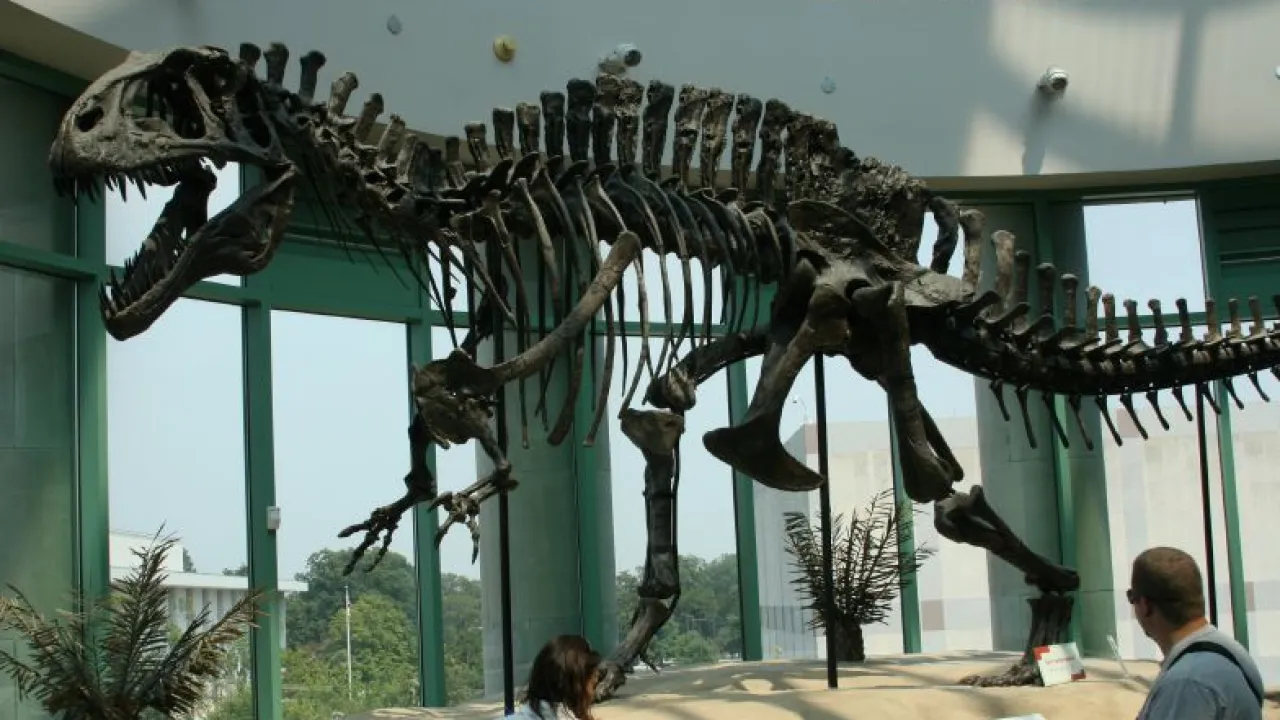
Stretching 38 feet long and weighing six tons, Acrocanthosaurus carried foot-tall bony spines along its neck, back, and tail. Rather than holding a thin skin sail, these spines anchored thick bands of muscle.
3
Oklahoma's State Dinosaur
Because its first skeletons were found in Atoka County, Oklahoma, this Early Cretaceous giant proudly serves as Oklahoma's official state dinosaur!
1. What wrapped around the tall backbone spines of Acrocanthosaurus?
2. Which US state honors Acrocanthosaurus as its official state dinosaur?
🤯 Mind-Blowing Fact • Grade 3
The famous skeleton nicknamed 'Fran,' housed at the North Carolina Museum of Natural Sciences, preserves one of the most complete giant carcharodontosaurid skulls ever found!
✨ Word Sparks (Grade 3 Glossary)
Tap 🔊 to hear
tendon
A tough cord connecting muscle firmly to bone
tidal flat
Muddy coastal land covered and uncovered by tides
vertebrae
The linked bones that form an animal's backbone
🪝
How did Acrocanthosaurus use its tall back ridge and hooked arms to hunt giants?
1
Titan of the Gulf Coast
Warm ocean breezes blow across muddy in Early Cretaceous Texas and Oklahoma 112 million years ago. Striding past cypress groves comes Acrocanthosaurus atokensis, an 11.5-meter, six-ton cousin of Africa's Carcharodontosaurus. Long before Tyrannosaurus rex evolved, Acrocanthosaurus reigned from Texas all the way east to Maryland.
2
Why Such Tall Spines?
Along its stood thick neural spines over thirty-five centimeters tall—more than two and a half times the height of the backbone centers beneath them! Rough ridges on those bones show they anchored massive and muscles, stiffening its back and neck like a suspension bridge while absorbing heavy shocks.
3
Short Reach, Tight Grip
Detailed joint studies of a nearly complete skeleton nicknamed 'Fran' revealed that Acrocanthosaurus could not reach far forward with its short arms. However, once pressed close against huge prey, its muscular three-fingered hands pulled inward with tremendous force.
4
Following Giant Herds
Famous Paluxy River trackways capture three-toed theropod prints shadowing bath-tub-sized sauropod tracks across ancient lime mud.
1. How did Acrocanthosaurus use its short, muscular forelimbs?
2. How wide was the North American range of Acrocanthosaurus?
🤯 Mind-Blowing Fact • Grade 4
CT scans of 'Fran's' skull showed Acrocanthosaurus held its snout tilted downward by about 25 degrees below horizontal so both eyes could focus clearly ahead!
✨ Word Sparks (Grade 4 Glossary)
Tap 🔊 to hear
range of motion
How far a joint can bend or rotate naturally
epaxial
Muscles positioned along the upper side of backbones
retract
To pull backward or draw inward forcefully
🪝
What happens when paleontologists test every single arm and leg joint of a six-ton dinosaur?
1
An Early Cretaceous Powerhouse
Imagine standing along an Aptian–Albian coastal plain 112 million years ago, where a warm inland sea lapped at modern-day central Texas. Emerging onto the white lime mud is Acrocanthosaurus atokensis, North America's largest Early Cretaceous carnivore at 11.5 meters long. Named in 1950 by J. Willis Stovall and Wann Langston Jr. from Oklahoma fossils, this carcharodontosaurid built its entire skeleton for tackling supersized herbivores.
2
Engineering of the High Spines
Unlike Spinosaurus, whose tallest spines rose mainly over the middle back, Acrocanthosaurus carried thick, thirty-five-centimeter neural spines continuously from neck to mid-tail. Interlocking bony prongs called hyposphenes linked adjacent vertebrae, while muscles flanked the spines to form a bison-like muscular ridge. This reinforced beam kept its spine stable as its 1.3-meter skull delivered slashing bites.
3
Secrets From Skeleton 'Fran'
Using the extraordinarily well-preserved specimen NCSM 14345—nicknamed 'Fran'—paleontologists Phil Senter and James Robins mapped the exact in its forelimbs. Its shoulder socket tilted backward and its elbow bent less than ninety degrees, preventing forward reaching; instead, once its jaws clamped onto a giant sauropod like Sauroposeidon, its sickle-clawed hands retracted forcefully against its chest.
4
Reading the Paluxy Detective Trail
At Dinosaur Valley State Park in Texas, parallel sauropod and large theropod trackways preserve real-time stride lengths, speed changes, and muddy toe slips from 113 million years ago.
1. Why did Acrocanthosaurus tilt its head about 25 degrees downward while alert?
2. How did Acrocanthosaurus's neural spines differ from those of Spinosaurus?
🤯 Mind-Blowing Fact • Grade 5
3D computer muscle reconstructions of Acrocanthosaurus's legs and tail showed its massive caudofemoralis tail muscle provided the main forward thrust for chasing twenty-ton sauropods!
✨ Word Sparks (Grade 5 Glossary)
Tap 🔊 to hear
ichnology
The branch of geology studying fossilized footprints and traces
binocular overlap
Where both eyes view the same target for depth
ligament
Tough fibrous tissue connecting one bone directly to another
🪝
How do biomechanical models and fossil trackways unite to reconstruct Acrocanthosaurus atokensis in living motion?
1
North America's Carcharodontosaurid Giant
During the Aptian and early Albian stages of the Early Cretaceous (115–105 MYA), an expanding Gulf of Mexico fringed Oklahoma and Texas with humid conifer forests and carbonate tidal flats. Dominating this ecosystem from the western interior to Maryland's Arundel Clay was Acrocanthosaurus atokensis, an 11.5-meter, six-metric-ton carcharodontosaurid named by J. Willis Stovall and Wann Langston Jr. in 1950 after Atoka County, Oklahoma.
2
Axial Stiffening and Muscular Hump
Acrocanthosaurus derives its name from neural spines measuring more than 2.5 times the height of their supporting centra from the cervicals through the anterior caudals. Cervical spines exhibit deep rugose excavations that housed robust interspinal , while dorsal vertebrae interlock via accessory hyposphene-hypantrum articulations. Rather than supporting a thin thermoregulatory skin sail, these stout spines anchored massive epaxial musculature that absorbed violent reaction forces when slashing multi-ton sauropods.
3
Endocranial Posture and Cranial Bite
High-resolution CT reconstructions of specimen NCSM 14345 ('Fran') by Franzosa and Rowe revealed large olfactory bulbs, an allosauroid-grade S-shaped braincase, and horizontal semicircular canals indicating a habitual head posture pitched roughly twenty-five degrees below horizontal, maximizing past its narrow rostrum.
4
Forelimb Kinematics and Running Speed
Range-of-motion analyses demonstrated limited humeral protraction paired with powerful retraction and permanently pronated, medially facing palms armed with curved manual claws. Meanwhile, three-dimensional musculoskeletal hind-limb models by Karl Bates and colleagues estimated top running speeds between twenty-five and thirty kilometers per hour—plenty fast to overtake giant titanosauriforms.
5
Ichnological Evidence at Glen Rose
Preserved in the Glen Rose Formation along Texas's Paluxy River, tridactyl Eubrontes-type trackways attributed to Acrocanthosaurus intersect wide Brontopodus sauropod trails, capturing one of paleontology's most famous predator-prey encounters.