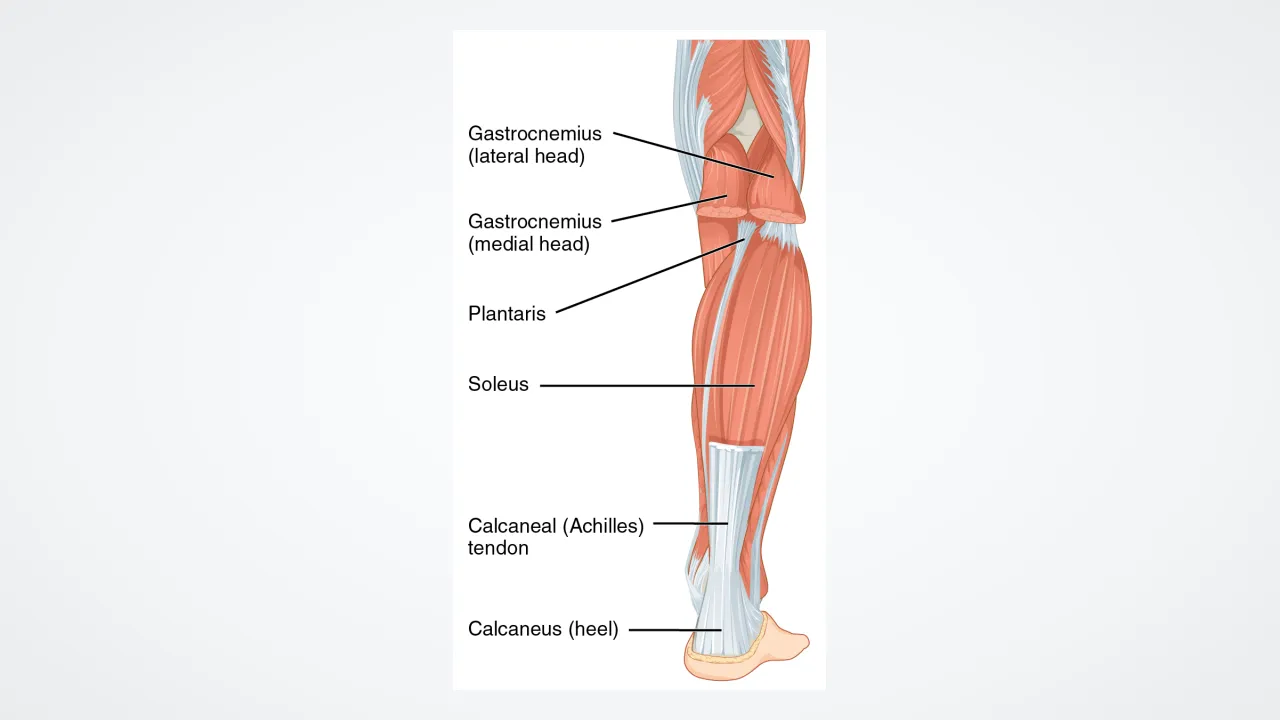
1. Where can you feel your thick Achilles tendon right under your skin?
2. Which body move uses your Achilles tendon the most?
🤯 Mind-Blowing Fact • Grade 2
When you sprint fast across a field, your Achilles tendon safely handles pulling forces up to twelve times your whole body weight!
✨ Word Sparks (Grade 2 Glossary)
Tap 🔊 to hear
Legend
A famous old adventure story passed down
Heel Bone
Sturdy back foot bone supporting your step
Recoil
Snap back into shape like a spring
🪝
Why is the strongest cord in your ankle named after an ancient Greek storybook hero?
1
A Mythological Name
Long ago in Greek , a brave hero named Achilles had magical protection everywhere except the back of his ankle, where his mother held him as a baby! Hundreds of years later, doctors named our thickest ankle cord the Achilles tendon in honor of that famous tale.
2
Two Calf Muscles, One Giant Rope
Two strong muscles on the back of your lower leg merge into your six-inch-long Achilles tendon, which anchors tightly onto your like a bridge cable.
3
Built Like a Pogo Stick
Every time your foot lands while running, your Achilles stretches like a giant rubber band and snaps free energy back into your next leap!
How did a super-long Achilles tendon turn humans into some of Earth's best distance runners?
1
Comparing Chimps and Humans
Tree-climbing chimpanzees have huge calf muscles all the way down to their heels with barely a stub of an Achilles tendon. Humans are built the exact opposite way: high calf muscles paired with a sleek, six-inch-long Achilles tendon! Scientists realized that long elastic cord is our secret endurance weapon.
2
Gastrocnemius Meets Soleus
Two distinct calf muscles share the Achilles tendon. On top sits the two-bellied , packed with fast power for basketball dunks and sprints. Underneath hides the flat soleus muscle, an endurance workhorse that keeps you standing upright and jogging steadily for miles.
3
Twisted Like a Suspension Cable
As the Achilles tendon travels down to your (heel bone), its fibers spiral ninety degrees like a braided steel bridge cable—making it stronger and springier!
4
Fluid Cushions Behind the Heel
Two tiny fluid-filled pillows called bursae tuck right next to the heel anchor so your tendon never rubs raw against bone or sneakers.
1. How does a human's Achilles tendon compare to a tree-climbing chimpanzee's?
2. Why do the fibers inside your Achilles tendon spiral gently as they reach your heel bone?
🤯 Mind-Blowing Fact • Grade 4
In 1693, Flemish anatomist Philip Verheyen became the very first scientist in history to write down the name 'chorda Achillis' (Achilles cord) in a medical textbook!
✨ Word Sparks (Grade 4 Glossary)
Tap 🔊 to hear
Second-Class Lever
Heavy-lifting lever with load between pivot and pull
Plantarflexion
Pointing your foot downward to push off
Soleus
Deep endurance calf muscle beneath the gastrocnemius
🪝
How does your foot work like a wheelbarrow lever when your Achilles tendon hoists you onto your toes?
1
A Classic Second-Class Lever
Most joints in your body trade leverage for speed, yet your ankle-and-foot system pulls off a heavy-lifting physics trick! When you rise onto the balls of your feet, your toes act as the pivot fulcrum at the front, your whole body weight presses down through the ankle in the middle, and your Achilles tendon pulls upward on the calcaneus (heel bone) at the back—working just like lifting handles on a loaded wheelbarrow!
2
The Triceps Surae Engine
Anatomists group the two-headed gastrocnemius and the deep together as the triceps surae ('three-headed muscle of the calf'). Because the gastrocnemius crosses behind the knee too, it delivers maximum power when your leg is straight; bend your knee deeply in a crouch, and the tireless soleus takes center stage to propel your ankle into .
3
Recycling 35% of Running Energy
Motion sensors reveal that during a steady jog, your six-inch tendo calcaneus stretches roughly five to seven percent on foot-strike and snaps back like a tuned bowstring, supplying more than one-third of the total mechanical energy needed for each stride!
4
The Quiet 'Watershed Zone'
About an inch or two above the heel bone sits a narrow section with fewer tiny blood vessels than the ends—which is why warming up calves gradually before winter sports keeps your Achilles happy and resilient.
1. Why is rising onto your tiptoes compared to lifting the handles of a wheelbarrow?
2. Roughly how much of the mechanical energy of each running step is recycled for free by the elastic stretch of your Achilles tendon?
🤯 Mind-Blowing Fact • Grade 5
Fossil heel bones show that our springy 6-inch Achilles tendon evolved around 2 million years ago in Homo erectus—turning early humans into marathon endurance athletes!
✨ Word Sparks (Grade 5 Glossary)
Tap 🔊 to hear
Tendo Calcaneus
Anatomical Latin name for the Achilles tendon
Paratenon
Stretchy gliding sleeve surrounding the Achilles tendon
Triceps Surae
Combined calf engine of gastrocnemius and soleus
🪝
How did fossil heel bones from two million years ago reveal when early humans evolved our marathon-running Achilles spring?
1
Macro-Anatomy of the Tendo Calcaneus
Measuring approximately fifteen centimeters long and up to six millimeters thick at its narrowest waist, the —universally celebrated as the Achilles tendon—is the thickest and strongest tendon in the human body. Forged by the aponeurotic fusion of the biarticular gastrocnemius, the monoarticular oxidative soleus, and frequently the slender plantaris, it inserts broadly onto the posterior tuberosity of the calcaneus, cushioned anteriorly by the retrocalcaneal bursa and Kager's fat pad.
2
Helical Fascicle Torsion and Paratenon Glide
Unlike tendons enclosed in true double-walled synovial sheaths, the Achilles glides inside a richly vascularized loose sleeve called a that stretches several centimeters without restricting motion. Internally, collagen fascicles originating from the gastrocnemius and soleus undergo a ninety-degree spiral torsion before inserting onto the calcaneus. Biomechanical modeling proves this helical twist equalizes strain across the enthesis during pronation-supination cycles while boosting elastic energy return above ninety percent.
3
Hypovascular Watershed Mechanics
During sprinting and triple-jump takeoffs, tensile loads inside the Achilles regularly reach nine to twelve times body weight—exceeding 9,000 newtons! Two to six centimeters proximal to the calcaneal insertion lies a relative 'watershed zone' where ascending calcaneal blood vessels meet descending muscular branches; progressive eccentric calf loading stimulates resident tenocytes there to remodel and thicken Type I collagen bundles.
4
Paleoanthropology of Human Endurance Running
Great apes such as Australopithecus and modern chimpanzees possess tiny calcaneal tubers indicating short, stiff heel tendons suited for climbing. Fossil calcanei of Homo erectus dating back nearly two million years reveal the sudden emergence of a tall, modern Achilles attachment—unlocking metabolic energy savings of over thirty-five percent during endurance running across open savannas.
5
From Homer's Iliad to Philip Verheyen
Though Hippocrates called it the 'great tendon,' the modern eponym dates precisely to 1693, when Flemish anatomist Philip Verheyen coined chorda Achillis in Corporis Humani Anatomia, immortalizing Homer's bronze-age hero inside orthopedic science.