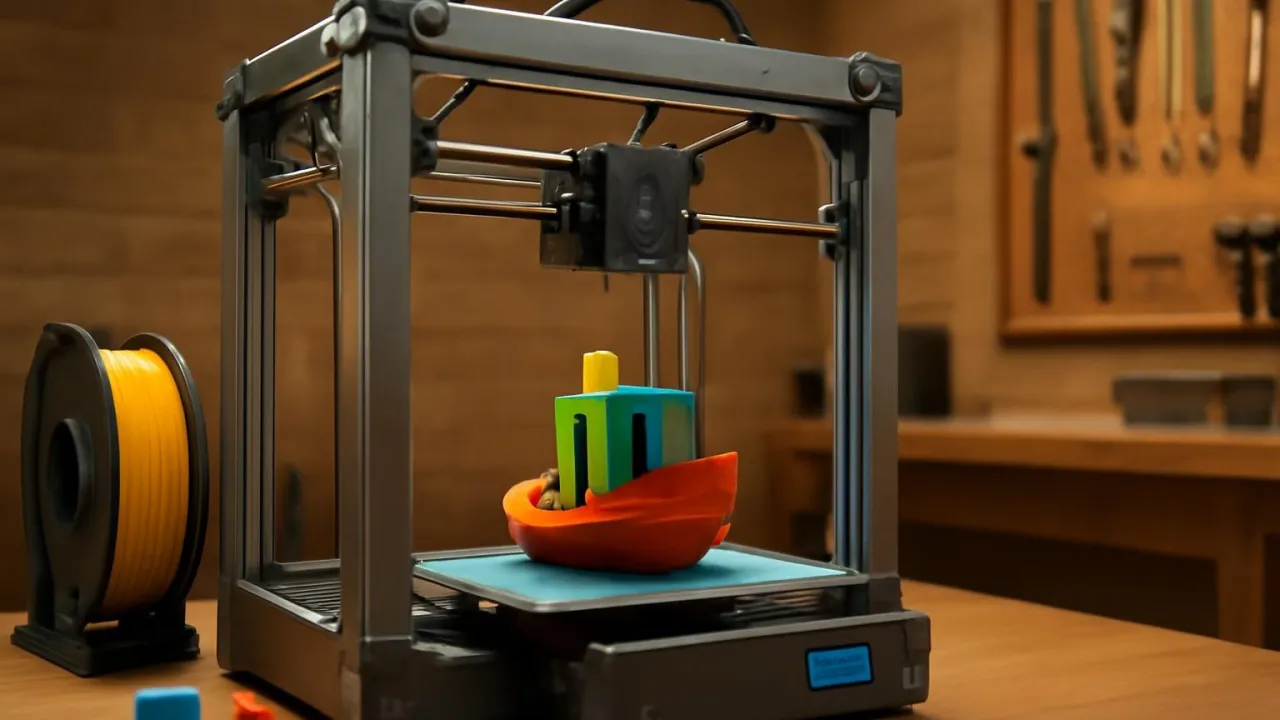
Doctors use 3D printers to make special bones for people!
✨ Word Sparks (Grade 2 Glossary)
Tap 🔊 to hear
design
A plan or drawing for something
robot
A machine that can move and work
technology
Science tools that help people
🪝
Have you ever watched a robot build something right in front of you?
1
How It Builds
A 3D printer moves back and forth, melting plastic as it goes. It builds objects by stacking thin layers on top of each other. Each layer is shaped by a computer's . Soon, you can see a toy or tool appear!
2
What Can It Make?
3D printers can make toys, model cars, and even parts for . Some can use chocolate or metal instead of plastic. People use them to create things quickly and try new ideas.
3
Watching the Magic
People love to watch the printer work, seeing each layer form. It feels like magic, but it is really science and . Every new layer brings the object closer to being finished.
Astronauts use 3D printers in space to make tools they need!
✨ Word Sparks (Grade 3 Glossary)
Tap 🔊 to hear
prototype
A test version of something new
filament
A long, thin piece of plastic
additive
Made by adding things together
🪝
What if you could invent your own toy and watch it appear, layer by layer?
1
The Magic of 3D Printing
When a 3D printer starts, you hear a gentle whirring sound as it moves. The printer melts plastic or resin, then squeezes it out in thin lines. Each line forms a layer, and each layer stacks on top of the last. Soon, a three-dimensional object begins to take shape right before your eyes.
2
From Computer to Creation
A computer design, called a , tells the printer exactly what to build. The printer follows the design, layer by layer, using special software. This process is called manufacturing because it adds material instead of cutting it away. The finished object can be a toy, a tool, or even a model of a building.
3
How It Works
The printer’s nozzle heats up and melts the plastic, which is called . As the nozzle moves, it lays down each layer in the correct shape. The layers cool and harden quickly, sticking together to form a strong object. This method lets people make things that would be hard to build by hand.
4
Changing the World
3D printers are used in schools, hospitals, and even space stations. Engineers use them to make new inventions and test ideas fast. Doctors can print custom body parts, like hearing aids or bone models. 3D printing is changing how we build, invent, and help people all over the world.
The world’s largest 3D-printed building is a two-story house in Dubai!
✨ Word Sparks (Grade 4 Glossary)
Tap 🔊 to hear
stereolithography
Printing by hardening liquid with light
CAD file
A computer-made design plan
prototype
A first model to test an idea
🪝
Imagine designing your own gadget and watching it rise, layer by layer—how does this machine do it?
1
Building Objects from the Ground Up
A 3D printer operates by heating plastic filament or resin until it melts, then precisely depositing it in thin, flat layers. Each layer is shaped by a computer-aided design (CAD) file, which provides exact instructions for the printer’s nozzle. As each layer cools and hardens, it bonds to the one beneath, gradually forming a solid, three-dimensional object. This process is known as additive manufacturing, because it builds up material rather than carving it away.
2
The Invention That Changed Making
Chuck Hull invented the first working 3D printer in 1984, calling his method . He used ultraviolet light to harden liquid resin, creating detailed for engineers. Over time, other inventors developed new techniques, like fused deposition modeling (FDM), which uses melted plastic filament. These inventions have made it possible for people everywhere to turn digital designs into real-world objects.
3
How 3D Printers Work
The printer’s nozzle moves in three directions—left and right, forward and back, and up and down. It follows the pattern set by the , laying down each layer with great accuracy. The layers are often less than half a millimeter thick, allowing for intricate details and strong structures. This technology allows for rapid prototyping, meaning inventors can test and improve their ideas quickly.
4
A World of Possibilities
3D printers are now used in medicine, aerospace, education, and even art studios. Doctors print custom implants and prosthetics, while engineers create airplane parts and astronauts make tools in space. The technology is revolutionizing manufacturing, making it easier for people to invent, repair, and customize objects everywhere. As 3D printing advances, it will continue to shape the way we build and create.
1. What does a 3D printer use to know what shape to make?
2. Why is rapid prototyping important for inventors?
🤯 Mind-Blowing Fact • Grade 5
Scientists have 3D-printed a working human heart model using real cells for medical research!
✨ Word Sparks (Grade 5 Glossary)
Tap 🔊 to hear
fused deposition modeling
A way to print by melting plastic
selective laser sintering
Printing by melting powder with lasers
lattice structure
A crisscross pattern that makes things strong
🪝
What if you could design a tool on your computer and watch it rise, layer by layer, right on your desk—how does this incredible process transform the world?
1
The Science of Additive Manufacturing
3D printing, or additive manufacturing, constructs objects by depositing material in ultra-thin layers, each precisely shaped by a digital blueprint. The process begins with a computer-aided design (CAD) file, which is sliced into hundreds or thousands of cross-sectional layers. The printer’s nozzle, heated to temperatures between 180°C and 250°C for plastics, extrudes melted filament or resin onto a build platform. As each layer cools and solidifies, it fuses to the previous one, gradually forming a detailed three-dimensional object. This method allows for complex internal structures and geometries that traditional manufacturing cannot achieve.
2
From Concept to Reality: The Engineering Journey
Chuck Hull’s 1984 invention of stereolithography marked the first time digital designs could be transformed into physical prototypes using light-cured resin. Since then, techniques like (FDM) and (SLS) have expanded the range of printable materials to include plastics, metals, ceramics, and even living cells. Engineers use 3D printers to rapidly prototype new inventions, test aerodynamics, and create custom parts for everything from cars to spacecraft. The ability to iterate quickly shortens development cycles and encourages creative problem-solving.
3
Precision, Complexity, and Material Science
Modern 3D printers can achieve layer thicknesses as fine as 0.05 millimeters, enabling the creation of intricate details and lightweight . The choice of material—whether thermoplastic, photopolymer resin, or metal powder—affects the object’s strength, flexibility, and durability. Some advanced printers use multiple nozzles to combine materials or colors in a single print. This flexibility makes 3D printing ideal for producing medical implants, architectural models, and even functional machine parts.
4
Global Impact and Future Horizons
3D printing is revolutionizing industries worldwide by making manufacturing more accessible, sustainable, and customizable. In medicine, doctors print patient-specific implants, prosthetics, and even tissue scaffolds. In aerospace, engineers fabricate lightweight, fuel-efficient parts that would be impossible to machine. The technology is also empowering students, artists, and inventors to bring their ideas to life without expensive factories. As 3D printing evolves, it promises to democratize production and inspire new ways of thinking about design and engineering.
5
Challenges and Next Frontiers
Despite its advantages, 3D printing faces challenges such as slow build speeds for large objects, limited material choices, and the need for precise environmental controls. Researchers are developing faster printers, recyclable materials, and even bioprinters that can create living tissues. The future may bring 3D-printed houses, food, and medical organs, expanding the boundaries of what is possible. As additive manufacturing technology matures, it will continue to shape the way we solve problems and innovate across the globe.