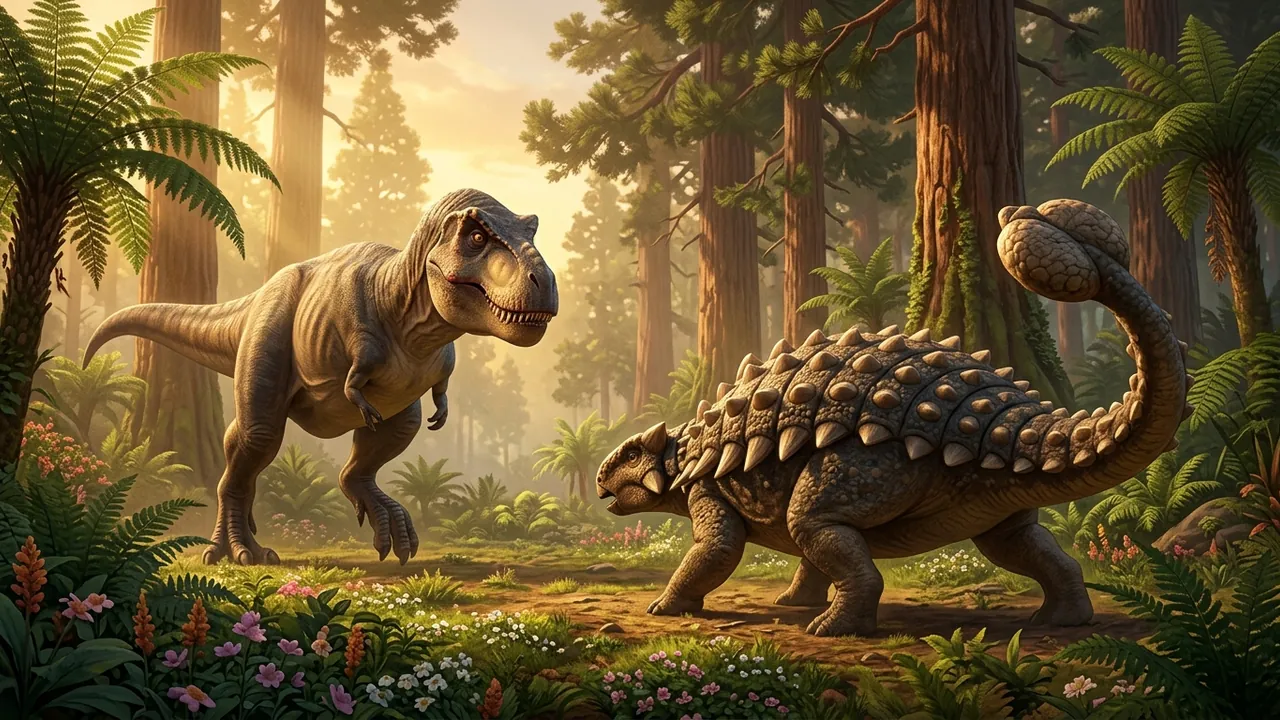
Meet the Legend: Peak Maastrichtian Armor
Within the uppermost Maastrichtian strata of the Hell Creek, Lance, and Scollard Formations (68–66 MYA), vertebrate evolution produced both the strongest terrestrial bite and the most sophisticated dermal armor in Earth's history. Representing apex osteophagous predation stood Tyrannosaurus rex; representing peak thyreophoran defense stood Ankylosaurus magniventris, the largest and most heavily built ever discovered in North America.
Measuring roughly eight meters in length, nearly two meters across its barrel ribcage, and six to eight metric tons in body mass, Ankylosaurus differed sharply from its clubless nodosaurid contemporaries such as Denversaurus. Whereas nodosaurids relied on narrow snouts and passive lateral shoulder spines, ankylosaurids combined broad cropping beaks with active posterior weaponry.
Fused cranial caputegulae tiles, co-ossified posterior dorsal ribs welded onto flared ilia, a ground-hugging center of mass, and a hundred-pound terminal club transformed this solitary browser into a walking biomechanical bunker. Even its specific name magniventris—Latin for 'great belly'—highlights the extraordinary breadth of its armored torso.
Cladistic studies trace ankylosaurid ancestry to Asian lineages that dispersed into western North America during Late Cretaceous land-bridge intervals across Beringia, culminating in giant Ankylosaurus right before the Cretaceous-Paleogene boundary.
Unlike gregarious ceratopsians or hadrosaurs that shared vigilance across large multi-generational herds, adult Ankylosaurus navigated predator-rich floodplains alone—relying on individual structural invulnerability refined under millions of years of intense tyrannosaurid selective pressure where every plate and tail tendon served active survival. Across two million years of shared Maastrichtian history, neither lineage yielded ground—forging an unforgettable evolutionary standoff between supreme cranial bite mechanics and impenetrable dermal architecture.
Lost World Habitat: Upland Facies & Rarity
Stratigraphic field surveys across Montana, Wyoming, and Alberta reveal an intriguing taphonomic puzzle: whereas Triceratops and hadrosaurid Edmontosaurus skeletons appear by the hundreds in Hell Creek channel sandstones, Ankylosaurus specimens remain remarkably scarce. Detailed sedimentary facies analysis indicates Ankylosaurus favored better-drained upland forest clearings and inland interfluves rather than soggy deltaic marshes where rapid burial occurred most frequently.
Even so, isolated keeled osteoderms, diagnostic phylliform teeth, and fused tail clubs confirm Ankylosaurus routinely traversed lowland floodplains patrolled by adult Tyrannosaurus rex. Argon-argon radiometric dating of volcanic bentonite ash beds confirms both species coexisted up to the 66.0-million-year extinction horizon.
Beneath towering metasequoia dawn redwoods, ginkgoes, cycads, tree ferns, horsetails, and early angiosperm shrubs carpeted warm, frost-free soils across eastern Laramidia, sharing stream banks with softshell turtles, champsosaurs, and dome-headed Pachycephalosaurus.
Stable oxygen and carbon isotope ratios sampled from Hell Creek tooth enamel verify that these armored herbivores drank freshwater from inland streams rather than brackish coastal estuaries. Curiously, when rare ankylosaur skeletons did wash into deep river channels during seasonal floods, bloated gas buildup paired with heavy dorsal osteoderms often flipped floating carcasses upside down before final burial in river sand!
Firm inland soils also suited seven tons of short-limbed dermal armor far better than deep swamp muck. Whenever monsoon rains flushed solitary ankylosaurs across forested levee trails toward sunny fern glades, they entered the exact hunting corridors patrolled daily by North America's largest theropod. Every fossilized footprint and isolated scute recovered from those sandy overbank beds marks another crossing between solitary tank and apex stalker.
What's on the Prehistoric Menu?
Cranial morphology illustrates how strict ecological niche partitioning prevented resource competition among Hell Creek megaherbivores. Whereas narrow-muzzled nodosaurids selectively plucked tender dicot foliage and Triceratops sheared woody palms higher off the ground, Ankylosaurus magniventris evolved a broad, squared premaxillary beak that functioned as an indiscriminate low-level lawnmower cropping tough ferns, cycad fronds, and horsetails within a meter of the soil.
Surprisingly, its maxillary and dentary tooth rows held relatively small leaf-shaped teeth coated in fluted enamel ridges that performed minimal oral chewing. Instead, behind posterior ribs fused rigidly onto wide hip bones sat a colossal hindgut fermentation chamber where symbiotic microbes broke down fibrous plant cellulose over multi-day retention times, extracting steady metabolic energy to mineralize hundreds of dermal scutes.
High-resolution micro-CT reconstructions of skulls also revealed astonishingly long, looped paranasal airways winding throughout the armored snout! Those vascularized nasal passages conserved respiratory moisture, cooled arterial blood bound for the braincase beneath thick dermal bone, and resonated low-frequency acoustic warnings across dense brush.
Across the trophic web, adult Tyrannosaurus rex specialized in pulverizing megaherbivore skeletons for marrow calories—yet Ankylosaurus's six-foot-wide vaulted back exceeded even tyrannosaur maximum jaw gape angles!
Because adult T. rex jaws opened roughly sixty-three to eighty degrees, biting downward onto such a broad, gently convex shield caused conical teeth to glance sideways harmlessly across keratinous plates rather than lock cleanly around vital rib or spinal bone, frustrating standard tyrannosaurid feeding mechanics. Meanwhile, steady hindgut fermentation allowed Ankylosaurus to thrive on abundant low-calorie ferns without risking exposed migrations across treacherous river mudflats.
Superpowers, Senses & Anatomy
Paleohistological thin-sections explain why dermal plates frustrated even osteophagous jaws generating over 35,000 Newtons of bite force. Unlike modern crocodilian scutes built of brittle parallel-fibered bone, Ankylosaurus osteoderms wove three-dimensional orthogonal bundles of structural collagen fibers around vascularized trabecular cores. Sheathed in tough outer keratin during life, this biological fiber-reinforced composite dispersed localized tooth stress without catastrophic fracture propagation.
Thousands of millimeter-scale dermal ossicles filled pliable skin folds between major keeled rows—even forming protective throat mail beneath the lower jaw—while curved bony palpebrals armored each upper eyelid and pyramidal squamosal and quadratojugal horns guarded the skull's rear corners against cervical bites.
Equally specialized was its musculoskeletal lever system. Unfused anterior tail vertebrae permitted wide horizontal sweeps powered by massive caudofemoralis muscles anchored to the flared ilia, acting like twin hydraulic cables on either side of the broad hips.
Along the distal tail, seven caudal vertebrae interlocked in V-shaped zygapophyseal joints encased tightly inside bundles of ossified tendons! That rigid biological handle accelerated fused terminal osteoderms up to fifty-seven centimeters long and nearly fifty kilograms in mass like a precision horizontal wrecking ball.
Fused sacral and posterior dorsal ribs prevented pelvic torsion during maximum-velocity swings, ensuring kinetic energy transferred straight from hip musculature into the terminal bone knob without straining the spine, shearing intervertebral discs, or jarring internal digestive organs on impact. Meanwhile, expansive olfactory chambers inside the broadened nasal vault detected approaching carnivores upwind long before visual contact occurred through dense redwood undergrowth, giving Ankylosaurus ample time to plant all four feet securely.
Flight vs. Fight Arena!
Evolutionary game theory highlights a profound risk whenever an adult Tyrannosaurus rex confronted a healthy adult Ankylosaurus. Known in behavioral ecology as the life-dinner principle, the herbivore defended its entire survival whereas the predator risked career-ending trauma for a single meal in an ecosystem stocked with softer hadrosaur prey that lacked bony clubs.
Precluded from cursorial escape by short limb proportions and heavy dermal bone investment, Ankylosaurus committed completely to Team Fight by anchoring its wide-gauge stance flat against floodplain mud. That crouched posture denied T. rex both physical leverage to overturn seven metric tons and jaw gape clearance to bite across a convex carapace.
Simultaneously, lateral sweeps of the stiffened handle cut through a hundred-degree horizontal arc at the exact elevation of an approaching theropod's tibiotarsus and arctometatarsus. Low fern cover offered zero protection for exposed predator shins whenever T. rex stepped inside that two-meter strike radius.
impact calculations demonstrate that large clubs swung near twenty meters per second generated impulses exceeding 14,000 Newtons—more than sufficient to shatter thick cortical leg bone and permanently incapacitate an obligate bipedal hunter!
Even a non-fatal hairline fracture in a weight-bearing metatarsal risked debilitating osteomyelitis bone infection and eventual starvation, strongly selecting for cautious adult tyrannosaurs that respected braced ankylosaurid defenders, aborted risky lunges early, and moved on toward safer river-channel hunting grounds. Only overturned juveniles or mired individuals caught in deep flood clay offered realistic opportunities, confirming that mature Ankylosaurus commanded decisive defensive superiority across firm Maastrichtian clearings whenever challenged head-on.
Fossil Detective Secrets
High-resolution computed tomography and stress modeling have conclusively settled century-old debates over whether tail clubs served merely as visual ornaments. Biomechanical investigations led by paleontologist Victoria Arbour digitally reconstructed CT-scanned fossil tail knobs under high-velocity impact loads, proving spongy internal trabecular bone damped destructive recoil waves while dense cortical rims delivered bone-crushing stress exceeding thousands of Newtons per square centimeter.
In 2022, exceptional soft-tissue keratin and preservation in the related Campanian ankylosaurid Zuul crurivastator—literally named 'Destroyer of Shins'—revealed healed dermal fractures clustered along the lateral flanks rather than the shoulders.
That pathology distribution demonstrated ankylosaurids wielded their clubs both for ritualized flank-slamming contests against rival ankylosaurs and for active anti-predator defense against tyrannosaurids! Healed fibular and rib calluses documented in several large Late Cretaceous tyrannosaurs further underscore the mechanical hazards of engaging armored prey across ancient Laramidia.
Interestingly, ontogenetic growth studies show juvenile ankylosaurs hatched without fused tail knobs or rigid tendon handles, relying first on forest camouflage and rapid skeletal growth before ossifying their heavy caudal clubs during adolescence when tyrannosaur predation risk peaked.
Preserved together across uppermost Maastrichtian beds of western North America, composite collagen osteoderms, ossified caudal handles, and digital crash simulations confirm Ankylosaurus magniventris endured the reign of Tyrannosaurus rex right up to the end of the Age of Dinosaurs as an unbreakable triumph of defensive evolution. Every newly prepared Hell Creek osteoderm and synchrotron bone scan continues to reveal microscopic weave patterns that inspire modern materials engineers designing lighter, tougher impact shields for helmets and spacecraft today.