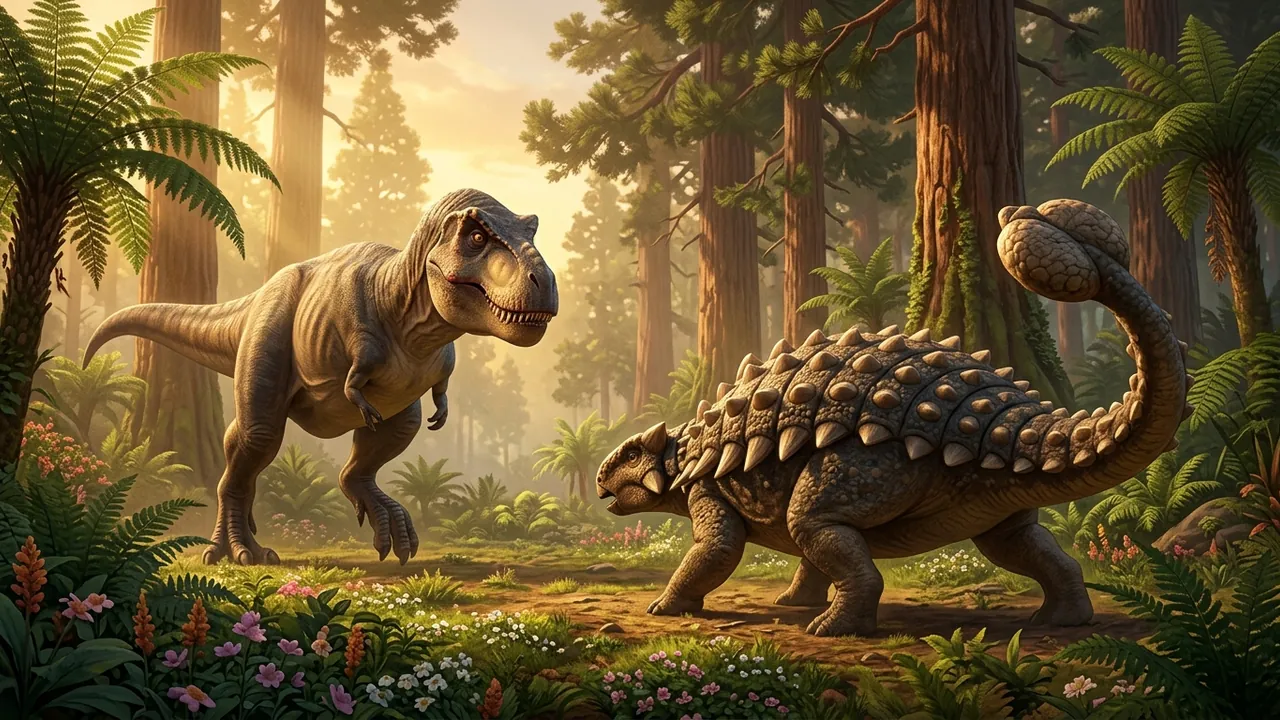
Meet the Legend: Unstoppable vs. Unbreakable
In nature's grand survival arena, some animals evolve swift legs to flee danger while others build living fortresses. Sixty-six million years ago in western North America, two champions tested the limits of bone: Tyrannosaurus rex and Ankylosaurus magniventris! Both dinosaurs lived in the same lush river basins at the very end of the Age of Dinosaurs.
Tyrannosaurus rex towered twelve feet high at the hip and wielded the strongest bite of any land predator on Earth. Facing it stood twenty-six-foot, seven-ton Ankylosaurus, whose Greek name translates to fused lizard because its skull, ribs, and hips locked together.
Built wider than a pickup truck and hugging the ground on four sturdy legs, this armored possessed an unforgettable set of survival adaptations. Instead of running away from bone-crushing jaws, Ankylosaurus answered every challenge with body-wide shield plates, armored eyelids, and a swinging hundred-pound bone sledgehammer!
Lost World Habitat: Coast-to-Coast Armor
During the Late Cretaceous Period, warm rivers wound lazily through dawn redwood forests and sunny fern glades across Montana and Wyoming toward an inland sea. Soft floodplains bloomed with horsetails, magnolias, cycads, and low fruiting shrubs where Ankylosaurus browsed in peace.
Armored dinosaurs had already thrived across North America for tens of millions of years! Right along the Virginia and Maryland coastal corridor, Early Cretaceous river clays and sandstones preserve fossilized tracks and relatives of armored dinosaurs that once munched coastal ferns near our own Mid-Atlantic region.
By sixty-six million years ago out west in Hell Creek, predators had grown into eight-ton giants, while turtles, crocodiles, and small feathered dinosaurs shared those warm river valleys. In response to giant tyrannosaurs, Ankylosaurus evolved into the biggest, widest club-tailed dinosaur in history, perfectly adapted for open forest clearings.
What's on the Prehistoric Menu?
Healthy ecosystems rely on food-chain sharing so different plant eaters do not compete for the exact same leaves. While taller Triceratops sheared tough palms and duck-billed Edmontosaurus reached overhead branches, low-slung Ankylosaurus cropped soft ferns and shrubs less than three feet off the soil.
As a wide-muzzled , Ankylosaurus scooped big mouthfuls with its square beak and sliced them lightly with small leaf-shaped cheek teeth. Inside its massive barrel ribcage sat a giant fermenting gut where helpful microbes broke down tough plant fibers slowly all day long.
Meanwhile, patrolling Tyrannosaurus rex stood atop the food web, searching river trails for calorie-rich prey to fuel its eight-ton body. Young or careless duck-billed dinosaurs supplied most tyrannosaur meals, because turning seven tons of interlocking back armor into lunch posed a thorny puzzle that even king-sized jaws struggled to solve!
Superpowers, Senses & Anatomy
Every square foot of Ankylosaurus's upper body showcased defensive . Rows of keeled bony plates called osteoderms grew directly inside its thick leathery skin, surrounded by hundreds of pebble-sized bone beads that flexed like medieval chainmail around its neck and shoulders so it could still move smoothly.
Even its eyes wore armor! Each upper eyelid contained a curved bone that snapped shut like a protective window shutter against thorny branches or snapping teeth, while four pyramid-shaped horns guarded the back corners of its skull.
At the rear end, powerful hip muscles swung a remarkable defensive weapon. Flexible joints near the hips let the tail sweep wide from left to right, while seven interlocking end vertebrae wrapped tightly in tendons formed a stiff, unbending handle tipped with fused bone knobs weighing roughly one hundred pounds!
Flight vs. Fight Arena!
Hauling heavy bone armor meant Ankylosaurus traded away running speed, strolling only about five or six miles per hour across forest glades. Instead of Flight, every bone and muscle in its low-slung body committed 100 percent to Team Fight!
Because Tyrannosaurus rex possessed bone-splintering bite power, Ankylosaurus followed one golden survival rule: never let the predator flip it onto its soft, unarmored belly. Whenever T. rex circled close, Ankylosaurus bent its short legs and pressed flat into the mud like an anchored boulder.
Its broad, domed back was far too wide and curved for T. rex's jaws to grip cleanly, and biting straight down met tough keratin over woven bone. Then, pivoting sharply, Ankylosaurus whipped its tail handle sideways just above the ferns—aiming a hundred-pound bone club straight at T. rex's fragile ankles!
Fossil Detective Secrets
Because drier forest clearings eroded faster than muddy river bottoms, complete Ankylosaurus skeletons are much rarer than Triceratops or duck-billed dinosaur fossils. Even so, discoveries dug from Montana and Alberta give fossil detectives extraordinary clues about how its armor worked!
Using hospital CT scanners, paleontologists peered inside solid stone tail clubs without slicing a single precious fossil open. Digital crash tests on 3D computer models proved a full swing packed enough force to fracture thick predator leg bones while spongy inner chambers protected the tail itself from shock!
Fossils of closely related ankylosaurs even preserve healed dents along their side osteoderms from sparring matches and predator standoffs. Combined with rare healed leg injuries found on large tyrannosaurs, these stone clues prove Ankylosaurus truly earned its title as the unbreakable tank of the Cretaceous!