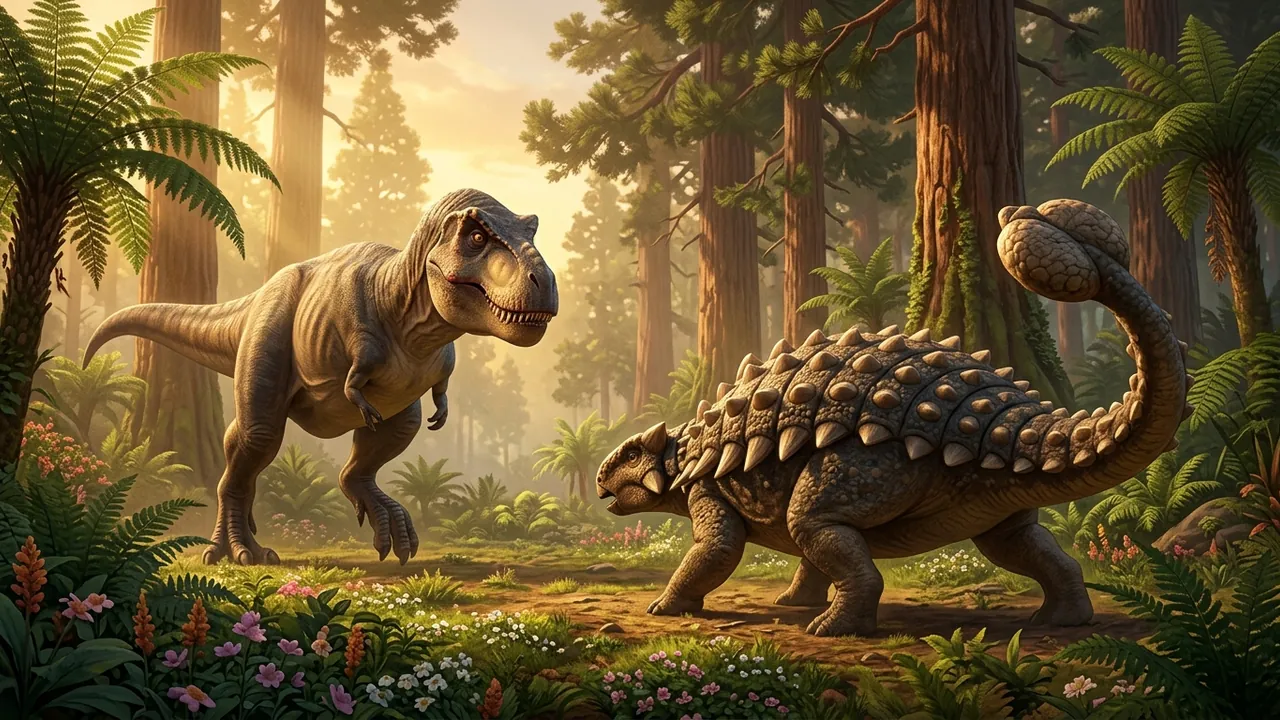
Meet the Legend: Ultimate Force vs. Armor
Physics students often ask a classic question: what happens when an unstoppable force meets an immovable object? Sixty-six million years ago in Late Cretaceous North America, evolution staged a real biological version of that experiment between Tyrannosaurus rex and Ankylosaurus magniventris! Both titans roamed the same coastal river valleys of ancient Montana, Wyoming, and the Dakotas.
Adult T. rex stretched forty feet long, stood twelve feet tall at the hip, and concentrated roughly 8,000 pounds per square inch of crushing pressure into thick, deep-rooted teeth. No earlier land predator packed as much bone-splintering force into a single bite.
Across the fern clearing stood twenty-six-foot, seven-ton Ankylosaurus—wider than a family SUV, built with an ultra-low , wrapped in interlocking armor, and armed with a hundred-pound bony tail sledgehammer!
Even four of its back ribs welded solidly onto its wide hip bones like steel bridge girders so its torso stayed rock-steady during powerful tail swings! By comparing tyrannosaur bite stress against bone armor and tail-club leverage, paleontologists reveal how two record-breaking body plans balanced supreme offense against unyielding defense.
Lost World Habitat: Floodplain Energy Flow
In the humid Hell Creek ecosystem of ancient Montana and the Dakotas, lush coastal floodplains supported rich, multi-layered food webs. Warm sunlight fueled dense ground carpets of ferns, horsetails, cycads, and early fruiting shrubs beneath towering dawn redwood canopies, while turtles and crocodylians filled winding bayous.
Growing and carrying hundreds of pounds of dermal bone armor required careful daily energy budgeting. Ankylosaurus solved that challenge with a slow, thrifty walking pace and a cavernous barrel torso housing an enormous hindgut fermentation chamber, where billions of symbiotic gut microbes extracted nutrients slowly from tough ground plants.
Meanwhile, active warm-blooded predators like Tyrannosaurus rex patrolled broad river valleys burning thousands of calories every day. Because well-drained upland forest clearings offered firm footing and abundant low ferns, solitary Ankylosaurus often grazed away from crowded lowland swamps where heavy paws sank deep into mud.
Whenever a patrolling tyrannosaur stepped into one of those sunlit glades after a summer rainstorm, energy economics forced a high-stakes choice: risk crippling ankle trauma against a living tank braced firmly on solid ground, or keep hunting along riverbanks for unarmored duck-billed prey!
What's on the Prehistoric Menu?
Comparing both skulls reveals how sharply their ecological niches differed inside the Hell Creek food web. Ankylosaurus evolved a wide, squared keratin beak—nearly twice as broad as armored cousins that nibbled selective twigs—allowing it to crop huge mouthfuls of ferns and low shrubs close to the soil like a wide lawnmower. Small leaf-shaped cheek teeth performed simple snipping while its giant gut handled heavy chemical digestion.
Inside its broad, armored skull, looping S-shaped nasal passages acted as natural heat exchangers that kept brain blood cool beneath thick head plates and amplified deep, booming warning rumbles through dense forest brush.
Tyrannosaurus rex sat atop the food web as a specialized bone-crusher whose massive jaw adductor muscles pulverized ribs and limb bones for rich marrow calories and essential calcium.
Against adult Ankylosaurus, however, simple geometry foiled that feeding strategy completely! Even when T. rex opened its jaws past sixty-five degrees, Ankylosaurus's six-foot-wide vaulted back offered no narrow edge where teeth could clamp cleanly without skidding harmlessly off tough, keratin-coated plates that shielded every vital organ underneath. Consequently, Ankylosaurus grazed calmly across sunlit fern glades while faster herbivores stayed constantly on high alert near dense timber.
Superpowers, Senses & Anatomy
Why didn't Ankylosaurus armor crack like brittle ceramic tiles under T. rex's multi-ton bite? Microscope slices reveal each functioned as a natural material! Inside a light spongy core, structural collagen protein fibers crisscrossed in three-dimensional mats—working just like woven fiberglass or modern Kevlar vests to disperse concentrated tooth pressure and stop cracks from spreading.
In life, tough outer keratin sheaths wrapped over every bony scute, adding another shock-absorbing shield layer. Between major keeled plates sat thousands of pebble-sized bone ossicles embedded in leathery dermis so neck and shoulder joints bent smoothly as the heavy browser walked through thickets.
Even its eyes wore curved bony palpebral shutters that clicked closed during danger, while four triangular horns guarded the back corners of its skull against neck bites!
Behind the flared pelvis, flexible basal tail joints powered a stiffened seven-vertebra handle wrapped tightly in mineralized tendon rods. At the tip sat fused terminal osteoderms weighing roughly one hundred pounds that accelerated sideways at speeds approaching forty-five miles per hour like a living wrecking ball engineered for maximum impact! No other plant eater on Earth combined flexible neck chainmail, shuttered eyelids, and rigid tail leverage so seamlessly.
Flight vs. Fight Arena!
Topping out near five or six miles per hour, Ankylosaurus never spent a single calorie trying to outrun agile predators. Every detail of its wide, ground-hugging skeleton embodied uncompromising Team Fight biomechanics from snout to tail club across the Late Cretaceous floodplain!
In a face-off, T. rex's only realistic winning play was wedging a foot or snout beneath a smaller ankylosaur to flip it over and expose its soft, unarmored underside. Against a seven-ton adult with wide-splayed limbs and an ultra-low , crouching flat into floodplain mud sealed that gap completely and made tipping physically impossible even for an eight-ton giant.
Simultaneously, huge caudofemoralis tail muscles anchored to the wide hips whipped the hundred-pound bone club horizontally across the ferns through a sweeping hundred-degree arc.
Physics calculations show that concentrated impact —exceeding 14,000 Newtons over a split second—struck at the exact height of T. rex's shin and foot bones! Because an eight-ton biped cannot hunt on a fractured ankle, wise tyrannosaurs respected that swinging danger zone and backed away safely toward easier meals. Patience, low balance, and sweeping lateral force turned seven tons of slow browser into Hell Creek's toughest matchup.
Fossil Detective Secrets
In 1906, paleontologist Barnum Brown excavated the type skeleton of Ankylosaurus magniventris from Montana's Hell Creek badlands—the exact same rock formation where he had uncovered Tyrannosaurus rex just four years earlier! Over the past century, modern engineering tools transformed how scientists test this ancient matchup.
Biomechanical research teams placed fossil ankylosaur tail clubs inside medical CT scanners to build 3D digital crash simulations. Their models proved two major breakthroughs: large bone knobs delivered more than enough impact to shatter dense theropod cortical bone without cracking the club itself, and internal spongy bone chambers safely absorbed the heavy recoil wave!
Spectacular fossils of related ankylosaurs from Alberta and Montana also preserve healed dents clustered along their flank osteoderms, showing these armored tanks swung clubs during rival contests as well as active predator defense.
Paired with armor microscopy and rare healed lower-leg fractures documented on large Late Cretaceous tyrannosaurs, stone evidence explains why healthy adult Ankylosaurus roamed ancient western floodplains as virtually unbreakable fortresses that even bone-crushing apex predators approached with extreme caution! Each newly scanned and tail vertebra adds fresh biomechanical proof that smart structural engineering defeated raw jaw strength.