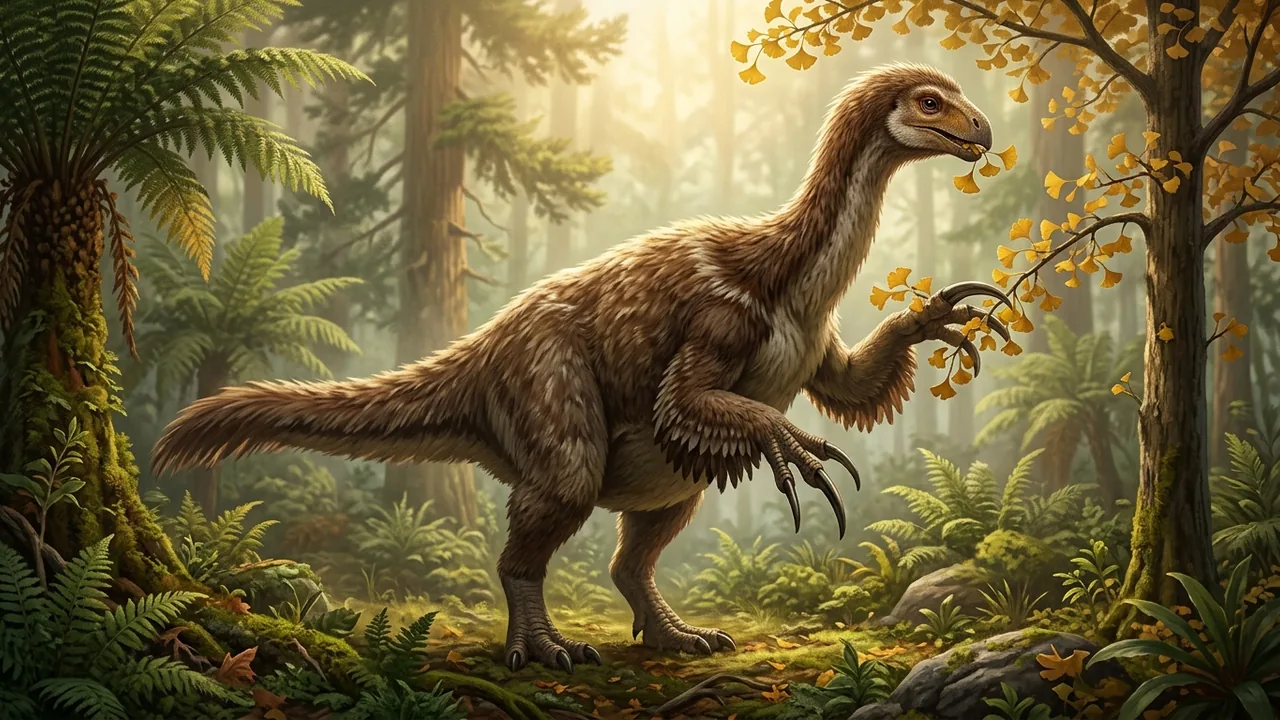
Meet the Legend: Pinnacle of Herbivorous Theropods
Within Theropoda—the dinosaurian clade celebrated for hypercarnivorous giants like Tyrannosaurus and sickle-clawed dromaeosaurs—Therizinosaurus cheloniformis represents one of evolution's boldest dietary reversals. Inhabiting central Asia roughly 70 million years ago during the early Maastrichtian stage of the Late Cretaceous, this colossal reached lengths of 10 meters (33 feet), reared nearly 5 meters tall, and weighed approximately 4.5 to 5 metric tons.
Most astonishing were its hypertrophied three-fingered hands: elongated bony manual unguals encased in curved sheaths reached nearly 1 meter (3.3 feet) along their dorsal arc, making them the longest claws evolved by any known metazoan in Earth's history!
Yet cladistic and anatomical evidence proves this imposing giant practiced peaceful obligate . Descending from small omnivorous coelurosaurs, therizinosaurians reshaped the predatory theropod bauplan from snout to tail.
A diminutive skull tipped with an edentulous rhamphotheca topped an elongate cervical series, while dense filamentous and quill-like plumage—documented directly in basal Chinese relatives Beipiaosaurus and Jianchangosaurus—insulated its barrel-chested torso.
Anchored by flare-ilium hips and robust four-toed feet, Therizinosaurus stood as a feathered ecological counterpart to Cenozoic giant ground sloths.
By modifying ancestral grasping arms into towering canopy-gathering scythes while retaining hollow pneumatic neck vertebrae, this extraordinary Mongolian browser demonstrated just how adaptable the theropod body plan could become across Late Cretaceous forests. No other dinosaur lineage bridged bird-like wrist anatomy, shaggy plumage, five-ton bulk, and specialized canopy reach in quite the same way, earning Therizinosaurus a permanent place among paleontology's most unforgettable evolutionary marvels.
Lost World Habitat: Nemegt Fluvial Stratigraphy
Sustaining five-ton high browsers required far richer primary productivity than arid desert dunes could ever supply. Therizinosaurus thrived across the wet alluvial plains preserved in southern Mongolia's Nemegt Formation (~70 million years ago), whose overlies older Campanian eolian beds and records a dramatic regional shift toward humid, seasonally monsoonal river systems.
Cross-bedded channel sandstones, point-bar deposits, and organic-rich overbank mudstones trace broad meandering rivers, oxbow lakes, and forested floodplains draining inland basins. Paleobotanical fossils—including petrified logs of Araucariaceae conifers, Metasequoia-like taxodiaceans, ginkgoes, ferns, aquatic charophytes, and diverse angiosperms—confirm lush multi-tiered gallery woodlands.
Within this fertile ecosystem, megaherbivores partitioned vegetation across distinct structural heights. Low-slung ankylosaurids (Tarchia) cropped understory ferns, crested hadrosaurids (Saurolophus angustirostris) and giant ornithomimosaurs (Deinocheirus) worked mid-story and riparian zones, titanosaurian sauropods (Nemegtosaurus) stripped upper conifer crowns, and upright Therizinosaurus monopolized the 3-to-5-meter woodland canopy tier.
Abundant freshwater unionid bivalves, gar-like fishes, trionychid turtles, and crocodyliforms inhabited active channels alongside bird-like alvarezsaurids, troodontids, oviraptorosaurs, and the ecosystem's apex tyrannosaurid predator, Tarbosaurus bataar.
Seasonal flood surges periodically buried giant forelimb elements in sandy point-bar lenses, preserving the holotype fossils studied today.
Isotopic signatures locked inside fossilized Nemegt dinosaur teeth and freshwater mollusk shells further confirm pronounced wet-dry seasonality: warm monsoonal summers fueled explosive canopy growth while cooler dry winters tested how efficiently large herbivores stored and conserved energy across forested river corridors that stretched between ancient central Asian mountain ranges, making the Nemegt Basin an oasis of giant dinosaur biodiversity.
What's on the Prehistoric Menu? Adapting to Plants
Transitioning a carnivorous lineage to bulk foliar demanded sweeping cranial, dental, and visceral reorganization. Inferred from well-preserved skulls of close relatives Erlikosaurus and Segnosaurus, Therizinosaurus possessed an edentulous premaxillary tip sheathed in a sharp rhamphotheca that cropped leafy stems cleanly, followed by tightly packed rows of small, lanceolate (leaf-shaped) cheek teeth bearing coarse marginal denticles.
Computed tomography (CT) and finite-element cranial analyses of Erlikosaurus demonstrate low bite forces optimized for stripping and coarsely slicing foliage rather than heavy oral grinding. Instead of chewing thoroughly like dental-battery hadrosaurs, therizinosaurids delegated chemical cellulose breakdown to prolonged microbial hindgut fermentation.
Accommodating a multi-hundred-kilogram fermenting digesta load reshaped the entire pelvic girdle. Whereas ancestral theropods possessed a propubic pelvis projecting forward, therizinosaurids evolved a wide, flared ilium and a strongly configuration in which the pubis rotated caudally alongside the ischium.
That opisthopubic architecture simultaneously enlarged abdominal volume and shifted center-of-mass posteriorly over the hindlimbs, enabling an upright torso posture that freed its 2.4-meter forelimbs to harvest ginkgoes, conifers, and fruiting angiosperms effortlessly.
Enlarged nasal cavities and fleshy cheeks further assisted oral food retention and thermal balance during continuous daytime foraging.
Meanwhile, elongated cervical vertebrae lightened by internal air chambers gave its small skull a wide three-dimensional feeding envelope—allowing Therizinosaurus to strip several cubic meters of foliage without taking a single heavy step, conserving precious metabolic calories across long afternoon browsing bouts while gut microbes steadily converted fibrous leaves into usable energy.
Superpowers & Anatomy: Finite-Element Claw Physics
Measuring over 70 centimeters along the bony ungual core—and roughly 100 centimeters (3.3 feet) with their living sheaths restored—the manual claws of Therizinosaurus are unmatched in vertebrate morphospace. Each robust 2.4-meter forelimb combined a massive humerus with wide pectoral and deltoid muscle crests, a hinged wrist, and three functional digits bearing laterally compressed, blade-like unguals.
To resolve longstanding functional debates over whether these scythes excavated burrows, ripped bark, or impaled prey, paleobiologists led by Zichuan Qin conducted three-dimensional finite-element biomechanical simulations across Therizinosauria in 2023. Testing simulated digging, piercing, and hook-pulling loads revealed a striking evolutionary trade-off: while smaller, deeper claws in Early Cretaceous relatives tolerated varied mechanical forces, extreme claw elongation in Late Cretaceous Therizinosaurus drastically amplified bending and torsional stress magnitudes!
Applying heavy digging or bone-slashing forces to meter-long narrow unguals risked structural failure. Under light tensile hook-and-pull loads, however, those elongated arcs functioned admirably as long-reach rakes that drew pliable leafy branches into oral range while the animal rested stably on broad, functionally four-toed (secondarily tetradactyl) feet.
Biomechanics and sexual selection likely acted in concert: peramorphic ('over-grown') scythe claws served simultaneously as canopy foraging hooks, socio-sexual ornaments, and sweeping defensive deterrents.
Just as ceratopsian frills and deer antlers signal individual vigor across open clearings, gleaming meter-long keratinous blades flashed unmistakable visual cues to rival browsers and prospective mates alike across misty Mongolian floodplains—proving evolution often pairs practical feeding mechanics with dramatic social display when giant herbivores share lush woodland habitats.
Flight vs. Fight Arena: Deterrence Against Tarbosaurus
Within the Nemegt floodplain arena, evolutionary Flight-versus-Fight trade-offs separated coelurosaurian cousins cleanly by body mass. Lightly built ornithomimids such as Gallimimus bullatus invested in elongated distal limb segments and cursorial speed—sprinting away on Team Flight whenever apex tyrannosaurid Tarbosaurus bataar attacked. Five-ton Therizinosaurus, by contrast, possessed shortened tibiae relative to its femora, a heavy abdomen, and broad plantigrade-like feet utterly unsuited for rapid escape.
Committed by anatomy to Team Fight, an adult Therizinosaurus leveraged vertical height, forelimb reach, and threat signaling to neutralize predation before physical impact occurred! Braced securely on wide four-toed feet and a muscular tail, a rearing adult elevated its head and shoulders nearly five meters above the forest floor—towering well above the cranial height of a twelve-meter Tarbosaurus.
Flaring dense arm and trunk plumage magnified its visual silhouette while powerful pectoralis and latissimus dorsi musculature swept two 2.4-meter arms armed with six meter-long keratinous blades across a wide defensive arc.
Even though finite-element mechanics show its slender unguals could not cleave thick tyrannosaur bone, rapid slashing sweeps aimed at exposed facial tissues, eyes, or throat posed a potentially fatal hunting injury to an obligate predator.
Consequently, healthy adult Therizinosaurus enjoyed formidable size-and-weaponry refuge across Nemegt woodlands, forcing tyrannosaurs to target juveniles or less perilous hadrosaur prey.
In evolutionary terms, trading cursorial speed for five-ton bulk, upright posture, and sweeping forelimb reach turned an ancestral predator's grasping hands into one of the Mesozoic Era's most effective defensive shields.
Fossil Detective Secrets: Cracking the 'Turtle' Code
Few taxonomic mysteries in paleontology rival the half-century detective quest required to assemble Therizinosaurus cheloniformis. During the 1948 Soviet-Mongolian Paleontological Expedition into Nemegt Formation at Nemegt, researchers excavated several colossal, laterally flattened manual unguals alongside broad rib fragments—completely isolated from any skull, pelvis, or hindlimb.
Publishing the holotype description in 1954, anatomist Evgeny Maleev coined Therizinosaurus cheloniformis ('turtle-formed scythe lizard'), interpreting the enigmatic bones as flipper claws of a giant, kelp-harvesting marine chelonian reptile! Even after complete 2.4-meter forelimbs and shoulder girdles surfaced in 1970, fragmentary evidence left researchers divided over whether the animal was a giant predatory carnosaur or something wholly unprecedented.
The Rosetta stones emerged gradually across Asia and North America: first Segnosaurus and Erlikosaurus in Mongolia revealed an pelvis, four-toed pes, and leaf-toothed herbivorous skull; then Early Cretaceous Alxasaurus (1993) in Inner Mongolia connected those weird hips directly to giant scythe-clawed forelimbs!
Spectacular feathered skeletons of Beipiaosaurus in Liaoning, China (1999), and Nothronychus in Utah and New Mexico soon anchored Therizinosauria firmly inside Maniraptora.
What began in 1948 as a misidentified 'sea turtle' ultimately unveiled one of evolution's grandest surprises: a five-ton, fluffy-feathered dinosaur dedicated peacefully to !
Every new therizinosaur fossil unearthed from Asian deserts to North American badlands continues to refine this comparative puzzle, showing how patient anatomical sleuthing can reconstruct an entire giant dinosaur from once-baffling three-foot claws while inspiring young fossil detectives to keep questioning first impressions whenever strange new bones emerge from ancient stone.