Meet the Legend: A Theropod Turned Leaf-Lover
Most members of the theropod dinosaur suborder—from towering Tyrannosaurus to swift Velociraptor—earned fame as sharp-toothed carnivores. Then along came Therizinosaurus cheloniformis, a thirty-three-foot, five-ton rebel from Late Cretaceous Mongolia that rewrote every rule of theropod design!
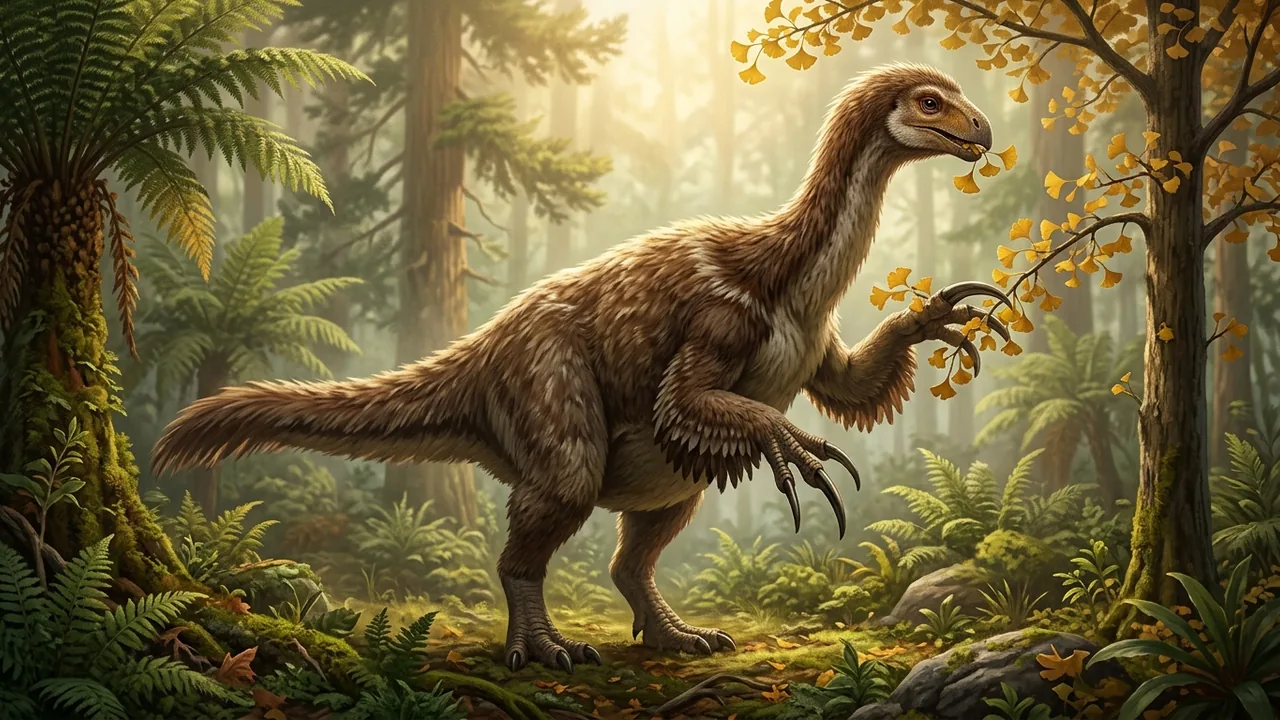
Living approximately 70 million years ago, Therizinosaurus stood sixteen feet tall with an upright torso, a slender bird-like neck, and a coat of dense, filamentous feathers. Extending from its massive eight-foot arms were three narrow, gently curved claws measuring up to 3.3 feet (1 meter) along their outer curve—the longest claws ever evolved by any animal on land or sea.
Instead of stalking prey, however, this gentle giant occupied a peaceful plant-eating niche! Its ancestors gradually traded serrated steak-knife teeth and sprint speed for a smooth beak, tiny leaf-shredding cheek teeth, and a barrel-shaped belly.
Combining dinosaurian heritage with sloth-like high habits, Therizinosaurus proves that evolution can repurpose predatory anatomy into extraordinary herbivorous tools.
Broad, sturdy four-toed feet anchored its massive frame securely on muddy woodland trails while long feathered arms gathered armfuls of golden ginkgo leaves without ever needing to sprint after prey or fight over carcasses.
Lost World Habitat: The Lush Nemegt Food Web
Seventy million years ago, southern Mongolia's Nemegt Basin looked dramatically greener than the dry red dunes of earlier epochs. Fed by seasonal monsoons and mountain runoff, wide meandering rivers carved sandy point bars, oxbow lakes, and swampy floodplains flanked by towering conifer and ginkgo forests.
At the base of this productive ecosystem, abundant solar energy fueled lush primary producers: araucaria pines, dawn redwoods, golden ginkgoes, horsetails, aquatic pondweeds, and fast-spreading flowering plants. That massive green biomass supported a multi-layered web of dinosaurian herbivores.
Low to the ground, club-tailed ankylosaurs like Tarchia cropped ferns, while herds of crested hadrosaurs such as Saurolophus chewed mid-level shrubs and giant titanosaurs stripped high crowns. Therizinosaurus slotted neatly into the 10-to-16-foot woodland zone, harvesting tender shoots and fruit along wet forest margins.
Supporting so many plant-eating tons in turn sustained agile dromaeosaurs, giant toothless Deinocheirus omnivores, and five-ton apex predator Tarbosaurus bataar at the top of the food chain.
Fallen leaves, fruits, and branches nourished beetles, freshwater snails, and soil decomposers below, recycling vital nutrients right back into the damp Mongolian floodplain so fresh shoots sprouted every rainy season.
What's on the Prehistoric Menu? Gut Power!
Fueling a 10,000-pound warm-blooded body on leaves alone requires serious digestive engineering! Because raw conifer needles and ginkgo stems contain tough cellulose walls that vertebrate stomach acid cannot dissolve by itself, Therizinosaurus relied on microbial inside an enormous gut.
In typical meat-eating theropods, the pubic hip bone angled forward between the legs. In Therizinosaurus, natural selection rotated the pubic bone backward parallel to the tail—mirroring ornithischian plant-eaters and modern birds! That clever shift moved its center of gravity back over its sturdy legs while opening cavernous abdominal space for winding intestines.
Feeding started with effortless reach. Sitting back on its broad pelvis or standing upright, Therizinosaurus used eight-foot arms to draw upper branches toward its small skull during unhurried sessions.
A sharp U-shaped rhamphotheca (beak) clipped leafy clusters cleanly, while rows of small, coarse-serrated, leaf-shaped cheek teeth sliced foliage just enough for billions of symbiotic gut bacteria to unlock steady energy!
Spending less energy chewing each mouthful allowed this towering browser to harvest hundreds of pounds of leafy shoots every single day across shady river valleys.
Superpowers & Anatomy: Claw Biomechanics
For decades scientists debated what meter-long claws actually did: did Therizinosaurus rip open giant termite mounds, spear fish, or slash tree trunks? In 2023, paleobiologists solved the puzzle using 3D finite-element —the same computer engineering software used to stress-test airplane wings and suspension bridges!
Researchers digitally modeled the narrow, laterally flattened bone cores and outer sheaths of smaller primitive therizinosaurs alongside giant Therizinosaurus. Whereas compact claws on early cousins handled moderate digging and gripping forces cleanly, extreme elongation in Therizinosaurus multiplied bending and twisting stress near the claw mid-shaft.
Had Therizinosaurus slammed those slender meter-long blades into hard-packed soil or bone, dangerous mechanical strain could have fractured the claw! Instead, the long lever arm excelled at low-stress hook-and-pull , gently gathering wide armfuls of leafy twigs closer to its beak.
Just like giant antlers on bull elk or peacock tails, exaggerated meter-long claws also served as unmistakable visual signals of health, maturity, and reach across misty woodland clearings!
Strong shoulder and chest muscles gave those eight-foot forelimbs smooth control, letting a five-ton giant part delicate branches without snapping its remarkable keratin blades.
Flight vs. Fight Arena: Facing Tarbosaurus!
Every Nemegt herbivore needed an answer for Tarbosaurus bataar—a forty-foot, five-ton tyrannosaur armed with sixty banana-thick, bone-crushing teeth! Swift ornithomimids like Gallimimus relied on 35-mile-per-hour sprints on Team Flight, leaving predators coughing in river dust. Therizinosaurus, however, had short shin bones, wide hips, and flat four-toed feet built for stability rather than running.
With top speed limited to a lumbering jog, fleeing through dense woods was impossible—placing Therizinosaurus squarely on Team Fight! Whenever Tarbosaurus stalked within range, shifted from foraging reach to towering intimidation.
Planting its broad feet and wide tail firmly as a tripod base, Therizinosaurus reared sixteen feet tall—looking down onto the tyrannosaur's skull! Puffing out dense arm and body feathers made its torso appear massive while robust chest and shoulder muscles swept eight-foot arms wide.
Even though its three-foot claws were not built to chop heavy bone, a fast lateral sweep aimed at a predator's sensitive eyes, snout, or throat represented an unacceptable injury risk—convincing cautious tyrannosaurs to seek less prickly quarry!
In nature's high-stakes survival arena, looking too tall and dangerous to attack is often the smartest defense strategy a slow-moving giant can deploy.
Fossil Detective Secrets: From Sea Turtle to Theropod
Why does a feathered woodland dinosaur carry the scientific species name cheloniformis, meaning 'turtle-formed'? Because Therizinosaurus fooled fossil detectives for more than twenty years! In 1948, paleontologists excavating Nemegt sandstones in southwest Mongolia uncovered giant flattened rib pieces and enormous curved ungual (claw) cores over 28 inches long—without a single skull or leg bone attached.
Describing those mysterious fossils in 1954, anatomist Evgeny Maleev hypothesized they belonged to a colossal, 15-foot-long turtle-like reptile that used scythe claws to harvest underwater plants! Even after eight-foot forelimbs turned up in 1970, experts argued over whether they belonged to a giant predator or an unknown plant-eater.
The breakthrough arrived when paleontologists discovered more complete cousins—Segnosaurus in Mongolia, Alxasaurus in Inner Mongolia, Nothronychus in North America, and feathered Beipiaosaurus in northeastern China.
Lining up their hips, long necks, leaf-shaped teeth, bellies, and progressive claw piece by piece finally revealed the truth: Therizinosaurus was a gentle, fluffy-feathered giant at the pinnacle of herbivorous theropod evolution!
Comparing related fossils across continents proved once again how patient teamwork turns scattered mystery bones into clear, vivid portraits of prehistoric life.