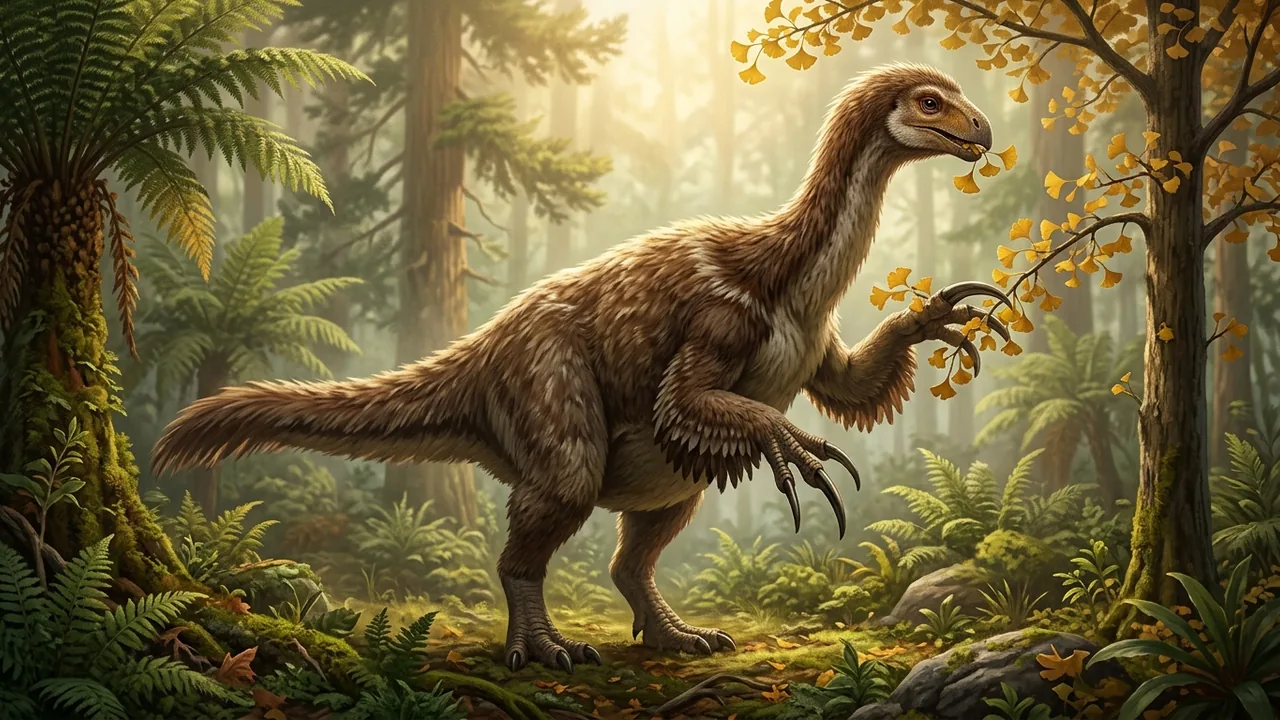
Meet the Legend: The Salad-Loving Claw Champion
If you judged a dinosaur only by its hands, Therizinosaurus would look like the fiercest monster ever to walk the Earth! Stretching thirty-three feet long, standing sixteen feet tall, and weighing roughly five tons, this towering Late Cretaceous giant carried three curved claws on each hand measuring a record-breaking three feet long!
Yet fossil clues reveal a wonderful scientific surprise: Therizinosaurus was a peaceful, shaggy-feathered ! Even though its distant theropod ancestors hunted meat, its family tree evolved an incredible set of physical adaptations for browsing treetops instead of chasing prey.
With a small head perched atop a long neck, a wide potbelly, sturdy four-toed feet, and yard-long claws sheathed in smooth , Therizinosaurus looked like a giant feathered ground sloth strolling calmly through prehistoric Asia—proving that even huge claws can belong to gentle leaf-eaters!
Lost World Habitat: Rivers of Ancient Mongolia
About 70 million years ago, Therizinosaurus lived in a lush floodplain ecosystem in southern Mongolia known today as the Nemegt Basin. Unlike the dry sand dunes found in older Mongolian rocks, the Nemegt landscape shimmered with wide meandering rivers, muddy ponds, cypress swamps, and cool gallery forests.
Towering araucaria conifers, fan-leaved ginkgoes, ferns, and early flowering shrubs grew thickly along wet riverbanks, acting as rich green producers for giant plant-eating dinosaurs. Duck-billed Saurolophus herds, armored ankylosaurs, and swift ostrich-mimic dinosaurs shared these shady waterways.
Floodwaters buried fallen leaves, tree trunks, and giant bones beneath soft sandbars that hardened into tan rock. Right here in Virginia, Early Cretaceous river clays of the Potomac Formation along the I-95 corridor formed in a similar streamside way—preserving fossil conifers, ferns, ginkgo relatives, and dinosaur footprints!
What's on the Prehistoric Menu?
How does a five-ton forest giant stay full from sunrise to sunset? By turning into a high-reach eating machine! In the Nemegt woodland food chain, sunlit ginkgoes, horsetails, conifers, and fruiting shrubs served as abundant producers. While low-slung armored dinosaurs munched ground ferns, tall Therizinosaurus worked the upper branches as a specialized high-browsing .
Reaching upward with muscular eight-foot arms, it hooked leafy boughs with its curved claws like long garden rakes and bent them gently down to mouth level. A sharp beak at the tip of its snout snipped stems cleanly, while dozens of tiny, leaf-shaped cheek teeth sliced greens into smaller pieces.
Because raw leaves take a long time to break down, Therizinosaurus evolved extra-wide hip bones supporting a massive, barrel-shaped digestive tract packed with helpful gut microbes!
Superpowers & Anatomy: Secrets of 36-Inch Claws
Why did a peaceful plant-eater grow claws longer than a yardstick? Scientists tested digital 3D models of Therizinosaurus claws to uncover how this extraordinary worked! Each narrow, slightly curved bone core was covered by a tough sheath that stretched total claw length to roughly three feet (one meter).
Engineering tests showed that if Therizinosaurus tried digging hard rocky ground with such long, slender blades, the claws could bend or crack. Instead, they excelled at sweeping, pulling foliage, and visual display!
Other body adaptations supported that browsing lifestyle from head to toe. Hollow neck bones kept its long neck light, fluffy feather insulation regulated body warmth, and four sturdy toes on each broad foot acted like wide snowshoes on soft, muddy Nemegt riverbanks while it leaned back to feed.
Flight vs. Fight Arena: Towering Deterrence!
Even a five-ton faced serious danger in Late Cretaceous Mongolia! Prowling the exact same riverside forests was Tarbosaurus bataar—a forty-foot, bone-crushing tyrannosaur closely related to North America's T. rex. Unlike fast Gallimimus herds that sprinted away on Team Flight, wide-hipped, flat-footed Therizinosaurus was built for stability rather than speed.
Outrunning an athletic tyrannosaur was impossible, so Therizinosaurus relied on bold Team Fight deterrence! At the rumble of approaching footsteps, it planted its broad feet, reared upright to its full sixteen-foot height, and flared its shaggy arm feathers wide.
Towering higher than Tarbosaurus's skull, Therizinosaurus swept its eight-foot arms and six gleaming, three-foot claws through the air! Because a single defensive swipe could blind or injure an attacker, this bold defensive convinced smart predators to hunt safer targets along open riverbanks.
Fossil Detective Secrets: Solving a 50-Year Puzzle
Therizinosaurus gave paleontologists one of the trickiest jigsaw puzzles in fossil history! In 1948, a joint Soviet-Mongolian expedition digging in tan Nemegt sandstone uncovered flattened rib fragments and gigantic curved claws over two feet long—with no skull, hips, or hind legs nearby.
Studying those strange bones in 1954, paleontologist Evgeny Maleev named the creature Therizinosaurus cheloniformis—meaning turtle-formed scythe lizard—thinking the claws belonged to a giant aquatic reptile! Twenty years later, new Mongolian expeditions unearthed giant eight-foot arms and shoulders proving the claws belonged to a theropod dinosaur.
Finally, discoveries of smaller, complete therizinosaur cousins in China and Mongolia—some preserving fuzzy feather outlines in fine stone—completed the picture, revealing every plant-eating of Earth's fluffiest, longest-clawed gentle giant! Today, paleontologists still explore those Mongolian cliffs searching for the first complete Therizinosaurus skull.