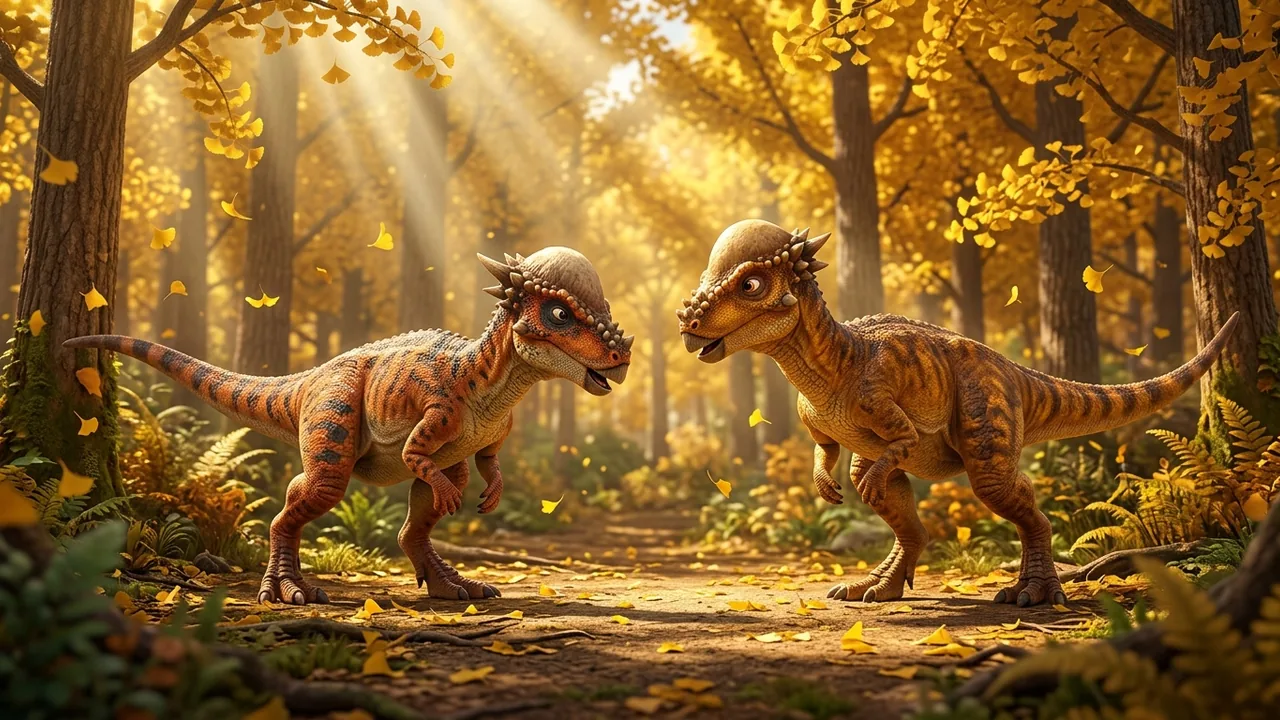
Meet the Legend: Apex of Bone-Domed Marginocephalia
Near the close of the Mesozoic Era, Pachycephalosaurus wyomingensis emerged as the largest and most anatomically specialized member of Pachycephalosauria—a remarkable lineage of bipedal ornithischians celebrated for vaulted cranial roofs. Measuring approximately four and a half meters from rostral beak to tail tip and weighing between three hundred sixty and four hundred fifty kilograms, this cursorial dinosaur belonged to Marginocephalia, the evolutionary clade uniting thick-skulled pachycephalosaurs with horned ceratopsians via a shared overhanging parietosquamosal skull shelf.
Whereas quadrupedal ceratopsians expanded that posterior shelf into broad defensive neck shields, Pachycephalosaurus fused and thickened its frontal and parietal bones upward into a massive hemispherical dome reaching twenty-two centimeters—nearly nine full inches—in vertical thickness right above its compact braincase.
Surrounding this smooth central vault, clustered dermal ossifications formed spiky nasal rosettes along the dorsal snout and blunt pyramidal nodes across the squamosal rear border behind the temples. Microscopic thin-sections demonstrate that subadult skulls expanded skyward through richly vascularized bone tissue laced with dense blood vessels before consolidating into dense, minimally vascularized adult bone.
Mapping this extraordinary cranial revolutionized modern dinosaur taxonomy, proving that elaborate juvenile spike arrays and rounded adult domes belonged to sequential life stages of a single dynamic species rather than separate rival genera.
Balanced horizontally across sturdy three-toed hind limbs by a rigid caudal basket of interwoven ossified tendons, and holding short five-fingered forelimbs tucked close to its deep ribcage, Pachycephalosaurus united nimble woodland agility with unmatched cranial armor across western North America. Flaring pelvic blades and locked dorsal vertebrae completed a compact athletic build unlike any living animal today.
Lost World Habitat: Hell Creek & Lance Stratigraphy
Diagnostic fossils of Pachycephalosaurus wyomingensis come exclusively from upper Maastrichtian terrestrial deposits across Montana, South Dakota, and Wyoming—most notably the Hell Creek and Lance formations, alongside equivalent horizons in Colorado's Laramie Formation. High-precision argon-argon dating of volcanic sanidine crystals extracted from interbedded bentonite ash layers constrains these rock units tightly between sixty-nine and sixty-six million years ago, terminating right at the global end-Cretaceous impact clay.
Detailed basin documents meandering river point-bars, sandy crevasse splays, and organic-rich floodplain mudstones laid down across broad coastal and piedmont plains draining eastward from rising Cordilleran mountains into the retreating Western Interior Seaway.
Fossilized leaf margins, dispersed spore and pollen assemblages, and paleosol geochemistry reconstruct a humid, warm-temperate to subtropical climate lacking winter freezes, dominated by lush gallery forests of Metasequoia dawn redwoods, Ginkgo adiantoides, taxodium cypresses, palms, sycamores, and rapidly diversifying broadleaf angiosperm shrubs.
Careful taphonomic logging across Hell Creek stratigraphy reveals a telling ecological pattern: rounded, water-worn pachycephalosaur domes appear disproportionately inside coarse gravel channel lags rather than quiet coastal coal swamps, indicating breeding populations favored well-drained inland piedmont woodlands and upland hills upstream from crowded coastal marshes.
Within these shaded forest corridors and stream valleys, Pachycephalosaurus coexisted alongside horned Triceratops, duck-billed Edmontosaurus, club-tailed Ankylosaurus, aquatic Champsosaurus, soft-shelled river turtles, squirrel-sized multituberculate mammals, and swift, feathered maniraptoran predators. Seasonal monsoons replenished upland creeks each summer while mild coastal breezes sustained evergreen foliage throughout the entire year, creating diverse microhabitats from misty riverbanks to breezy inland ridges.
What's on the Prehistoric Menu?
Reconstructing the feeding biology of Pachycephalosaurus puzzled vertebrate paleontologists for generations because energetic river currents routinely stripped delicate maxillae and lower dentaries away from durable skull domes. Breakthrough synchrotron radiation and high-resolution micro-CT scans of articulated immature skulls recovered from Hell Creek finally revealed a surprisingly complex heterodont dentition preserved intact inside young jaws.
At the anterior tip of the narrow snout sat a sharp, continuously growing keratinous beak tailored for selective cropping of calorie-dense seeds, nuts, fleshy angiosperm fruits, and tender gymnosperm shoots near shaded forest understories. Immediately behind that beak, three pairs of curved, pointed premaxillary teeth carried sharp front and rear serrations strikingly convergent with the ziphodont blades of small carnivorous theropods!
Separated from those front fangs by a short toothless diastema gap, eighteen to twenty maxillary and dentary cheek teeth featured low, triangular, laterally compressed crowns sculpted with coarse vertical ridges and swollen basal collars above the gumline.
Throughout skull , angled enamel microwear facets confirm that upper and lower cheek rows sliced past one another like miniature garden shears to shred fibrous leaves, seed husks, and tough fruit rinds without horizontal grass-grinding motions.
Meanwhile, pairing ridged plant-shredding cheek teeth with blade-like serrated front crowns points strongly to opportunistic seasonal omnivory—allowing Pachycephalosaurus to capture beetles, orthopterans, millipedes, amphibians, or small lizards whose concentrated calcium, phosphorus, and protein fueled rapid dome construction. Broad posterior ribs simultaneously housed a spacious fermentative gut that extracted steady energy from coarser winter browse.
Superpowers & Anatomy: Cranial Ontogeny & Shock Physics
Few case studies illuminate dinosaur cranial as dramatically as the histological unification of Dracorex hogwartsia, Stygimoloch spinifer, and Pachycephalosaurus wyomingensis into one continuous life cycle. Thin-section microscopy across dozens of Hell Creek skulls proved that flat-topped Dracorex specimens consist entirely of porous, fast-growing bone with open cranial sutures and sharp juvenile nodal spikes.
During subadult Stygimoloch growth stages, rapid vertical expansion of the frontoparietal vault pushed up a steep central dome while posterior squamosal horns elongated to ten centimeters for visual display among woodland rivals. As individuals reached skeletal maturity, bone-resorbing osteoclast cells blunted those long rear horns into rounded bosses while dense cortical remodeling thickened the adult dome to twenty-two centimeters.
Three-dimensional finite-element crash simulations explain how this vaulted architecture survived high-energy collisions without concussing the small, thick-walled braincase underneath. Internally, radiating columns of spongy cancellous trabecular bone acted as biological crumple zones, deflecting compressive stress waves laterally away from delicate neural tissue and out through thickened orbital bars.
Behind the skull, beveled cervical articulations and interlocking tongue-and-groove dorsal zygapophyses aligned the S-curved neck and spine into a torsion-resistant compression beam, while a dense woven basket of ossified tendons braced the tail against recoil.
Coupled with enlarged olfactory bulbs for keen woodland scent tracking and forward-angled orbits providing crisp binocular depth perception, Pachycephalosaurus united sharp sensory targeting with remarkable impact engineering. Vascular grooves etched across the dome surface further suggest a tough, keratinous outer sheath protected the living skull roof.
Flight vs. Fight Arena! Paleopathology & Defense
Surviving across late Maastrichtian floodplains and uplands required finely tuned Flight-versus-Fight behavioral strategies matched against dramatically different theropod predators sharing western Laramidia. When confronted by multi-ton apex hunter Tyrannosaurus rex—or long-legged, pursuit-adapted juvenile tyrannosaurs—Pachycephalosaurus relied on keen binocular sight, brisk bipedal speed, and agile maneuvers through dense upland timber to evade capture before an ambush closed in.
Against contemporaneous woodland dromaeosaurids such as feathered, two-meter Acheroraptor temertyorum, however, a four-hundred-fifty-kilogram adult stood decisively on Team Fight! Planting its muscular three-toed hind feet, flexing its S-curved neck, and whipping its nine-inch bone dome forward or sideways like a kinetic battering ram allowed Pachycephalosaurus to repel forty-pound sickle-clawed hunters with bone-rattling force.
Compelling forensic evidence for real head-to-head and flank combat comes from systematic investigations examining more than one hundred pachycephalosaurid skulls across museum collections. Fully twenty-two percent of mature domes preserve localized pitted depressions, resorptive craters, and smooth collars of remodeled periosteal bone—exact anatomical matches for healed impact trauma and secondary bone infections seen in modern head-butting bighorn sheep and muskoxen!
Tellingly, flat-headed juvenile stages show almost zero cranial lesions, confirming that vigorous dome-clashing and broadside flank-butting escalated during adult as rivals contested social dominance.
Protected by wide, flaring pelvic ribs that shielded vital abdominal organs and shock-dispersing internal skull struts, mature contenders battled energetically for prime woodland breeding territories and walked away ready for the next challenge. High metabolic stamina and sturdy hind-limb leverage ensured neither woodland raptors nor rival challengers caught an alert adult unprepared.
Fossil Detective Secrets: Taphonomy & Synced Clocks
Piecing together the complete natural history of Pachycephalosaurus required blending river taphonomy, high-precision geochronology, and non-destructive medical imaging across northern Great Plains badlands. Because solid twenty-two-centimeter frontoparietal domes behave hydrodynamically like dense quartz cobbles in raging storm floodwaters, isolated water-worn domes outnumber articulated skeletons by more than ten to one across Hell Creek and Lance .
After early explorers collected puzzling skull fragments during the late nineteenth century—including one bumpy bone spike briefly mistaken for reptile armor—amateur fossil hunter William Winkley unearthed a spectacularly complete, knob-ringed adult skull on a Carter County ranch in Montana in 1938, finally revealing the dinosaur's dramatic spiky snout and vaulted crown.
Decades later, tying exact quarry positions and elevations to argon-argon dates from volcanic bentonite ash horizons proved that flat-headed Dracorex, long-spiked Stygimoloch, and domed Pachycephalosaurus lived side by side during the exact same final million years of the Cretaceous rather than representing separate evolutionary eras.
High-energy synchrotron X-ray scans combined with lesion mapping and histological thin-sectioning then confirmed the juvenile-to-adult growth sequence without damaging priceless museum holotypes, preserving delicate internal bone chambers for future generations of students.
Today, every weathered bone dome eroding out of Montana sandstone celebrates how scientific detective work united dragon-spiked youngsters, omnivorous jaws, and shock-absorbing cranial armor into one unforgettable Late Cretaceous survivor. Rare articulated juvenile skeletons excavated during recent field seasons continue to illuminate how rapidly these agile woodland runners grew, foraged, and defended themselves across ancient western North America.