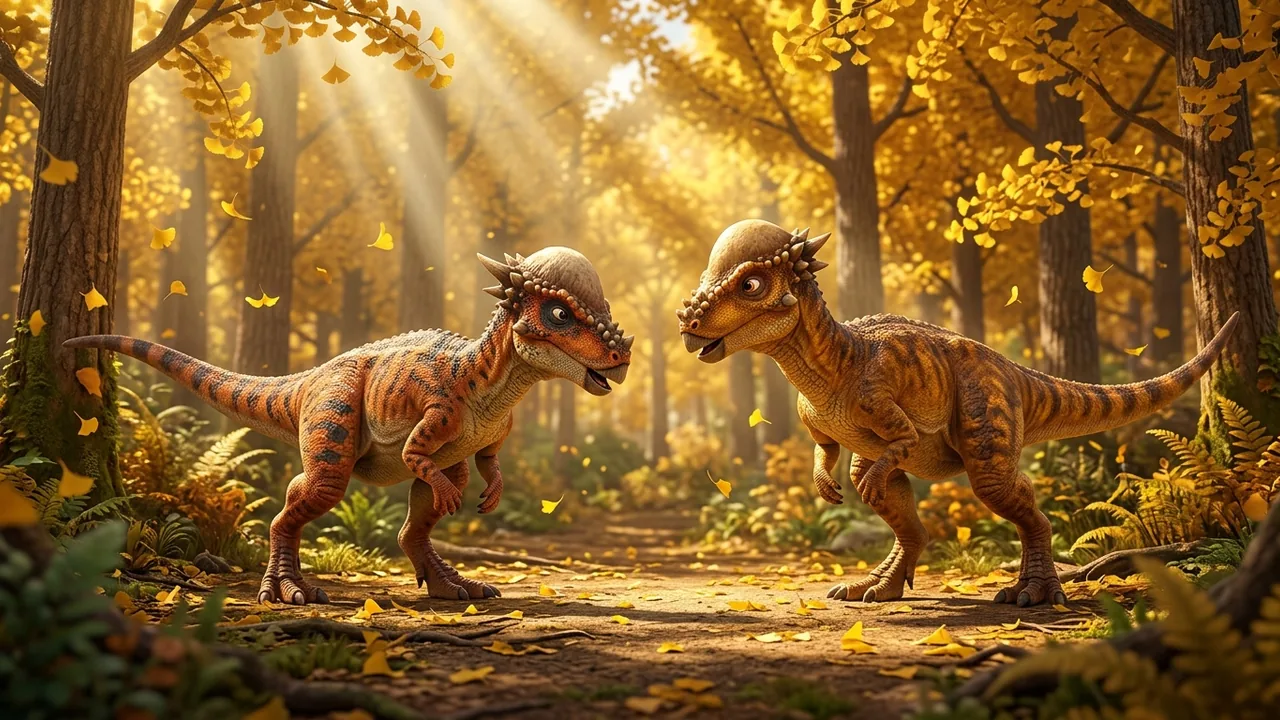
Meet the Legend: Bipedal Cranial Engineering
Measuring fifteen feet from rostral beak to tail tip and weighing between eight hundred and one thousand pounds, Pachycephalosaurus wyomingensis stood out as one of the most extraordinary athletes of the Late Cretaceous. Unlike massive four-legged tanks that anchored themselves on heavy pillar limbs, this marginocephalian kept the swift bipedal stance of its smaller ancestors while crowning its skull with nine inches of fused frontoparietal bone.
Rings of conical bony nodes ornamented its narrow snout and jutted backward from a shelf-like squamosal rim behind the temples. To counterbalance that front-loaded cranium, an intricate weave of tendons encased the rear half of its tail, locking the caudal vertebrae into a rigid horizontal stabilizer.
Researchers investigating dinosaur compare Pachycephalosaurus to a remarkable blend of a fast ostrich and a muscular bighorn ram. Short five-fingered forelimbs stayed tucked neatly near its chest while long shins and sturdy three-toed feet powered brisk sprints and sharp pivots along wooded trails.
Every element of its compact frame worked in harmony to support nimble forest foraging alongside energetic physical contests. Wide pelvic blades anchored powerful thigh muscles, while interlocking spinal joints kept its back level and steady through every stride.
Lost World Habitat: Upland & Floodplain Webs
Between sixty-nine and sixty-six million years ago, Pachycephalosaurus ranged across western North America from Montana and South Dakota southward into Wyoming. While meandering lowland rivers supported huge herds of Triceratops and Edmontosaurus near the retreating Western Interior Seaway, durable dome fossils washed down from inland gravel channels indicate Pachycephalosaurus also frequented well-drained upland hills.
Towering canopies of dawn redwood, bald cypress, ginkgoes, sycamores, and early flowering trees shaded damp carpets of ferns, horsetails, and fruiting shrubs. Within this layered woodland food web, Pachycephalosaurus occupied a versatile middle tier rarely filled by giant specialized lowland grazers.
Studying locomotor explains how upright balance on two hind legs helped Pachycephalosaurus exploit steeper, timber-crowded slopes where multi-ton quadrupeds moved awkwardly. Nimble individuals wove effortlessly between dense tree trunks, harvested fallen nuts and sweet autumn berries, and dispersed fertile seeds across sunny forest clearings.
Meanwhile, wide flaring rear ribs enclosed a spacious digestive gut capable of fermenting fibrous leaves whenever soft fruit grew scarce. Along those shaded woodland creeks, Pachycephalosaurus crossed paths with armored Ankylosaurus, squirrel-like gliding mammals, soft-shelled river turtles, aquatic Champsosaurus, and quick feathered dromaeosaurs.
What's on the Prehistoric Menu?
For more than seventy years after scientists named Pachycephalosaurus, its exact diet remained a puzzle because turbulent rivers had stripped fragile jawbones away from nearly every recovered skull cap. Then detailed CT scans of finely preserved juvenile skulls unveiled an exciting surprise in feeding : Pachycephalosaurus possessed heterodont—or multi-styled—dentition inside the very same mouth!
Immediately behind its sharp, narrow keratinous beak sat three pairs of curved, pointed teeth lined with fine serrations remarkably similar to the crowns of small predatory theropods. Separated by a short toothless gap, the rear upper and lower jaw rows carried triangular, leaf-shaped cheek teeth sculpted with coarse vertical ridges.
This dual dental toolkit granted Pachycephalosaurus outstanding flexibility across changing woodland seasons. Its hooked beak and ridged cheek rows neatly sheared fibrous leaves, tough seed coats, nuts, and fleshy fruits, while those blade-like premaxillary front teeth gripped and punctured beetles, katydids, millipedes, frogs, or small lizards.
Supplementing everyday plant calories with protein-rich and calcium-rich animal prey gave growing youngsters a vital nutritional advantage. Extra dietary minerals helped fuel the rapid bone growth needed to construct nine inches of dense cranial armor before adulthood.
Superpowers & Anatomy: Shock-Absorbing Dome
Could a living dinosaur ram solid targets with its forehead without injuring its own brain? Paleobiologists used computer crash modeling—the exact engineering software used to test modern football helmets and race cars—to trace stress waves moving through detailed digital CT models of Pachycephalosaurus skulls.
Beneath a hard outer bone shell, growing domes contained radiating columns of spongy bone oriented perpendicular to the curved impact surface. Much like microscopic shock struts inside bighorn sheep horn cores, those tiny trabecular beams flexed slightly under heavy compression, channeling dangerous shock waves harmlessly around the thick-walled braincase.
Furthermore, specially beveled neck joints allowed Pachycephalosaurus to drop its snout until dome, cervical spine, and back vertebrae aligned into one straight compression column that prevented neck sprains. Interlocking spinal tabs stopped sideways twisting on contact, while the rigid basket of tail tendons absorbed backward hip recoil.
Large forward-tilted eye sockets completed this anatomical defense system by providing crisp binocular depth perception. Combined with enlarged scent lobes at the front of the brain, keen eyesight let Pachycephalosaurus judge closing speed, forest obstacles, and strike distance down to a fraction of an inch!
Flight vs. Fight Arena! Dual-Action Fighter
Positioned near the center of Hell Creek's woodland web, a nine-hundred-pound Pachycephalosaurus balanced swift footwork against fearless close-quarters defense. Whenever an adult or long-legged juvenile Tyrannosaurus rex patrolled a floodplain valley, brisk sprinting at roughly fifteen to twenty miles per hour through dense upland timber offered the smartest escape.
Against wolf-sized feathered hunters such as six-foot Acheroraptor, however, body mass and favored Team Fight decisively! Planting its sturdy hind feet, bracing its rod-like tail, and snapping its lowered nine-inch dome forward or sideways turned Pachycephalosaurus into a swinging battering ram that sent forty-pound raptors tumbling into the ferns.
Intraspecific contests between rival Pachycephalosaurus were just as energetic during autumn territorial gatherings. Dropping their chins so rounded domes collided with resonant thuds—or swinging spiked snouts broadside into a challenger's wide, muscular flank—rivals tested strength and balance to claim mates and prime fruiting groves.
Because wide pelvic ribs shielded vital internal organs and internal skull struts cushioned direct jolts, mature adults absorbed heavy blows safely. Once a challenger backed down, both rivals walked away unharmed and ready to guard the forest.
Fossil Detective Secrets: Cracking the Growth Code
Solving the mystery of how Pachycephalosaurus grew up required uniting rugged field geology with hospital-grade X-ray imaging. Because solid nine-inch domes resisted river wear long after delicate jawbones broke apart, paleontologists originally named three separate dinosaur genera from the same Montana and Wyoming rock beds based on skull shape.
Flat-topped skulls ringed with sharp spikes were named Dracorex, medium domes carrying four-inch rear horns became Stygimoloch, and towering nine-inch domes with blunt knobs stood alone as Pachycephalosaurus. When researchers examined microscopic bone slices and CT scans across dozens of skulls, internal growth textures revealed one single animal!
Both Dracorex and Stygimoloch skulls contained porous, rapidly growing bone and open sutures typical of youngsters and teenagers—including sharp front teeth still erupting inside juvenile jaws. Entering adulthood, upward expansion of spongy and dense outer bone inflated the tall dome while shrinking the long rear spikes into blunt adult knobs.
Combined with healed impact dents discovered on more than one out of every five adult domes, these forensic clues solved a century-old riddle. Fossil detectives proved how spiky youngsters matured into Hell Creek's iconic bone-domed champion!