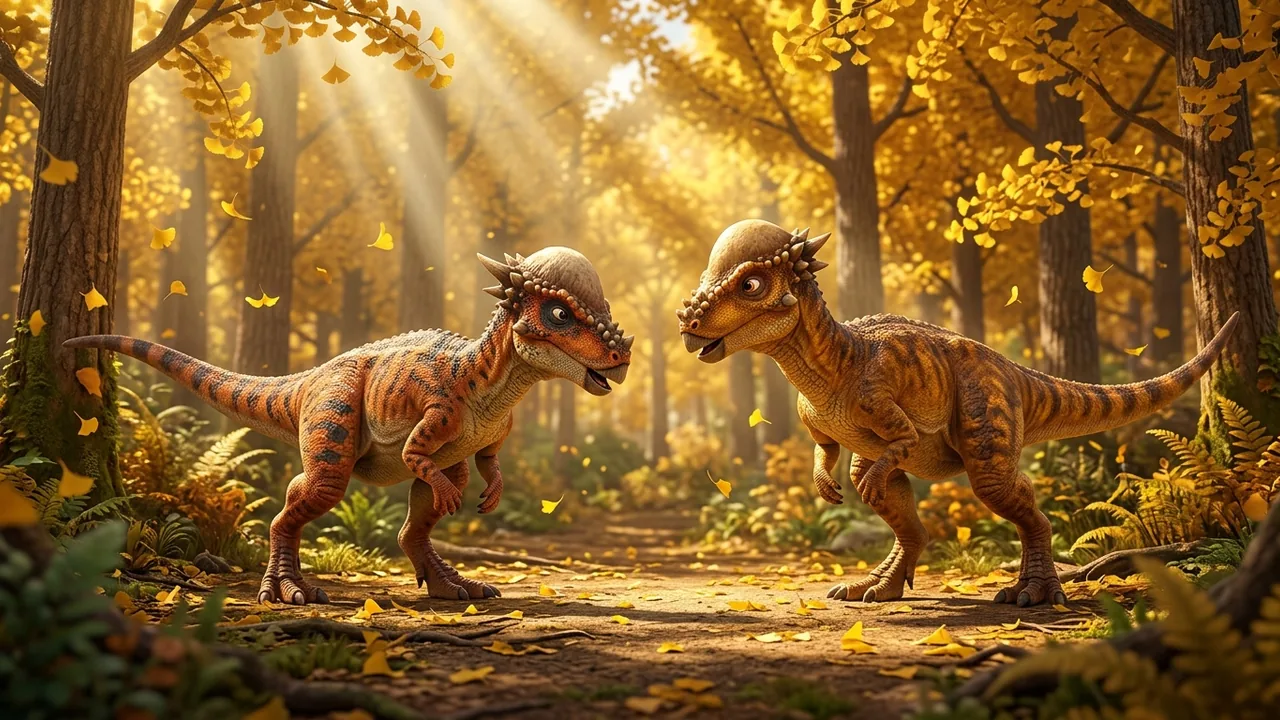
Meet the Legend: Shelf-Headed Battering Ram
Stretching fifteen feet from beak to tail tip and weighing close to one thousand pounds, Pachycephalosaurus was the largest bone-headed dinosaur ever to walk the Earth. Although it dashed upright on two sturdy, three-toed hind legs instead of lumbering on all fours like horned tanks, scientists classify it as a close cousin of Triceratops inside the —or fringed-head—dinosaur family!
Its unmistakable physical crowned the very top of its skull: a rounded dome of dense solid bone measuring up to nine inches thick. Clusters of pyramid-shaped bony knobs framed its narrow muzzle and studded a rugged bony shelf jutting from the back of its head.
Combined with five-fingered grasping hands, wide barrel-shaped hips, and a rod-stiffened tail held straight out behind its body for balance, Pachycephalosaurus blended athletic woodland speed with natural head armor built to withstand astonishing impacts!
Lost World Habitat: Laramidia's Forest Hills
From sixty-nine to sixty-six million years ago, Pachycephalosaurus inhabited forested river valleys and drier upland hills across modern Montana, Wyoming, and South Dakota. During that Late Cretaceous era, the warm, shallow Western Interior Seaway divided North America into two island continents: western Laramidia and eastern Appalachia.
Whereas Virginia's Culpeper Basin on eastern Appalachia preserves much older Early Mesozoic dinosaur footprints pressed into red quarry sandstone, this agile thrived millions of years later across western Laramidia's lush woodlands. Warm seasonal rains nourished fan-leaved ginkgoes, dawn redwoods, tree ferns, horsetails, and early flowering fruit bushes.
Within this vibrant forest , Pachycephalosaurus shared shady streambanks with club-tailed Ankylosaurus, duck-billed Edmontosaurus, Champsosaurus river reptiles, soft-shelled turtles, and small tree-climbing mammals. Foraging along breezy inland hillsides as well as lowland floodplains let it find quiet groves away from giant coastal herds!
What's on the Prehistoric Menu?
Understanding Pachycephalosaurus's exact place in the Late Cretaceous food chain took decades of fossil detective work because early discoveries included only thick skull caps without jaws. When complete juvenile skulls finally emerged from western rocks, CT scans showed that this nimble was likely an adaptable woodland !
At the tip of its narrow snout, a sharp hooked beak clipped protein-rich seeds, figs, berries, and tender fern fronds cleanly from low forest bushes. Right behind that beak sat curved, pointed front teeth lined with tiny saw-like edges remarkably similar to small meat-eating dinosaur teeth, followed by rows of ridged, leaf-shaped cheek teeth.
In a bustling forest , that clever two-part dental toolkit allowed Pachycephalosaurus to shred tough green leaves while also snapping up beetles, cicadas, millipedes, frogs, and tiny lizards. Eating both plant producers and insect prey supplied extra minerals for building its thick skull!
Superpowers & Anatomy: Shock-Proof Design
Carrying a nine-inch bone helmet required far more than piling heavy weight onto a dinosaur's forehead—every part of Pachycephalosaurus's skeleton showed a coordinated structural for balance and shock protection. Inside the growing skull dome, tiny spongy honeycomb bone chambers flexed slightly to cushion jolts before shock waves reached the small braincase.
Where the heavy skull met the spine, specially angled neck bones allowed Pachycephalosaurus to tuck its chin low, lining its dome, muscular neck, and sturdy back into one straight horizontal beam. Meanwhile, interwoven lattices of hardened tendons stiffened the back half of its tail like a fibreglass balance pole.
Sensory casts of its skull reveal one more woodland superpower: wide eye sockets angled forward so both eyes overlapped! Clear binocular depth perception helped this swift judge exact distances whether leaping mossy logs or aiming a defensive strike.
Flight vs. Fight Arena! Woodland Showdowns
Surviving inside the busy Hell Creek demanded smart split-second choices depending on which hunter stepped onto the trail. Whenever a forty-foot Tyrannosaurus rex thundered through the redwoods, nimble two-legged Pachycephalosaurus relied on keen hearing, early alertness, and tight woodland turns to slip out of sight.
Against agile six-foot feathered hunters such as Acheroraptor, however, this muscular nine-hundred-pound dinosaur belonged squarely on Team Fight! Pivoting rapidly on powerful thighs and dropping its armored crown, Pachycephalosaurus swung its nine-inch bone dome like a heavy battering ram that sent forty-pound raptors scrambling for safety.
Behavioral also shaped noisy contests inside its own herds each season. Mature Pachycephalosaurus faced off in sunlit clearings—bobbing spiky snouts, clashing rounded domes head-on, or swinging forceful flank butts against rivals' wide, rib-shielded sides to win territory without fatal harm!
Fossil Detective Secrets: Skull Shape-Shifters
Whenever seasonal storms flooded Late Cretaceous streams, swirling sand and gravel buried durable Pachycephalosaurus skull domes long after delicate limb and rib bones washed apart. Even tumbled along rocky riverbeds like heavy stone bowling balls, those solid nine-inch domes survived sixty-six million years to guide modern fossil detectives!
Hospital-style CT scanners unlocked two sensational secrets hidden inside those fossilized skulls. First, roughly one out of every five adult domes preserves healed pits and smooth regrown bone scars—direct proof that living Pachycephalosaurus used their thick skull in real shoving and head-bumping contests.
Second, comparing microscopic bone rings across dozens of specimens revealed an astonishing life-cycle makeover! Flat-headed juveniles once named Dracorex sprouted long rear spikes as teenagers once named Stygimoloch, before shrinking those spikes and inflating the round dome of adult Pachycephalosaurus!