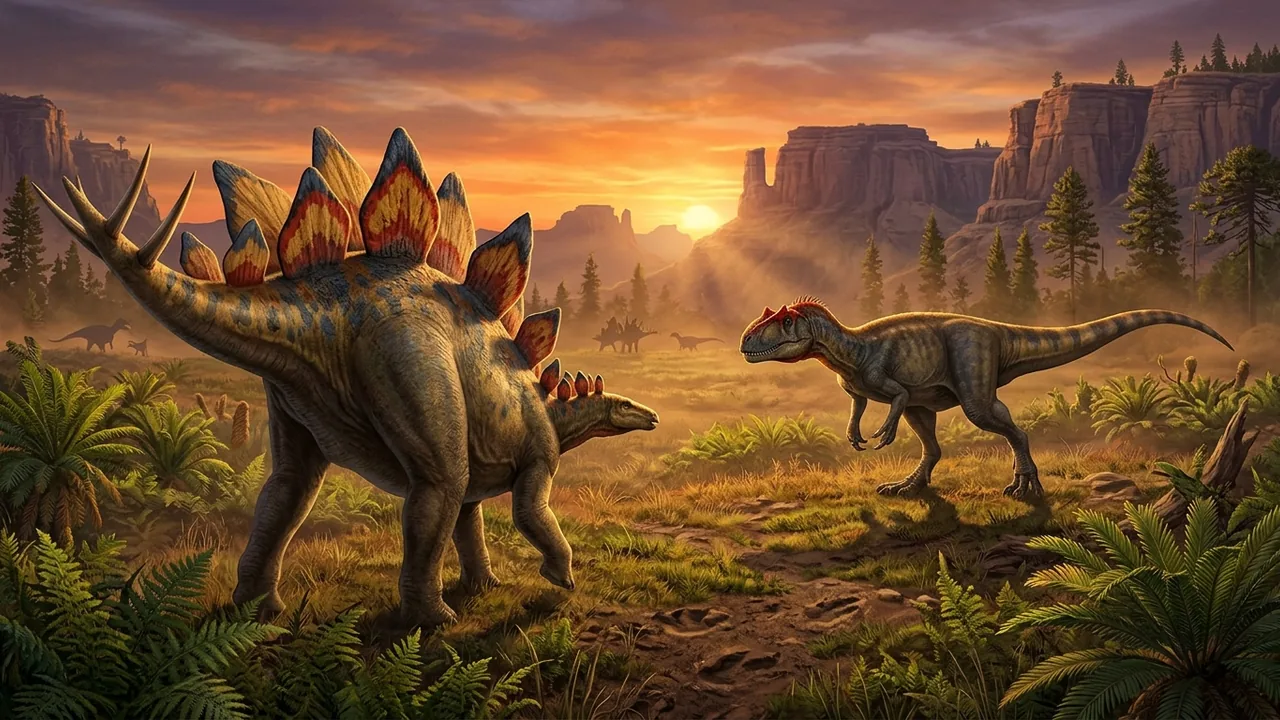
Meet the Legend: Icons of the Morrison
More than eighty million years before Tyrannosaurus rex and Triceratops evolved in Maastrichtian swamps, Late Jurassic ecosystems staged their own unforgettable predator-prey rivalry across western Laurasia. Throughout the Kimmeridgian and Tithonian stages (155–145 MYA), sleek carnosaur Allosaurus fragilis shared semi-arid floodplains directly alongside heavily armed thyreophoran Stegosaurus stenops. High-precision argon-argon and uranium-lead radiometric dating of volcanic ash horizons confirms both species walked the exact same river valleys for millions of years.
Stratigraphic excavations across the famous —spanning Colorado, Utah, Wyoming, and Montana—plus contemporaneous Lourinhã Formation beds in coastal Portugal demonstrate that allosaurid and stegosaurid lineages coevolved across two continents before the North Atlantic fully widened.
Measuring roughly nine meters long and two metric tons, Allosaurus exemplified classic tetanuran speed and endurance: pneumatic air sacs lightened its horizontal vertebral column while three-fingered grasping forelimbs and keratin-crested lacrimal bones above the eyes defined its unmistakable predatory profile.
Facing it across fern savannas stood nine-meter, five-ton Stegosaurus, famous since Othniel Charles Marsh named it in 1877 for its high-arched pelvis, diminutive elongated skull, seventeen alternating dorsal plates, and four paired terminal spikes.
Whereas later Cretaceous ankylosaurids evolved low, immobile dermal bunkers, Stegosaurus paired tall vascularized display plates with a supple, muscular tail weapon known scientifically as the .
Together in museum sandstone walls like Dinosaur National Monument and Utah's Como Bluff, their intertwined skeletons capture a multi-million-year evolutionary arms race contrasting wide-gape slashing predation against high-velocity lateral puncture defense. Few fossil pairings anywhere on Earth preserve predator anatomy, prey weaponry, and direct battle scars inside the exact same strata.
Lost World Habitat: Semi-Arid Floodplains
Sedimentological studies of the reconstruct a vast seven-hundred-thousand-square-mile alluvial plain stretching east of early Cordilleran mountain uplifts long before true flowering angiosperms or turf grasses existed anywhere on Earth. Braided sandy rivers wound through gallery woodlands of araucarian conifers, tree ferns, and ginkgoes, giving way outward to sunlit savannas carpeted by low ferns, horsetails, clubmosses, and bennettitalean cycadeoids.
Carbonate caliche nodules, seasonal mudcracks, and oxidized red mudstones embedded in Morrison paleosols indicate pronounced seasonal aridity interrupted by intense monsoon flooding. Microscopic bone of annual growth rings inside Morrison dinosaur limb bones confirms animals endured recurring dry-season resource stress.
During lush wet months, abundant spore-plant growth supported extraordinary megaherbivore diversity—including diplodocid and macronarian sauropods such as Diplodocus, Apatosaurus, Brontosaurus, Camarasaurus, and towering Brachiosaurus alongside swift ornithopods like Camptosaurus and Dryosaurus.
When prolonged dry seasons shrank ephemeral streams into isolated oxbow waterholes and alkaline ponds, herbivores of every size converged tightly around dwindling riparian corridors.
In that crowded dry-season landscape, Allosaurus numerically dominated the large-predator guild over rarer rivals like Torvosaurus and Ceratosaurus—accounting for over seventy percent of all theropod specimens recovered across Morrison quarries!
Close quarters beside muddy watering channels meant solitary or small-herd Stegosaurus repeatedly crossed paths with hungry Allosaurus patrolling gallery-forest shade, turning every shrinking riverbank and fern clearing into a high-stakes Late Jurassic arena where alertness governed daily survival. Even fossilized unionid freshwater mussels, lungfish burrows, and aquatic turtle shells buried beside dinosaur trackways record how swiftly shallow Morrison channels dried under hot summer suns and forced rival species together.
What's on the Prehistoric Menu?
Cranial biomechanics and stable carbon isotopic signatures reveal how sharply Stegosaurus and Allosaurus partitioned energy flow across Morrison food webs. Carrying its narrow, low-slung skull less than one meter above the substrate, Stegosaurus cropped non-woody horsetails, ferns, mosses, and tough cycadophytes using an anteriorly toothless rhamphotheca beak, avoiding direct competition with high-browsing macronarian sauropods.
Although small, leaf-shaped cheek teeth suggested weak chewing to nineteenth-century anatomists, finite-element skull modeling in 2016 demonstrated Stegosaurus generated bite forces exceeding 140 to 275 Newtons per tooth—ample mechanical shear to slice fibrous Jurassic cycad fronds prior to prolonged hindgut microbial fermentation inside its capacious ribcage.
Allosaurus fragilis occupied an apex carnosaur niche utilizing craniodental mechanics radically distinct from bone-crushing Cretaceous tyrannosaurs. Isolated jaw adductor musculature in Allosaurus produced relatively modest bite forces around 3,500 Newtons—yet finite-element engineering proved its vaulted upper cranium safely withstood over 55,000 Newtons of vertical reaction stress!
Biomechanical jaw-muscle reconstructions explain that remarkable paradox: specialized quadrate-articular jaw joints allowed an extraordinary gape approaching seventy-nine to ninety-two degrees while long cervical muscles anchored behind the occiput powered rapid cranial .
Anchoring its hind feet firmly and gripping prey with robust three-clawed manual digits whose palms faced medially inward, Allosaurus drove its serrated maxillary tooth row downward and backward like a curved butcher's saw.
Against unprotected ornithopods or juvenile sauropods, that slash-and-retract technique proved devastating; against five-ton adult Stegosaurus, however, reaching the narrow neck demanded navigating a sweeping wall of rear tail spikes first.
Superpowers, Senses & Anatomy
Microscopic bone has revolutionized how paleontologists interpret Stegosaurus's iconic dorsal plates versus its lethal caudal spikes. Thin-sections cut through alternating dorsal plates reveal thin outer cortical bone walls enclosing fragile, highly vascularized cancellous bone scored externally by branching arterial channels.
Rather than serving as heavy bite-proof shields—one Morrison neck plate was bitten clean through by Allosaurus—keratin-sheathed plates functioned primarily for species recognition, visual flank enlargement, and active vascular thermoregulation! Underneath the lower jaw, tightly packed dermal gular ossicles formed a genuine chainmail bib shielding the vulnerable trachea and carotid arteries from slashing teeth.
By sharp contrast, histology of the four paired terminal tail spikes—formally termed the —reveals thick-walled, dense fibrolamellar cortical bone specifically engineered to resist extreme bending and compressive impact loads without snapping!
Crucially, Stegosaurus lacked the ossified caudal tendon bundles that immobilized ankylosaurid tail handles. Instead, broad caudal transverse processes and tall neural spines anchored massive iliocaudalis and longissimus muscles along a supple, fifty-vertebra tail held horizontally well clear of the ground.
Covered in sharp keratinous horn sheaths extending total spike length close to one meter, those four outward-angled lances swung through wide lateral S-curves at high angular velocity.
Meanwhile, CT endocasts show Allosaurus relied on binocular visual overlap of roughly twenty degrees—narrower than Tyrannosaurus rex's hawk-like gaze—requiring precise head alignment, sensitive inner-ear balance, and keen olfactory tracking before committing to any close-range lunge past those swinging spikes. Every anatomical detail—from Stegosaurus's chainmail throat beads to Allosaurus's reinforced lacrimal crests—reflects millions of years of reciprocal Late Jurassic selective pressure.
Flight vs. Fight Arena!
Limb osteology left Stegosaurus zero evolutionary ambiguity between Flight and Fight. Massively shortened forelimbs paired with columnar, non-cursorial femora capped its maximum walking gait near six to seven kilometers per hour, whereas athletic Allosaurus sprinted past thirty kilometers per hour on elongated tibiae and springy three-toed metatarsals.
Yet disparate front-to-hind limb proportions granted Stegosaurus an unexpected rotational advantage during close standoffs! Planting its tall, pillar-like hind limbs as a stationary central fulcrum, muscular splayed forelimbs pushed laterally against firm savanna soil to pivot the entire five-ton body rapidly, keeping the armed tail tracking an orbiting predator.
From Allosaurus's tactical perspective, attacking a healthy adult Stegosaurus presented an acute geometric dilemma. Approaching straight ahead risked meeting a rapid sideways pivot while targeting a low, ossicle-armored throat tucked tightly beneath towering shoulder plates.
Attempting to flank the herbivore to deliver cranial slashes exposed Allosaurus's unarmored chest, abdomen, and pelvis directly to horizontal sweeps spanning nearly three meters!
Dynamic musculoskeletal tail models calculate that a full-power lateral swing accelerated conical keratin-tipped spikes past eleven meters per second, concentrating thousands of Newtons of piercing stress onto needle-narrow points capable of punching straight through thick hide and cortical bone.
Unless multiple Allosaurus distracted a solitary browser simultaneously or isolated an inexperienced juvenile away from cover, a vigilant adult Stegosaurus controlled its rear hemisphere with decisive Team Fight authority, forcing seasoned Jurassic predators to weigh severe maiming risk before lunging. Consequently, alert adult Stegosaurus held firm ground across open fern savannas while Allosaurus probed cautiously for blind-spot openings.
Fossil Detective Secrets
Skeptics once questioned whether small-brained Stegosaurus could aim its tail accurately—until paleontologist Kenneth Carpenter and colleagues published landmark paleopathological proof from quarries in Utah and Colorado! Together, two complementary museum specimens document reciprocal combat injuries between live Allosaurus and Stegosaurus individuals.
First, an adult Stegosaurus cervical dermal plate excavated at Dinosaur National Monument displays a clean, U-shaped bite excision along its dorsal margin matching the exact maxillary arch breadth and tooth spacing of an adult Allosaurus, confirming theropods actively targeted the vulnerable neck region during close ambushes.
Second—and even more spectacular—an Allosaurus anterior caudal vertebra recovered from Utah's famous Cleveland-Lloyd Dinosaur Quarry preserves a circular, conical puncture wound driven straight through its right from the ventral underside!
When researchers inserted an actual fossil Stegosaurus dermal spike into the damaged vertebra, its conical taper, curvature, and cross-sectional diameter matched the bone opening like a forensic ballistic cast, proving the strike swept upward and forward into the standing predator's tail base.
Surrounding the shattered dorsal exit rim, irregular bony calluses of reactive osteoblast remodeling prove the struck Allosaurus survived the initial blow before enduring chronic bacterial osteomyelitis infection pulled asymmetrically by strong tail muscles.
Frozen together in 150-million-year-old Morrison sandstone beds across the American West, these dual forensic traces confirm beyond scientific doubt that Late Jurassic clashes between hatchet-jawed Allosaurus and thagomizer-armed Stegosaurus were dynamic, perilous, and utterly real. Modern three-dimensional photogrammetry and laser surface scanning continue to refine those classic Utah specimens, letting students worldwide inspect every healed millimeter of Jurassic combat.