Meet the Legend: Jurassic Speed vs. Spikes
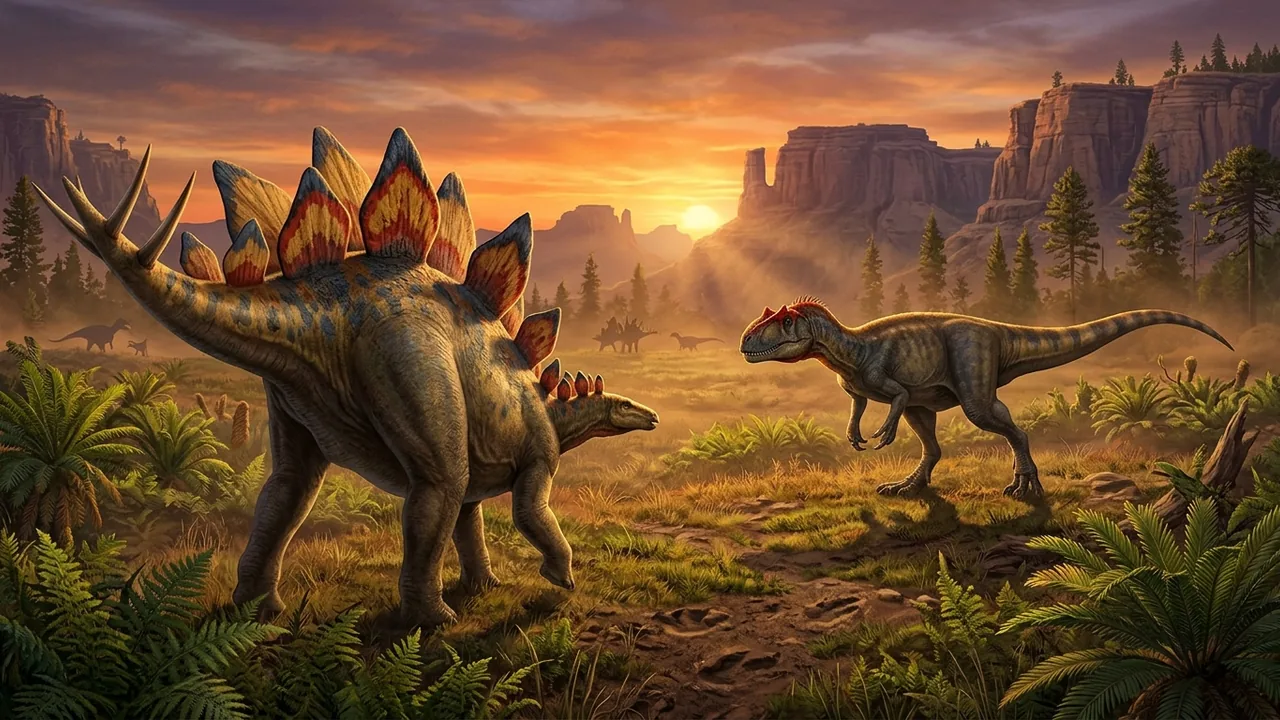
Travel back 150 million years to the Late Jurassic Period—more than eighty million years before Tyrannosaurus rex ever walked Montana! Across western North America, two contrasting giants dominated river savannas: agile two-ton Allosaurus fragilis and five-ton armored Stegosaurus stenops.
Measuring roughly thirty feet long, Allosaurus was built like a heavyweight sprinter balanced horizontally over powerful hind legs. Three-fingered grasping hands with curved eight-inch claws and twin hornlets above its eyes made it the undisputed top hunter of its Jurassic ecosystem.
Standing twenty-nine feet long across the fern plain, Stegosaurus looked almost architectural! Seventeen alternating diamond-shaped plates rose over two feet tall along its arched spine, leading back to four lethal horizontal spikes.
Although Stegosaurus outweighed Allosaurus more than two to one, its tiny narrow skull housed a walnut-to-lime-sized brain weighing barely three ounces! Fast spinal reflexes, muscular hip , and biomechanical leverage—not complex planning—powered its split-second tail defense.
Because dozens of skeletons of both dinosaurs appear side by side in famous sandstone quarries from Colorado to Utah, paleontologists study their anatomy as a classic evolutionary contest between slashing speed and concentrated puncture force.
Lost World Habitat: Morrison Savanna Web
During the Late Jurassic, a vast lowland basin called the Morrison ecosystem stretched from New Mexico north into Montana. Flowering plants and lawn grasses had not evolved anywhere on Earth yet! Instead, lush ground carpets of ferns, horsetails, clubmosses, and pineapple-like cycads grew beneath towering araucaria conifers and fan-leaved ginkgoes.
Climate clues preserved in ancient floodplain soils reveal dramatic wet-and-dry seasonal swings. Monsoon rains flooded braided sandy rivers each wet season, followed by long, sunny dry months when shallow lakes evaporated and concentrated thirsty wildlife around surviving water channels.
Inside that bustling food web, titanic sauropods like Brachiosaurus, Diplodocus, and Apatosaurus harvested tons of conifer needles and fern fronds every single day like moving cranes.
Because healthy forty-ton adult sauropods towered far beyond safe reach, two-ton predators like Allosaurus focused heavily on juvenile sauropods, fleet-footed Camptosaurus, and five-ton Stegosaurus browsing low cycads along sunlit woodland edges.
Whenever summer drought crowded dozens of thirsty herbivores onto narrow muddy riverbanks, tight spacing and open sightlines guaranteed tense daily encounters between stalking theropods with wide jaw and alert, spike-tailed defenders guarding their personal space!
What's on the Prehistoric Menu?
Examining jaw mechanics shows how these two neighbors fueled completely different lifestyles across the savanna. Holding its small head barely three feet off the soil, Stegosaurus cropped low horsetails, mosses, and tough cycad crowns with a narrow, toothless keratin beak while avoiding competition with high-browsing sauropods.
Although earlier scientists assumed Stegosaurus had a weak bite, 2016 computer stress models revealed its rectangular cheek jaws generated over 140 kilograms of bite force—plenty strong enough to shear woody Jurassic twigs before gut microbes fermented them inside its barrel ribcage!
Allosaurus hunted with a completely different biomechanical strategy than later bone-crushing tyrannosaurs. On its own, Allosaurus's jaw muscle clamp measured only around 3,500 Newtons—lighter than a modern lion's bite!
To compensate, elastic skull joints gave Allosaurus a remarkable jaw stretching up to seventy-nine or ninety-two degrees wide! Bracing its feet firmly, Allosaurus used massive neck muscles to drive its serrated upper tooth row downward and pull backward like a curved handsaw.
Assisted by inward-facing three-clawed forelimbs that generated high gripping against struggling quarry, Allosaurus inflicted rapid slashing strikes rather than prolonged bone-crushing holds.
Superpowers, Senses & Anatomy
Why did Stegosaurus carry tall plates along its back instead of flat armor tiles like Ankylosaurus? CT scans show its seventeen alternating dermal plates were thin and honeycombed internally, making them poor shields against direct jaws—yet branching grooves etched across their bony surfaces held rich blood-vessel networks!
Pumping warm blood into keratin-covered plates helped Stegosaurus dump excess body heat under sunny Jurassic skies and flush vivid warning colors to look intimidatingly tall from the flank. Meanwhile, a dense chainmail pavement of pebble-like bony ossicles guarded its vulnerable throat against neck lunges.
Its true defensive weapon waited at the opposite end: the four-spiked ! Unlike Cretaceous Ankylosaurus, Stegosaurus possessed zero stiffened ossified tendons along its tail.
Instead, fifty-plus flexible caudal vertebrae and broad muscle attachments generated high rotational , swinging the muscular tail smoothly side to side in tight S-curves while holding it horizontal well off the ground.
Extended by sharp horn sheaths in life, each conical bone spike measured two to three feet long and concentrated immense pound-per-square-inch puncture pressure onto four narrow tips that no wise hunter ignored!
Flight vs. Fight Arena!
Limb proportions dictated every tactical move in this Late Jurassic arena. Because Stegosaurus had long pillar-like hind legs and short, wide-set front legs, its top walking speed reached barely four or five miles per hour—making Team Flight impossible against an athletic Allosaurus sprinting near twenty miles per hour!
Instead, Stegosaurus turned unequal leg lengths into a brilliant Team Fight pivot! Planting its tall hind legs like a central fence post, Stegosaurus pushed sideways with muscular front feet to spin rapidly in place and keep its armored rear quarter aimed squarely at a circling predator.
For Allosaurus, safe attack windows were razor-thin: it had to dart past a sweeping nine-foot tail arc to reach Stegosaurus's low neck without getting impaled.
Physics favored the defender's reach and rotational ! Whipping its flexible tail laterally at speeds exceeding twenty-five miles per hour, Stegosaurus drove three-foot spikes horizontally at waist height—the exact elevation of Allosaurus's thighs, pelvis, and ribs.
Even a single grazing strike concentrated thousands of Newtons onto needle-sharp tips, turning careless ambushes into painful retreats across the sunlit fern plain while the armored browser resumed feeding!
Fossil Detective Secrets
Did Stegosaurus and Allosaurus truly trade blows in ancient Utah and Colorado, or merely walk past one another beside rivers? Paleontologist Kenneth Carpenter and colleagues published forensic fossil evidence from Morrison Formation quarries that proved real combat in both directions!
First, researchers documented an adult fossil Stegosaurus neck plate missing a clean U-shaped bite section near its top corner whose exact jaw arch width and tooth spacing matched a full-grown Allosaurus maxilla.
Even more dramatic was an Allosaurus caudal tail vertebra bearing a partially healed conical hole punched clean through its projecting side bone process from the —or lower—surface!
When paleontologists tested a real Stegosaurus spike against that shattered bone opening, the conical taper and angle matched like a detective's mold! Entering from the ventral underside proved Stegosaurus whipped its tail upward and sideways straight into the standing predator.
Remodeled bone growth around the fractured rim showed the wounded Allosaurus survived the puncture for weeks while limping under heavy muscle strain—leaving modern science with dual eyewitness fossils of a real Jurassic grudge match preserved forever in western stone! Together, those matching quarries prove beyond doubt that Stegosaurus swung its four-spiked tail with pinpoint defensive accuracy.