Meet the Legend: Classic Jurassic Rivals
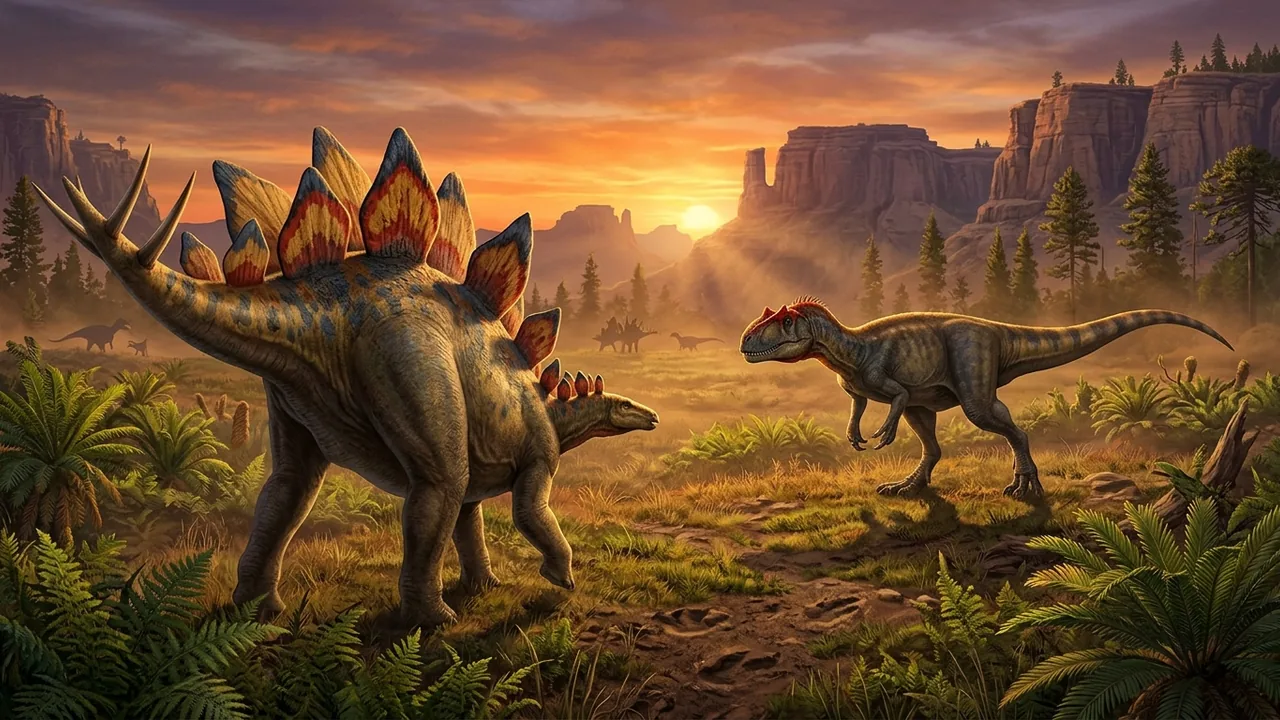
Long before horned Triceratops or Tyrannosaurus rex walked the Earth, two Late Jurassic legends ruled western floodplains one hundred fifty million years ago! Allosaurus fragilis was the top hunter of its era, stretching thirty feet long and weighing two athletic tons. Across the fern savanna stood twenty-nine-foot, five-ton Stegosaurus stenops!
Allosaurus wore twin red-tinted horns over its eyes and balanced its sleek body horizontally with a long muscular tail. Stegosaurus carried a double row of seventeen alternating diamond plates along its arched spine and four sharp spikes at the tip of its tail.
Because paleontologists routinely unearth their skeletons side by side in the exact same rock layers across Colorado, Utah, and Wyoming, scientists know every on these two famous Jurassic neighbors was tested in real face-to-face encounters!
Lost World Habitat: Seasonal Savannas
During the Late Jurassic Period, western North America looked like an ancient fern savanna crossed by braided rivers and groves of monkey-puzzle conifers, ginkgoes, and cycads. Warm rainy months turned floodplains emerald green, followed by sunny dry seasons when herds gathered tightly around shrinking lakes and streams.
Across our continent, Jurassic rocks record an exciting story of dinosaur growth! Here in Virginia's Culpeper and Danville rift basins, Early Jurassic mudstones preserve thousands of three-toed meat-eater footprints alongside early plant-eater tracks from the dawn of the Jurassic Period.
Forty million years later out west, Jurassic dinosaurs had grown into true giants! Stegosaurus shared Morrison waterways with towering Brachiosaurus, whip-tailed Diplodocus, turtles, and armored crocodiles—while watchful Allosaurus patrolled shady woodland borders waiting patiently for dry-season hunting opportunities beside muddy river bends. Every sunny fern clearing and sandy stream crossing brought Jurassic predators and plated browsers into shared territory!
What's on the Prehistoric Menu?
In the Morrison food chain, plant eaters divided plants by height so everyone found plenty to eat without crowding out neighbors. Long-necked sauropods stripped high conifer treetops, medium Camptosaurus browsed chest-high bushes, and low-headed Stegosaurus cropped soft ferns, horsetails, and cycad shoots within three feet of the ground.
Small leaf-shaped cheek teeth and a horny beak helped Stegosaurus snip hundreds of pounds of fibrous plants daily for its huge fermenting belly. Meanwhile, swift Allosaurus stood near the top of the Jurassic food web!
Running up to twenty miles per hour on springy hind legs, this agile chased medium ornithopods, ambushed young sauropods, and tested Stegosaurus defenses whenever dry-season hunger ran high. Keen smell and sharp eyesight helped Allosaurus spot solitary browsers wandering too far from protective river cover.
Superpowers, Senses & Anatomy
Both Jurassic rivals evolved specialized anatomical tools that matched their roles in nature! Instead of relying on crushing jaw pressure alone, Allosaurus opened its hinged skull nearly eighty to ninety degrees wide. Driven by powerful neck muscles, its upper jaw struck downward like a toothed hatchet while three large curved claws on inward-facing hands hooked firmly onto struggling prey!
Stegosaurus answered with dual-purpose plates and lethal tail armor. Wrapped in smooth sheaths and laced with tiny blood-vessel grooves, its seventeen tall back plates regulated body heat in sunny clearings and flushed vivid warning colors to make Stegosaurus look enormous from the side.
Under its chin, dozens of bony throat beads shielded vital neck vessels from bites. Best of all, at the end of its muscular, un-stiffened tail gleamed four horizontal spikes up to three feet long—its famous !
Flight vs. Fight Arena!
With tall hind legs and short, pillar-like front legs, five-ton Stegosaurus ambled slowly and could never sprint away from a twenty-mile-per-hour predator across open fern flats. Survival depended completely on bold Team Fight adaptations!
When Allosaurus circled in, Stegosaurus never stood straight toward the hunter like horned Triceratops did. Instead, Stegosaurus planted its tall back legs like a fence post and pivoted sideways with its front feet so its broad plates looked gigantic and its spiked tail stayed right between Allosaurus and its small head!
Because Stegosaurus lacked rigid tail rods, strong tail muscles bent its spine smoothly in wide left-and-right arcs. Held high off the dirt, its four -covered spikes whipped sideways at chest and hip height—forcing Allosaurus to dodge fast or suffer a bone-piercing strike that ended the chase!
Fossil Detective Secrets
For decades, some writers wondered whether Stegosaurus spikes were only for show—until paleontological detective work uncovered undeniable stone proof! Paleontologist Kenneth Carpenter examined fossils from Utah and Colorado quarries that caught both Jurassic rivals red-handed.
First, researchers studied a Stegosaurus neck plate missing a neat U-shaped bite notch that matched the exact snout curve and tooth spacing of an adult Allosaurus jaw! Even more dramatic was an Allosaurus tail pierced right through its side bone by a round, conical hole.
When scientists slid a real fossil Stegosaurus spike into that hole, it matched the exact angle and width of a low upward tail swing! Partially regrown bone around the wound showed the injured Allosaurus limped away and survived for weeks afterward, proving beyond doubt that Jurassic battles between hatchet claws and spiked tails were completely real.