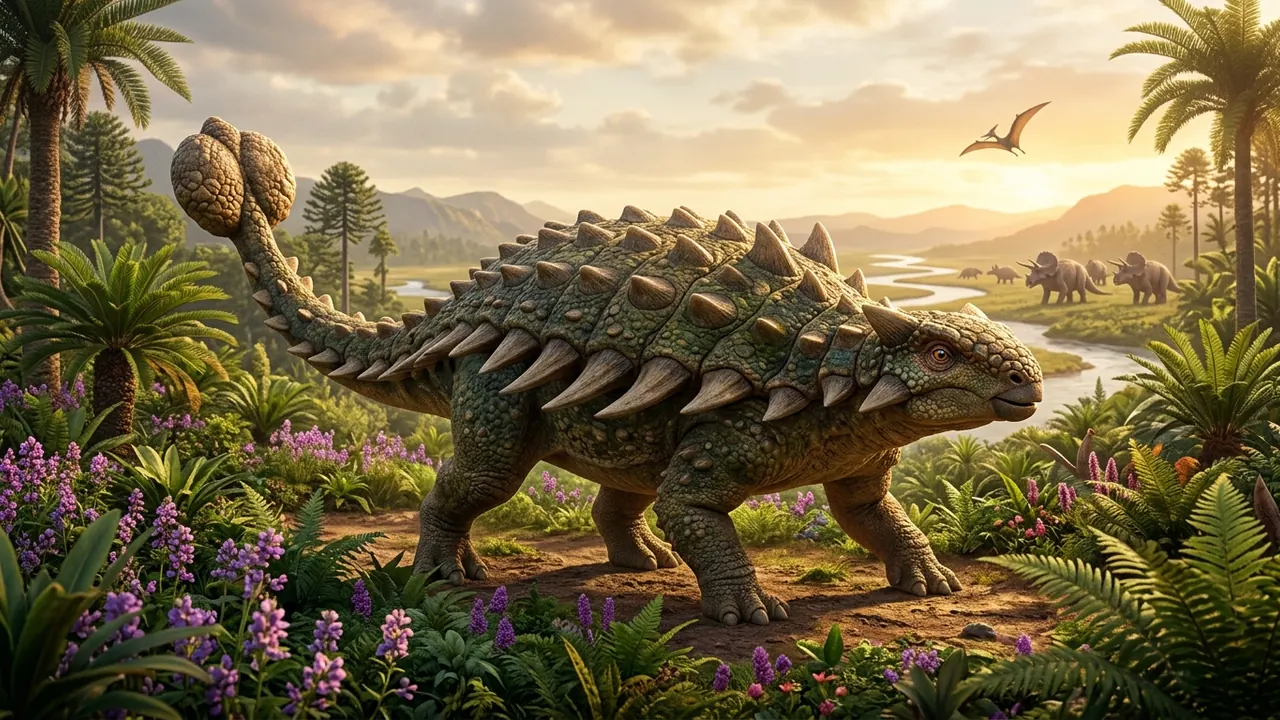
Meet the Legend: Ultimate Maastrichtian Tank
Standing at the evolutionary summit of thyreophoran dinosaurs, Ankylosaurus magniventris was the largest and latest-surviving member of the family. Mature individuals stretched six to eight meters from rostral beak to tail club, measured nearly two meters across the ribcage, and weighed five to eight metric tons—outmassing virtually every other armored terrestrial vertebrate in Earth's deep history while maintaining a remarkably low center of gravity.
Cladistic comparisons cleanly separate this club-tailed ankylosaurid from coeval nodosaurid cousins such as Denversaurus and Edmontonia, which possessed narrower snouts, elongated parascapular shoulder spines, and flexible clubless tails. Even the external nostrils of Ankylosaurus faced sideways near the broad snout margin rather than straight forward as in earlier Asian and North American relatives.
In Ankylosaurus, extensive cranial co-ossification remodeled and fused individual skull roof bones into an unbroken vault obliterating normal sutures, flanked posteriorly by pyramidal squamosal horns and ventrolateral jugal cheek horns. Remarkably, the supraorbital rim incorporated accessory palpebral bones that functioned as protective bony eyelids shielding both eyes from thorny branches, splinters, and predator claws.
Across the neck and trunk ran two arched cervical half-rings followed by transverse bands of keeled, hollow-based plates—each dermal set within an articulated mosaic of millimeter-scale ossicles that preserved supple limb and torso mobility across uneven forest terrain.
Comparative growth studies tracking ankylosaurian reveal that hatchlings began life with soft skin and small unfused scutes, progressively mineralizing extensive dorsal armor bands, fused pelvic shields, and massive terminal tail knobs as subadults matured into multi-ton fortresses.
Lost World Habitat: Maastrichtian Stratigraphy
Fossils of Ankylosaurus derive exclusively from latest Maastrichtian rock units of western North America: Montana's Hell Creek Formation, Wyoming's Lance Formation, and Alberta's Scollard Formation. High-precision argon-argon radiometric dating of volcanic bentonite ash beds interlayered through this pins Ankylosaurus's reign tightly between sixty-eight and sixty-six million years ago, directly preceding the end-Cretaceous bolide impact.
During those final two million years of the Mesozoic Era, meandering eastward-flowing rivers drained the rising Rocky Mountain cordillera toward the retreating Western Interior Seaway across humid subtropical plains of western Laramidia. Paleobotanical leaf-margin and palynological pollen assemblages record warm, frost-free forests of Metasequoia dawn redwoods, bald cypress, ginkgoes, palms, horsetails, tree ferns, and rapidly diversifying flowering angiosperms.
Curiously, quantitative field census surveys across Hell Creek stratigraphy show Ankylosaurus fossils are roughly twenty times rarer than skeletons of chasmosaurine Triceratops or hadrosaurid Edmontosaurus collected from identical rock horizons, accounting for scarcely one percent of large dinosaur discoveries across northern Montana.
Specialists in vertebrate attribute this striking rarity to ecological habitat partitioning rather than population collapse: whereas gregarious hadrosaurs congregated across waterlogged coastal deltas prone to rapid alluvial burial, solitary browsers favored better-drained inland piedmont woodlands higher up the watershed.
Consequently, upland individuals that died far from active river channels typically experienced surface scavenging, acidic root etching, and prolonged subaerial weathering long before exceptional seasonal floodwaters could entomb their heavy skeletons inside protective floodplain mudstones and channel sandstones. Only unusual hundred-year river floods swept intact upland carcasses into deep depositional basins where mineralization could preserve them.
What's on the Prehistoric Menu?
Reconstructing how a seven-ton armored browser fueled itself within Hell Creek highlights refined ecological niche partitioning among Late Cretaceous megaherbivores. Whereas coeval nodosaurids possessed narrow, rounded beaks suited to selective dicot plucking, this wide-skulled evolved a broad, ventrally deflected premaxillary bill nearly fifteen centimeters across for non-selective bulk cropping below one meter above the forest floor.
Behind that sharp keratinous rhamphotheca sat surprisingly small, phylliform cheek teeth bearing coarse marginal denticles rather than tightly packed ceratopsian shearing blades or hadrosaurian grinding batteries. Scanning electron microscopy of dental microwear preserves fine bidirectional scratches mixed with microscopic seed pits, indicating a varied diet of tender fern fronds, low angiosperm shrubs, horsetails, and pulpy understory fruits.
Deeply inset tooth rows bordered by muscular cheeks worked alongside a secondary bony palate and an unusually large, fully ossified hyoid apparatus that anchored a powerful tongue, allowing continuous nasal breathing while rolling cropped vegetation steadily backward toward the esophagus.
Because brief oral processing merely sliced foliage into coarse fragments, digestive efficiency depended on colossal gut residence time. Outwardly flared iliac blades, fused synsacral vertebrae, and posteriorly swept dorsal ribs created a cavernous abdominal cavity nearly one point eight meters wide—inspiring Barnum Brown's enduring species epithet magniventris, meaning great belly.
Within that vast hindgut fermentation chamber, symbiotic cellulolytic microbes broke down tough plant cell walls into absorbable volatile fatty acids over multi-day cycles, while slow quadrupedal foraging kept the daily metabolic cost of hauling heavy armor remarkably economical.
Superpowers & Anatomy: Cranial Loops & Club Growth
Modern paleohistology and X-ray micro-computed tomography have revolutionized how scientists interpret internal anatomy without cutting into rare museum skulls. Thin-section microscopy of an Ankylosaurus demonstrates that unlike thicker, solid-cored nodosaurid plates, each plate enclosed a lightweight vascularized trabecular core wrapped in three-dimensional, orthogonally interwoven bundles of mineralized structural collagen fibers.
This natural composite architecture maximized tensile toughness and crack-stopping resistance under extreme point loads while saving hundreds of kilograms of dead skeletal weight across the broad dorsum! Equally astonishing, digital CT reconstructions of the rostrum revealed tortuous, looping paranasal airways twisting through inflated maxillary sinuses before entering the muscular pharynx.
Comparative physiologists determined these blood-rich mucosal loops operated as efficient countercurrent heat exchangers—shedding excess metabolic heat through evaporative cooling to protect delicate brain tissue beneath heavy dorsal insulation while recovering exhaled moisture and resonating deep, low-frequency vocal calls across dense forest understories.
Posteriorly, tracing skeletal across ankylosaurines clarifies how the signature tail weapon assembled step by step during adolescence. Hatchlings and young juveniles possessed free, flexible caudal vertebrae, whereas maturing subadults fused the distal seven vertebrae into an interlocking wedge-and-socket handle reinforced externally by braided rods of ossified tendons.
Simultaneously, two massive major lateral plates and smaller minor terminal ossifications enveloped the tail tip, remodeling spongy dermal bone into a dense, forty-five-kilogram impactor engineered to withstand extraordinary bending moments without fracturing under high-velocity defensive strikes. Endocranial casts of the inner ear further confirm an elongated cochlear duct sensitive to booming low-frequency contact calls.
Flight vs. Fight Arena! Evolutionary Trade-Offs
In evolutionary ecology, Flight versus Fight reflects fundamental biomechanical trade-offs between cursorial locomotion and structural defense. By investing metabolic calcium and muscle mass into comprehensive dermal ossification and wide-gauge quadrupedal stability, Ankylosaurus forfeited high-speed flight—reaching estimated top speeds near three meters per second—to achieve near-immunity against subadult and adult Tyrannosaurus rex.
Confronted by a nine-ton ambush theropod capable of delivering more than thirty-five thousand Newtons of bone-crushing bite force, an alert hunkered low onto flexed forelimbs, shielding its soft unarmored ventrum flat against the forest soil while presenting arched, keratin-sheathed dorsal bands too wide, smooth, and convex for opposing jaws to purchase.
Meanwhile, roughly seven free proximal caudal vertebrae powered by massive caudofemoralis hip muscles swept the rigid tail handle through wide hundred-degree horizontal arcs close to ground level, accelerating the terminal club to generate localized impulses exceeding ten thousand Newtons—sufficient mechanical stress to fracture vulnerable tyrannosaurid tibiae or metatarsals on contact.
Recent paleopathological discoveries in closely related Campanian cousin Zuul crurivastator from Montana added a compelling behavioral dimension to this defensive model: healed scute fractures and localized bone remodeling clustered specifically along the mid-flanks, matching ritualized lateral strikes from rival ankylosaur clubs rather than overhead predator bites!
Thus, across its from lightly armored juvenile hiding quietly in dense fern cover to club-wielding eight-ton adult, Ankylosaurus's weapon evolved under dual selection pressures—serving intraspecific social dominance contests and decisive anti-predator deterrence alike. Predators quickly learned that testing a mature tank risked permanent, career-ending lameness.
Fossil Detective Secrets: Taphonomy of a Giant
Every known specimen of Ankylosaurus carries a compelling geological detective story rooted in field and vertebrate . In the summer of 1906, American Museum of Natural History collector Peter Kaisen and expedition leader Barnum Brown excavated the holotype skull roof, dorsal vertebrae, ribs, and dermal plates from Hell Creek Formation sandstones near Gilbert Creek, Montana, formally naming the genus in 1908.
Four summers later along Alberta's Red Deer River within Scollard Formation stratigraphy, Brown's crew recovered specimen AMNH 5214—preserving a complete cranium, jaws, limb bones, and the very first sledgehammer tail club ever linked definitively to Ankylosaurus in scientific literature!
As additional armored dinosaurs emerged across western North America, geologists documented a recurring taphonomic puzzle: articulated skeletons preserved in fluvial channel sandstones lie overturned on their backs roughly seventy percent of the time. Hydraulic flume experiments and computer buoyancy models proved that when bloated carcasses washed into deep rivers, trapped abdominal gases paired with top-heavy dorsal armor caused floating bodies to capsize belly-up before settling into soft bedload sand.
Conversely, carcasses decaying on dry floodplains suffered soft-tissue decomposition that scattered hundreds of isolated dermal scutes across wide areas, inspiring paleontologists Kenneth Carpenter and Victoria Arbour to conduct exhaustive 2004–2017 anatomical re-descriptions using articulated Asian and Canadian relatives as guides.
Recovered right up to the terminal Maastrichtian boundary beneath the iridium extinction clay, Ankylosaurus stands immortalized in stone as prehistory's unbreakable living tank. Future badlands excavations still aim to uncover the first fully articulated skeleton complete with every toe bone in place.