Meet the Legend: Composite Armor Giant
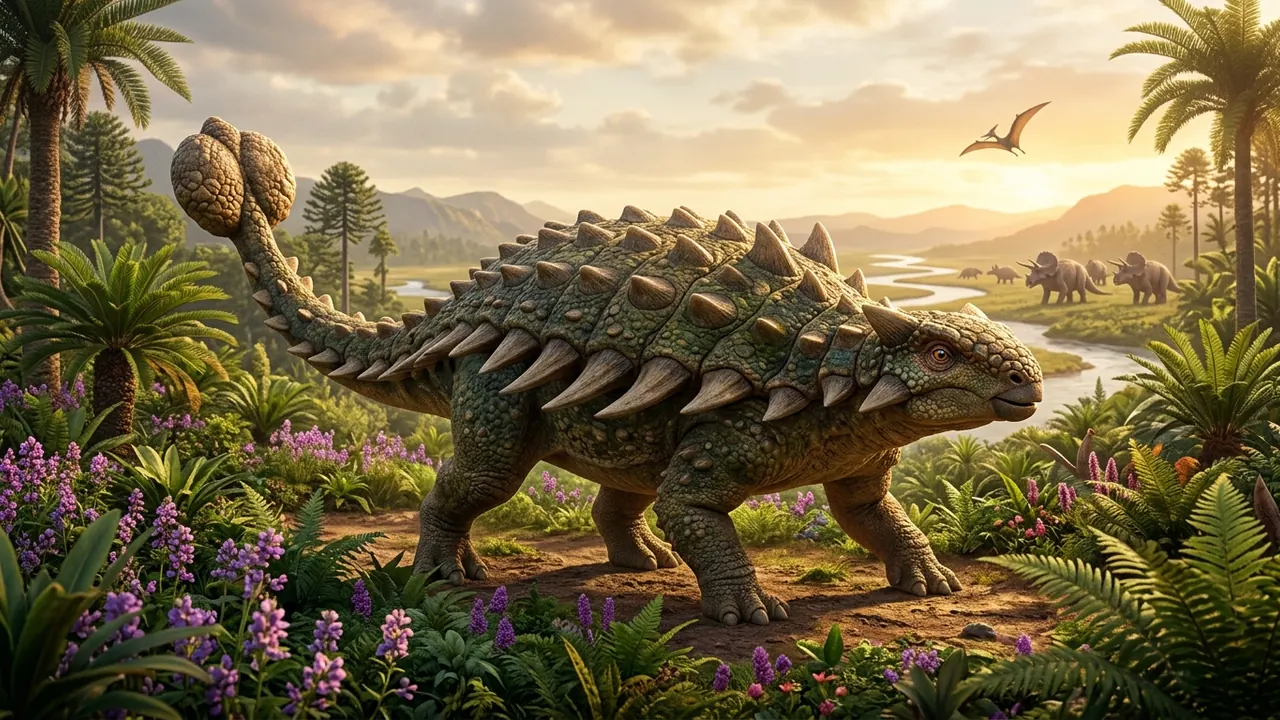
Measuring up to twenty-six feet in length, nearly six feet across the ribcage, and between five and eight tons in mass, Ankylosaurus magniventris was the heaviest armored dinosaur ever engineered by evolution. Four stout, pillar-like limbs held its wide torso low over the ground, creating an exceptionally stable center of gravity.
Its triangular skull fused dozens of separate cranial elements into a thick, vaulted helmet armed with two backward-pointing squamosal horns on top and two jugal cheek horns below. Even its eye sockets carried movable bony palpebral plates that snapped shut like armored eyelids.
Across its neck, shoulders, and back ran transverse bands of keeled dermal plates—each individual plate an anchored deep within tough hide woven with flexible fibers. Small pebble-like ossicles packed neatly around every large scute so the heavy shell flexed smoothly whenever the dinosaur turned or crouched.
Slightly longer hind limbs than forelimbs tilted its wide muzzle naturally toward ground-level vegetation while positioning massive hip muscles right behind its center of balance.
At the rear, interlocking tail vertebrae wrapped in tendons supported a hundred-pound terminal bone club. Modern researchers studying dinosaur view Ankylosaurus as nature's ultimate living fortress.
Lost World Habitat: Hell Creek Food Webs
Between sixty-eight and sixty-six million years ago, Ankylosaurus inhabited the warm subtropical river basins and forested uplands of western North America along the retreating Western Interior Seaway. Seasonal summer monsoons nourished lush canopies of dawn redwood, bald cypress, ginkgo, sycamore, and diverse flowering shrubs carpeted with knee-high ferns.
Within this vibrant Late Cretaceous food web, Ankylosaurus occupied the primary consumer tier alongside horned Triceratops and duck-billed Edmontosaurus. Rather than stripping identical bushes bare, these giant herbivores divided plant resources cleanly through ecological niche partitioning.
Tall hadrosaurs browsed foliage up to twelve feet high and narrow-beaked Triceratops sheared fibrous palms, whereas wide-muzzled Ankylosaurus cropped low fern glades and fruiting shrubs in shaded upland clearings. Carrying a heavy coat meant Ankylosaurus expended far less energy traveling long distances than migrating floodplain herds.
Shaded forest interiors also helped regulate body temperature, keeping dark keratin-covered armor plates from overheating beneath midday subtropical sunshine while offering quiet cover beside shallow woodland streams.
Studying habitat shows its broad four-toed hind feet and five-toed front feet spread tons of armored weight evenly across damp woodland soil without sinking into soft mud.
What's on the Prehistoric Menu?
Sustaining up to eight tons of armored muscle required steady daily intake of energy-rich plants, yet Ankylosaurus possessed surprisingly delicate teeth compared to duck-billed or horned neighbors. At the front of its jaws curved a five-inch-wide, scoop-shaped beak sheathed in sharp keratin that cropped tender ferns, horsetails, low dicot shrubs, and pulpy fruits.
Lining the sides of its jaws sat rows of small, cusp-rimmed leaf-shaped teeth coated in fluted enamel. Jaw reveal that instead of grinding tough twigs into fine paste inside cheek batteries, Ankylosaurus sliced mouthfuls briskly with an upward bite and slight backward pull of its lower jaw.
Sturdy hyoid throat bones anchored a muscular tongue that rolled cropped leaves steadily rearward past fleshy cheeks so precious greenery never spilled.
To extract full nutrition from coarsely chopped leaves, Ankylosaurus relied on the feature celebrated in its species name magniventris—Latin for great belly! Outwardly flared hip bones and wide-sprung ribs cradled an enormous hindgut fermentation chamber.
Inside that warm digestive vat, trillions of symbiotic microbes broke down stubborn plant cellulose over several days, fueling its primary consumer role while -reinforced skin supported its massive abdomen.
Superpowers & Anatomy: Fiberglass Bone & Loops
Under a powerful microscope, an Ankylosaurus looks remarkably like modern aerospace composite armor. Rather than forming heavy solid stone that would exhaust the dinosaur or crack cleanly on impact, each plate sandwiched a lightweight honeycomb core inside dense bone interwoven at right angles with tough fiber bundles.
Just as fiberglass or kevlar disperses shock waves across woven threads, that collagen matrix absorbed piercing tooth pressures without fracturing! Meanwhile, medical CT scans of Ankylosaurus skulls uncovered another hidden engineering marvel: labyrinthine nasal passages coiled in long loops through the snout before reaching the throat.
Carrying thousands of pounds of insulating armor risked overheating during humid Cretaceous summers. As air swirled through blood-rich membranes lining those coiled tubes, evaporation cooled warm venous blood before it reached the brain while doubling as a low-frequency acoustic chamber!
Simultaneously, an enlarged olfactory bulb at the front of the brain sharpened its sense of smell to locate ripe forest fruits and detect stalking carnivores.
At the opposite end of the spine, seven interlocking tail vertebrae encased in braided rods of tendon forged a rigid shaft tipping the scales with a hundred-pound terminal bone club.
Flight vs. Fight Arena! Sledgehammer Physics
Sharing floodplain borders with apex predator Tyrannosaurus rex—whose jaws generated over eight thousand pounds per square inch of bone-splintering bite force—put defensive to the ultimate test. Locomotion calculations show short-legged Ankylosaurus topped out around six miles per hour, ruling out high-speed flight across open ground.
Instead, Ankylosaurus anchored the heavyweight wing of Team Fight! Dropping onto bent elbows pressed its unarmored belly tight against the dirt while arched transverse bands of armor deflected downward bites. Trying to flip a low, six-foot-wide, seven-ton quadruped was physically nearly impossible even for the largest theropod.
Simultaneously, flexible free vertebrae at the tail base acted as a muscular pivot, whipping the stiff handle across a wide hundred-degree horizontal arc. Finite-element physics models demonstrate that a full-speed swing accelerated the hundred-pound club to deliver between 7,000 and 14,000 Newtons of concentrated impact force!
Because rotational kinetic energy rises with the square of swing velocity, wide hip muscles turned that rigid tail into a biological wrecking ball.
Delivered ten inches off the ground, a single direct strike generated enough stress to snap a charging predator's shin or ankle bones—stopping upward energy transfer cold.
Fossil Detective Secrets: Scanning the Tank
Since Barnum Brown excavated the type specimen in Montana's Hell Creek rocks in 1906 and uncovered the first complete tail club in Alberta four years later, fewer than a dozen Ankylosaurus specimens have entered world museums. Because dermal plates sat inside skin rather than locking directly onto ribs, decaying carcasses often scattered each across ancient stream beds.
For decades, museum mounts had to estimate exact plate rows and limb postures by comparing closely related armored skeletons unearthed across Mongolia, Utah, and western Canada.
Over the past decade, digital technology has unlocked secrets without chipping a single precious fossil. Using high-resolution medical CT scanners and 3D computer models, researchers tested whether bone clubs could withstand full-power strikes without shattering themselves on impact.
Virtual crash tests confirmed that tightly fused terminal knobs backed by braided tendons distributed shock waves safely along the rigid handle while concentrating crushing force onto a narrow impact point!
Paired with beautifully preserved cousin skeletons from Montana—complete with dark keratin sheaths still outlining flank spikes—these forensic breakthroughs confirm Ankylosaurus thrived as an unbreakable survivor right until the end of the Cretaceous Period.