Meet the Legend: Living Fortress
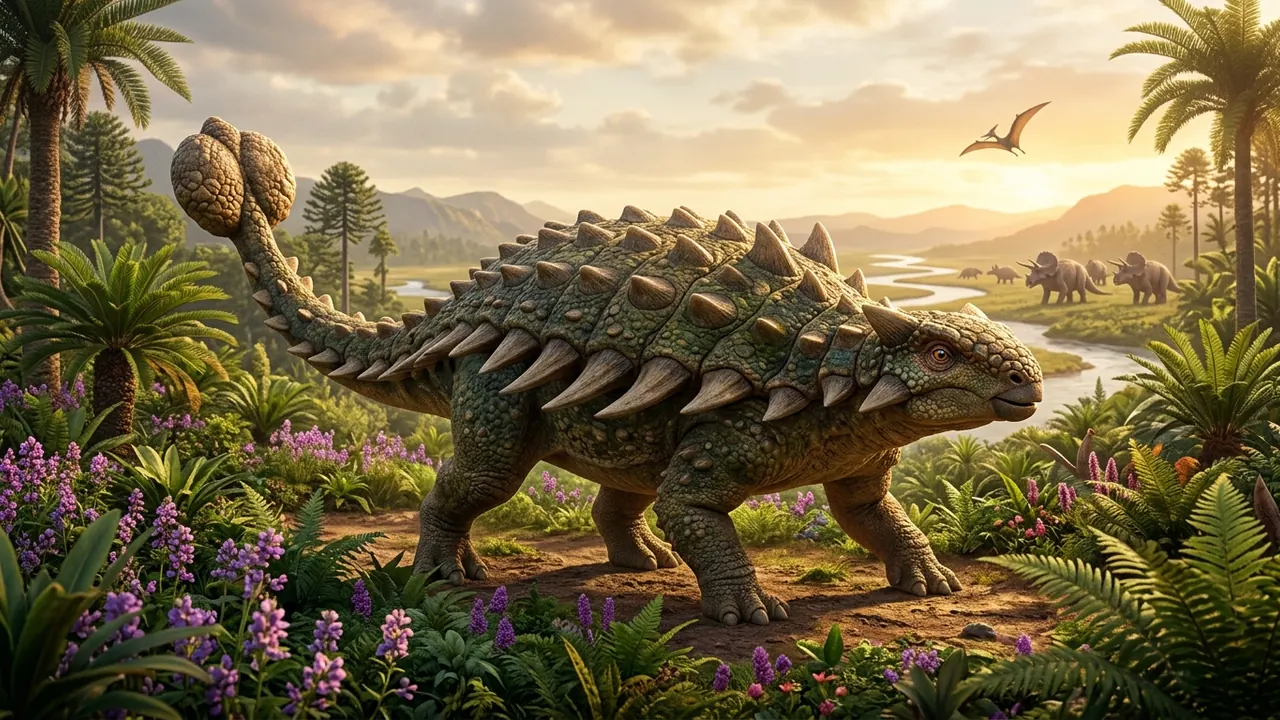
Among all the plant-eating dinosaurs that ever walked the Earth, none wore heavier protection than Ankylosaurus magniventris, the largest club-tailed dinosaur known to science. Stretching up to twenty-six feet from snout to tail tip and weighing up to eight tons, an adult rivaled a large elephant in mass while standing closer to the ground on four muscular legs.
Its Greek name means fused lizard, pointing to a remarkable structural . Dozens of skull bones grew tightly together into a solid, helmet-like dome tipped with four pyramid-shaped corner horns.
Across its broad neck, back, and hips ran neat rows of keeled bony plates—each individual plate called an —set inside leathery skin like natural paving stones. Half-rings of fused bone shielded its neck, while smaller pebble-like nodules filled every gap so hungry teeth found nowhere easy to grip!
Lost World Habitat: Laramidia's Uplands
Sixty-eight to sixty-six million years ago during the Late Cretaceous Period, Ankylosaurus roamed western North America across what are now Montana, Wyoming, and Alberta, Canada. Back then, the warm Western Interior Seaway divided our continent into western Laramidia and eastern Appalachia.
While Virginia's Culpeper Basin on the eastern side preserves much older Early Mesozoic dinosaur footprints pressed into red quarry sandstone, Ankylosaurus patrolled western Laramidia millions of years later. Warm coastal rains nourished a thriving forest filled with dawn redwoods, ginkgoes, tree-sized horsetails, lush fern glades, and colorful flowering shrubs.
Unlike duck-billed dinosaurs that crowded along muddy coastal swamps in huge herds, fossil clues suggest Ankylosaurus favored slightly higher, well-drained woodland trails. Beneath dappled forest canopies, each heavy stayed cool while soft-shelled river turtles, tiny mammals, frogs, and feathered raptors darted through the mossy leaf litter nearby.
What's on the Prehistoric Menu?
Inside the Late Cretaceous forest , green ferns and flowering bushes captured energy from sunlight as producers, while Ankylosaurus served as a multi-ton primary consumer . Because its short legs held its head less than three feet above the soil, it specialized in low understory plants.
Comparing beaks reveals a clever feeding that prevented food shortages among neighboring giants. Narrow-beaked Triceratops plucked tough, woody palm fronds selectively, whereas Ankylosaurus used a broad, square-shaped beak to crop wide mouthfuls of tender fern fronds, soft shoots, and low wild berries.
Rows of small, ridged cheek teeth chopped leaves briskly before swallowing. Behind its armored shoulders sat a ribcage almost five feet wide, housing a giant fermenting stomach where billions of helpful gut microbes slowly unlocked rich plant energy to power this peaceful, slow-moving herbivore!
Superpowers & Anatomy: Composite Shield
If Ankylosaurus's armor had been made of brittle solid rock, a giant predator's bite might have shattered it like dinnerware. Instead, nature engineered each as a lightweight composite : spongy inner bone wrapped in crisscrossing protein fibers that absorbed heavy impacts without cracking or weighing the animal down!
Even its eyes carried custom defense—crescent-shaped bony eyelid plates snapped shut like armor shutters whenever thorny branches or sharp claws swung close. Meanwhile, X-ray scans of Ankylosaurus skulls revealed looping, figure-eight nasal passages that warmed or cooled air, saved moisture, and resonated deep rumbling calls through dense woods.
Behind its wide pelvis stretched its ultimate defensive tool. While flexible joints near the hips swung smoothly left and right, the last seven tail bones locked inside stiffened tendon rods to support a fused one-hundred-pound bone club shaped like twin battering boulders!
Flight vs. Fight Arena! Grounded Defense
Every plant-eater in the Hell Creek needed a reliable answer to forty-foot Tyrannosaurus rex, whose banana-sized teeth could crush ordinary dinosaur bone. Lightweight ostrich-like dinosaurs sprinted away at thirty-five miles per hour on Team Flight, but a seven-ton tank could barely lumber past a slow jog.
Instead, every behavioral and physical placed this armored firmly on Team Fight! Whenever a predator circled close, Ankylosaurus folded its stout legs beneath its ribs, pressing its soft unarmored underside flat against the earth so no attacker could tip it upside down.
At the same instant, powerful hip muscles pivoted the base of its tail in wide, ground-skimming arcs. Because Tyrannosaurus rex balanced seven tons of body weight on just two ankles, one well-timed strike from that hundred-pound bone club made hunting an alert Ankylosaurus far too risky!
Fossil Detective Secrets: Buried Armor
Why have museums collected hundreds of Triceratops skulls from western badlands, yet fewer than ten partial skeletons of Ankylosaurus? Paleontologists solved that mystery by studying how water carries sand and mud across landscapes.
Animals living beside lowland rivers were quickly covered by flood sediment after death, sealing their skeletons safely underground. Because solitary Ankylosaurus spent more time in higher, drier forests, most skeletons weathered away on the surface before river mud could bury them.
When rare flash floods did wash an Ankylosaurus into a sandy channel, minerals slowly turned its domed skull, tail club, and banded armor into dark stone. First unearthed in Montana in 1906 by fossil hunter Barnum Brown, these remarkable bones prove that heavily armored plant-eaters thrived right up to the final chapter of the Age of Dinosaurs!